
A year of making space
I’ve been posting for about a year now, and I’m honestly a little surprised I’ve kept it up, because self-discipline has never really been one of my strengths. At the beginning of every month for the past twelve months, I’ve written about making space in our lives, and I really cannot stress enough how imperfectly I live this out, even as I keep returning to it again and again.
But I crave it in my weary soul. I crave time alone with God, even if it’s just a breath, even if it’s just an hour in spiritual direction, even if it feels small or fleeting or not nearly enough. Maybe that’s why I keep writing about it, because it matters so much to me and I am, at the same time, so very bad at it.
And here we are again, at the beginning of another month, still circling back to the same thing.
Reaching the twelve-month mark did make me curious, though, because how could I possibly have found something new to say about making space for an entire year? So here is a little round-up of some of my “make space” posts, not just as a look back, but as a reminder (for you and for me) of the many small ways this can look. Honestly, part of me wants to just repost them all this year because what more is there to say? And yet, God keeps putting things on my heart. And even when it’s worded differently, it is still the same gentle invitation: our lives are fuller, more complete, more deeply rooted, when we put down the phone, loosen our grip on our busy-ness, and choose to make time with God a priority.
Here are some of the ways I’ve been learning (and failing, and trying again) to make space:
Making space by noticing and slowing down: paying attention as a spiritual practice.
Making space opens us to God’s abundance: seeing the world through God’s eyes, looking for beauty, freedom, and enoughness.
Making space as prayer: wordless prayer and the daily examen.
Making space can be simple, and you are allowed to take up space.
Making space as holy hospitality: living open to God and others.
Making space as releasing: letting go of what fills our time, energy, and attention.
Making space as a priority of time: choosing it, protecting it.
Making space is hard to do alone: the gift of spiritual direction.
You don’t have to do all of this. I’m not doing all of this. Most days, I’m barely doing any of it in a way that feels “right” or consistent or enough.
But you know what you need. You know when a few deep breaths will help you re-center, and you also know when it won’t even begin to touch the surface of what your soul is carrying. You know when you need a real pause, a longer stretch of quiet, an honest conversation with God, or space to be held and guided in spiritual direction.
Maybe making space today looks small, and maybe it doesn’t. Maybe it asks more of you than you want to give, or more than feels convenient or easy.
But I am slowly, imperfectly learning that the invitation is not just to squeeze God into the margins, but to actually make room: to choose it, to protect it, to let it be as big as it needs to be. And so we begin again, here at the start of another month, not trying to do it perfectly, but listening honestly for what we need, and trusting that God will meet us there.
Is this too simple?
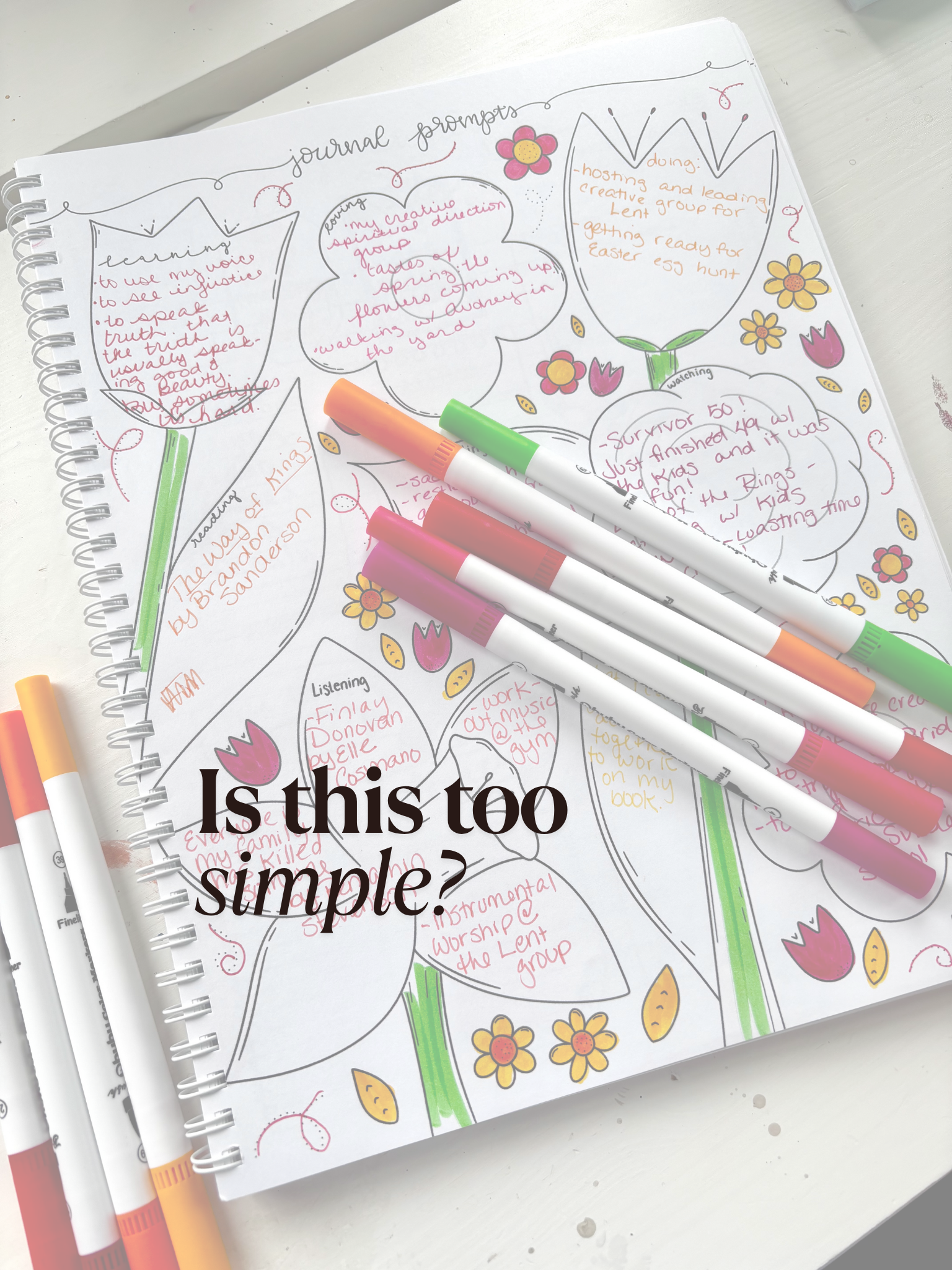
one of my recent pages from my coloring journal
I sometimes wonder if what I’m doing is too simple. Play, story, attention. It can feel small compared to everything else people are doing to help others grow spiritually. It’s quiet work. Ordinary work. The kind that doesn’t always look impressive from the outside.
But the more I sit with it, the more I come back to this: the connection between play, story, and spiritual formation is real.
Jesus taught through story. He invited people to see and notice, to imagine and wonder their way into truth. Children, in the same way, learn through play. They explore, create, and make meaning with their whole selves. And somewhere in the middle of all that, attention is being formed, not just what we see, but how we see. Imagination softens us. It opens us. It teaches us to notice what we might otherwise miss.
This isn’t stretching theology or trying to make something fit that doesn’t belong. It’s embodying something that has been true all along. When we slow down with a story, when we create with our hands, when we give our attention to what’s right in front of us, we are participating in a way of being that is deeply rooted in how we were made.
We aren’t creating something new in those moments. We’re practicing noticing what has already been there.
It can be very simple to begin.
You might open a children’s book and read it slowly, paying attention to what stands out to you. Or sit down with a coloring page or a blank piece of paper and begin to create without rushing. As you do, you could gently ask:
What is God inviting me to notice here?
or
What feels important right now?
There’s no right answer to find. Just an invitation to pay attention.
God is trustworthy. God is not hiding, waiting for us to get it right or try hard enough. Attention does not change God; it changes us. It gently forms us over time, shaping the way we see and experience the world.
And these small, quiet practices, story, play, noticing, become a way of life. They train us to recognize grace not as something distant or rare, but as something already present, already given, already here.
Chapel Talk: Praying with our Imagination
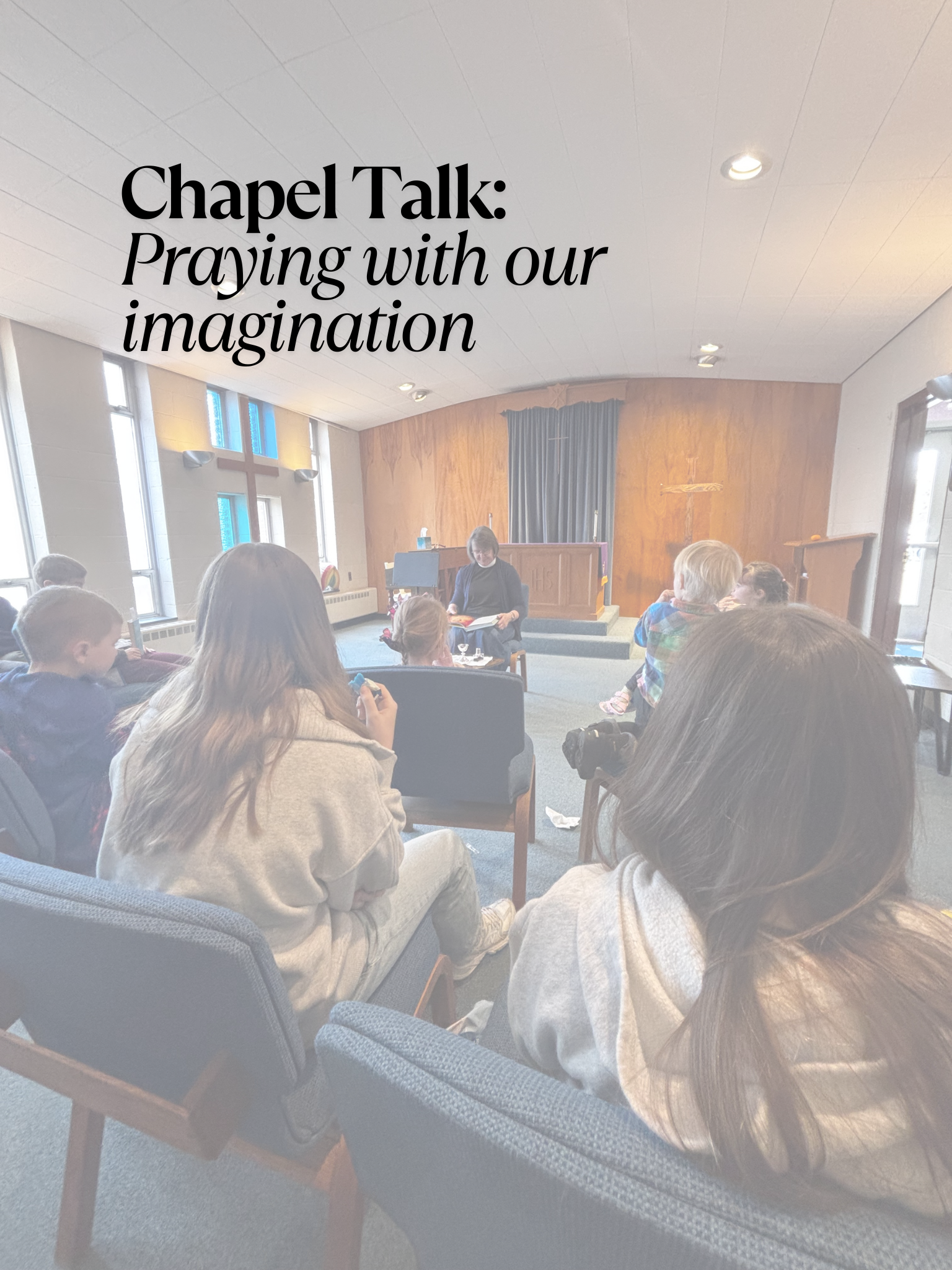
Deacon Jan teaching Apostles’ Kids about communion.
This past week, I got to speak in chapel at a local Christian school—first with grades K–2 and then again with grades 3–5—and I decided to teach them about imaginative prayer. I told them that I didn’t learn how to do this until I was 40 (they gasped in horror!), but I actually think kids are much better at it than adults because they have such wonderful imaginations.
The same imagination that helps children enter a story or a game of pretend can also help them step into a Bible story and notice Jesus there.
At the end, we took it one small step further, and I said very quietly, “Now imagine Jesus noticing you. [pause] What do you think his face looks like when he sees you?”
The room was silent. The wiggling had stopped. In that moment, I could feel that they had fully entered in.
Then I asked, “Do you think he is smiling?”
With their eyes closed, they all nodded vigorously and said, “Yes!”
And I thought, Lord, help me to enter in just like that. To believe, with my whole heart, that you smile when you notice me in the crowd.
So here is what I told them, in case you’d like to try it at home.
Sometimes people think prayer is only talking to God. And talking to God is definitely part of prayer! But prayer is actually three things.
Prayer is:
Talking to God,
Listening to God,
And being with God.
When we pray, we can do all three of those things. Sometimes we talk to God and tell him what we are thankful for or what we need. Sometimes we listen quietly. And sometimes we are just with God, knowing that he loves us.
Today I want to show you a way to pray that uses something God gave you that is very special: your imagination. Your imagination helps you picture things in your mind. When we read stories in the Bible, we can imagine being there in the story with Jesus.
Let’s try it together.
Imaginative Prayer
I’m going to read a short story about Jesus. While I read it, you can quietly imagine the story in your mind. You can close your eyes if you want, or just sit quietly. Imagine that you are there. You can be a character in the story or you can just be watching it happen from the side. As you are there, try to engage all your senses. What does it look like or smell like? How do you feel being there?
Read: Jesus Welcomes the Children
(Mark 10:13–16 or children’s Bible version*)
Now imagine the story again for just a moment and think about these questions quietly in your mind.
Where are you in the story? Are you one of the children running to get to Jesus? Or are you one of the shyer ones waiting behind?
Are you close to Jesus or farther away?
What do you see around you?
Now this is the best part: imagine Jesus noticing you.
What do you think Jesus’ face looks like when he sees you?
What do you think it feels like to be welcomed by Jesus?
Now you can finish this kind of prayer by saying something to Jesus in your heart.
Closing
Prayer can be talking to God, listening to God, and being with God. And sometimes when we read Bible stories, we can imagine being there with Jesus and listening to Him in a new way.
Jesus, thank you that we can talk to you, listen to you, and be with you.
Thank you for welcoming us and loving us.
Help us notice you this week.
Amen.
*I used the story “A Wide and Wiggling Wall” from the Book of Belonging on page 219. This story worked perfectly, because they actually talk about children’s imaginations and include a few wondering questions.
How do you create + play? Interview with Ryan

Creativity doesn’t always begin with confidence or expertise. Sometimes it begins with noticing something we once loved sitting quietly in the back of a closet and deciding to pick it up again.
In this conversation, I spoke with someone who recently returned to playing guitar after many years away from it. What started as the simple desire to learn one beloved song became something more: a way to quiet the mind, unwind during stressful moments, and connect with emotions that are sometimes hard to name.
His reflections remind us that creativity doesn’t have to be polished or public to be meaningful. Sometimes the most important thing is simply making space for a small, steady practice. One that helps us slow down, listen, and reconnect with ourselves.
Do you remember how you first got into guitar?
I played (poorly) years ago, as a teenager. A year or so ago, I noticed my guitar case was collecting dust in the back of my closet, and I thought I should get it out. I think I also wanted to play a specific song: Oh My Sweet Carolina.
Why that song?
It’s one of my favorite songs. I am not the most emotionally-in-touch person (surprise!), so I wonder if there is some aspect of melancholy in music that I find myself able to connect with more easily than other emotions. As for the song itself, it is beautiful in the way it expresses a longing for the loss of innocence and simplicity.
What happens in you when you play?
My brain gets quiet. There’s something interesting about how, in focusing on the mechanical execution of playing, other things in my head become muted.
Do you ever imagine playing in community?
The idea of making music with other people is appealing. I don’t really have the skill level required right now, but I’d be interested, if I could.
Does playing help you unwind?
Yes. I often find myself getting my guitar out when I’m stressed or emotionally unsettled. It’s calming in a way that I’m not sure I can describe.
Creative and generous God, thank you for planting your creativity in us, so that when we create we can feel closer to you and your delight in us. Bless Ryan, that whenever he reaches for his guitar, he would continue to be enveloped by calm and peace that can only be from your own Spirit. That with every chord he masters, he would find more and more delight in this creative practice and sense more of your delight in Him, just as He is. May the hiddenness of this act of play be an offering of worship from his heart to yours.
A Prayer for Making Space
Father, generous Host,
You have made room for us in Your heart and at Your table.
Teach us how to make room in our own lives.
Jesus, gentle Savior,
You stepped away to pray and returned with compassion.
Shape our hurried hearts into hearts that are present and attentive.
Holy Spirit, breath of peace,
quiet what is crowded within us.
Loosen what we cling to.
Create in us a spaciousness where love can grow.
Triune God,
may the margin we keep become holy ground,
a place where You dwell
and where others are truly welcomed.
Amen.
A Lenten Examen: Releasing and Returning
Begin by becoming still.
Take a slow breath. Remember that you are held in the presence of Jesus Christ, who meets you with mercy, not disappointment.
1. Notice the day
Where today did you feel drawn toward God?
Where did you feel distracted, hurried, or pulled away from him?
2. Consider what you are holding
Lent invites us to release the things we think we need —
the habits, comforts, distractions, or even good things
that quietly take our time, energy, and attention.
What feels heavy in your hands right now?
What might God be inviting you to loosen your grip on?
3. Ask for help
Speak honestly with Jesus about what you want to release.
Tell him where you feel resistant, tired, or unsure.
Ask him to help you open your hands.
4. Notice your need
Where did you struggle today?
Where did you fall short of what you hoped Lent would be?
Do not rush past this.
Let your weakness remind you that you need a Savior.
Let it point you back to grace.
5. Receive mercy
Jesus does not wait for you to succeed at Lent.
He meets you in your need.
Sit for a moment and receive his forgiveness, his presence, and his love.
6. Return with hope
Ask for the grace to follow him tomorrow —
not perfectly, but faithfully, one small step at a time.
Amen.
Bearing Witness as a Holy Calling
Yesterday I talked about how sharing parts of my story can be a way of asking you to bear witness to what God has done. I want to talk about what God has done and I want others to see what God has done, not as a point of pride, but because it’s so exciting and good. And bearing witness to that is holy work. I want to bear witness to what God has done and is doing in you, too (this is so much of what spiritual direction is).
Why is bearing witness such a holy calling?
Because it mirrors how God relates to us.
God doesn’t just act, He reveals. From the naming of creation in Genesis to the sending of disciples in Acts, God’s work is meant to be seen and told. Bearing witness means we participate in that same pattern: God moves, people notice, people tell.Because witness tells the truth without trying to control the outcome.
A witness doesn’t argue or perform. A witness simply says, this is what I’ve seen God do. The Gospel of John uses this language over and over; testimony lets truth shine without forcing it.Because witness honors the dignity and freedom of others.
When we bear witness, we trust the Holy Spirit to work. We’re not trying to manage someone’s response. We’re simply sharing what is real and leaving space for God to move.Because it’s how resurrection keeps traveling through the world.
The Church didn’t grow because people had perfect explanations. It grew because ordinary people told what they had seen, heard, and experienced of Jesus Christ. That’s still how faith spreads: through lived stories.Because witness requires vulnerability.
To bear witness is to let your life be evidence of God’s life, which can be scary. It means naming where you’ve been changed, where you’ve been carried, where grace has found you. That kind of truth-telling is sacred ground.
Bearing witness isn’t flashy work. It’s quiet, relational, and deeply holy. And when we do it for one another (noticing where God is moving, naming grace out loud, holding each other’s stories with reverence) we become part of how God keeps revealing love in the world.
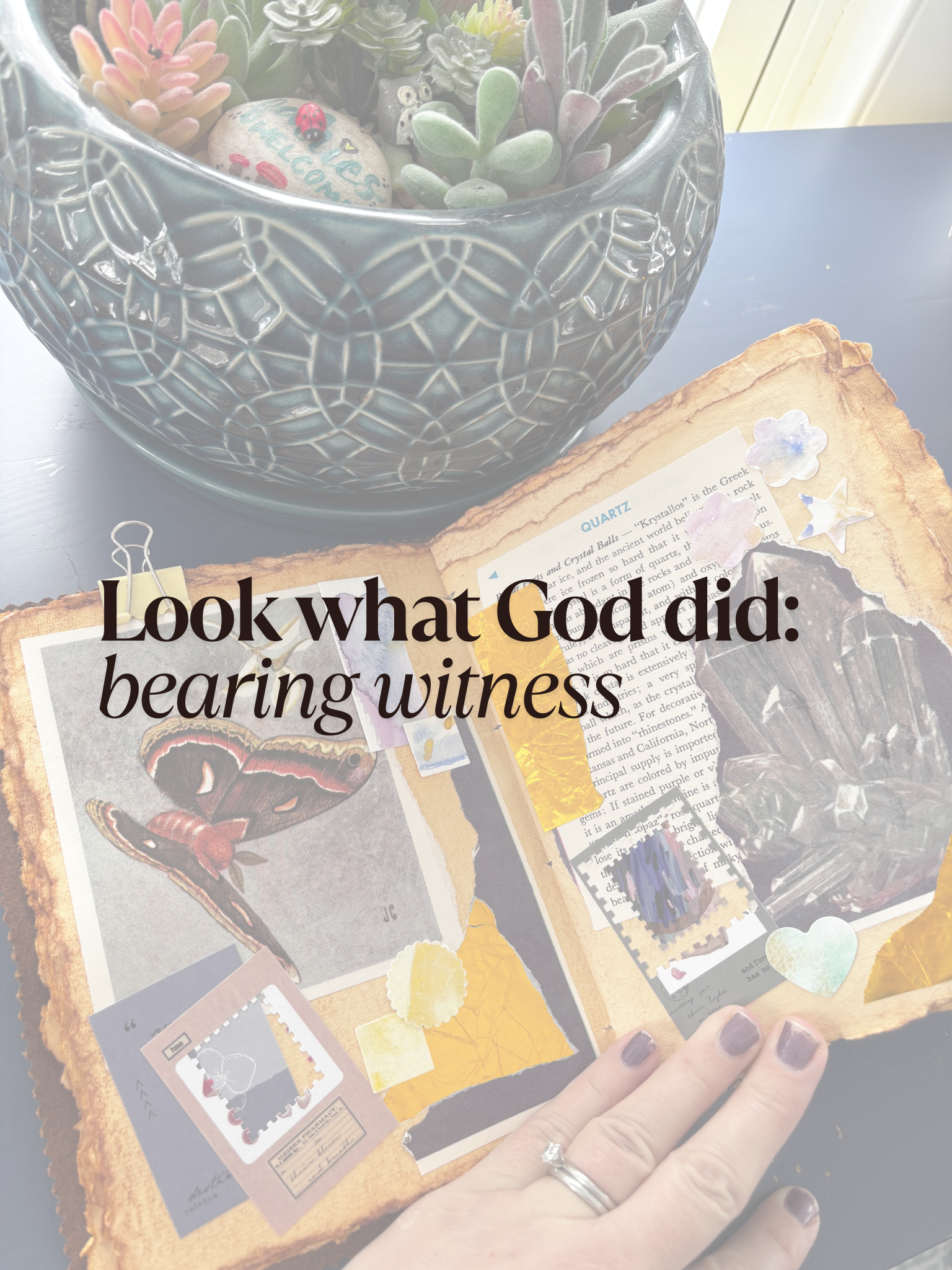
Look what God did: bearing witness
Sometimes I feel a little bit like a fraud.
I tell people to make ugly art, that what they make doesn’t have to be beautiful or meaningful to anyone else. And then I post my art online, and it’s often the pieces I think look the best. (Though I do try to be transparent about the process and all the messy pages that come in between…)
I tell people not to make their spiritual lives performative but then I share glimpses of mine publicly. And I worry if that makes me a hypocrite.
I’ve been sitting with that tension for a while now. Not trying to solve it too quickly, just noticing it. Because the truth is, the internet only ever shows a sliver of anyone’s life. Mine included. What people see online is not the whole process. It’s really just a glimpse of what grew from it.
Most of my art never leaves my notebook and most of my prayers are wordless and unfinished. Most of the ways I meet God are quiet, ordinary, and completely unshareable. They happen in the margins of the day, in the quiet spaces, in the moments when no one is watching and nothing looks particularly meaningful.
But that hidden space matters to me. It’s where the real work happens. It’s where I’m not trying to say something wise or create something beautiful or offer something helpful. It’s just where I’m showing up honestly.
So why share anything at all?
I think because sometimes what grows in secret becomes something that can serve other people. Not as proof that I’m doing it right or as a performance. But as a kind of witness.
Like saying, Look! This kind of prayer is possible.
Or, Look! God can meet us here too.
Or even just, You’re not the only one trying to figure this out.
There’s a difference, I think, between making something for people and letting people see what has already been made in the quiet.
One feels like performance. The other feels more like testimony.
I don’t always know where that line is. I’m still learning. I still check my motives. I still ask myself whether I’m sharing from a place of honesty or from a place of wanting to be seen a certain way. But I’m also realizing that hiding everything isn’t necessarily more holy. We’re shaped in secret, yes. But sometimes the fruit is meant to be shared. Not all of it. Maybe not even most of it. But sometimes a small piece of what grows in the hidden places can become an invitation for someone else. A reminder that God is at work in ordinary lives, a gentle encouragement to keep showing up.
Most of what shapes us will always remain out of sight. The roots go deeper than anything we could post. So maybe sharing the occasional blossom doesn’t mean the roots are performative. Maybe it’s just a quiet way of saying, Look what God grew here. He can do it in you, too.
Your Monthly Reminder: Make Ugly Art
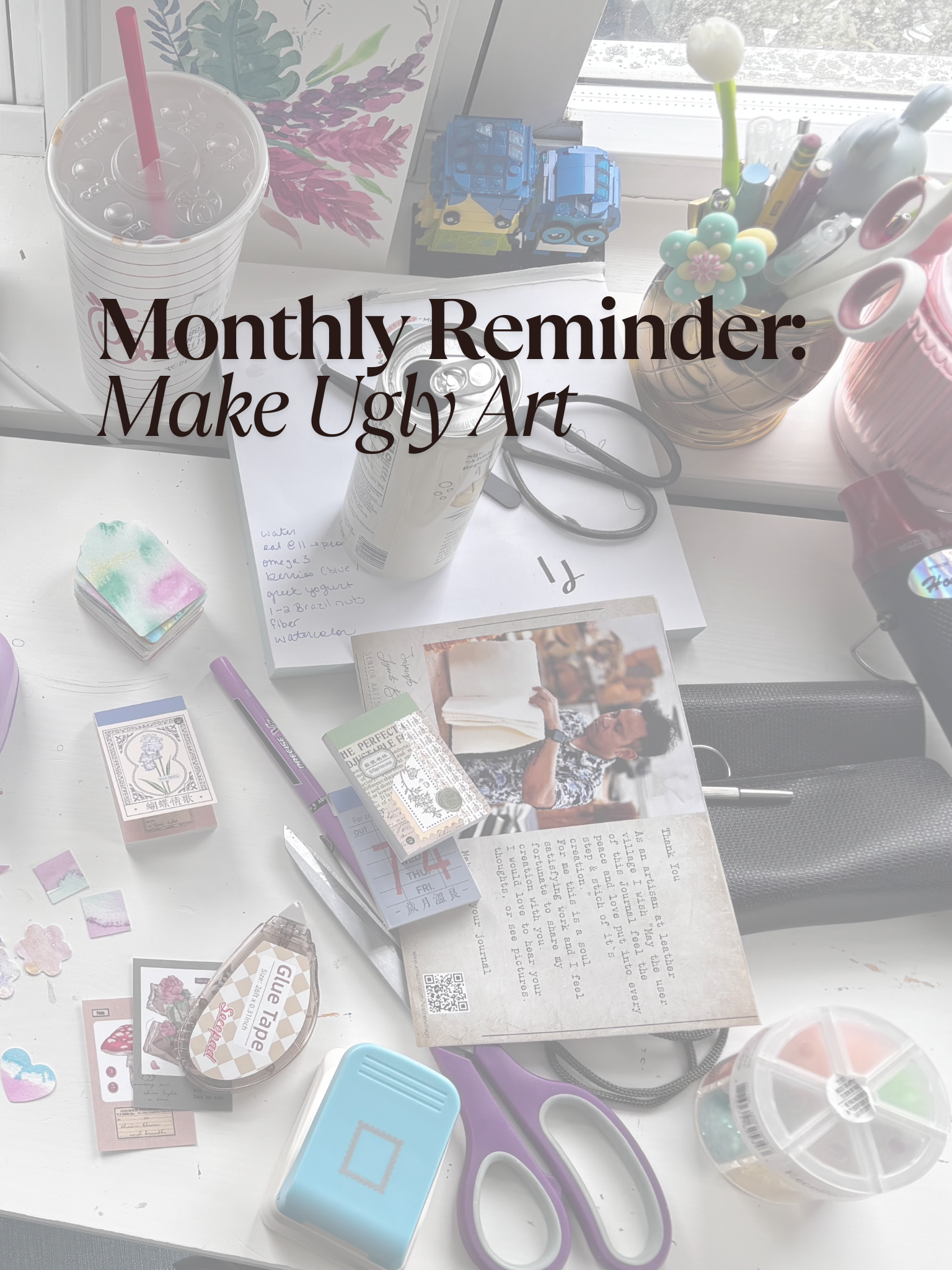
This is your gentle reminder to make ugly art. Yes, ugly! On purpose!
Why? Because making it ugly keeps the focus on the process, not the outcome. It frees you from performance or comparison. It reminds you that creation isn’t about impressing anyone; it’s about showing up, exploring, and playing.
And here’s something wonderful: even when your art feels “bad,” your skills grow! Every time you pick up a pencil, a paintbrush, or sit at the piano or guitar just to play… every time you throw together a few ingredients in the kitchen without worrying about the final dish… you’re building experience, learning, experimenting. You’re getting better, even if that’s not your goal.
Ugly art is honest art. It’s brave art. It’s art that belongs to you, fully and unapologetically. And in that belonging, in that courage to create without judgment, you’re echoing the Creator. God doesn’t call us to make things beautiful; He makes them beautiful. Our role is simply to join Him in creating.
Even our “ugly” efforts reflect something true and good. As we show up and make, God is at work in us, shaping not just our creations but our hearts. Things that feel awkward or clumsy can still be holy. Things that feel messy can still be part of the story God is telling through you.
So pick up that pencil. Throw some paint on the page. Sit at the keys and just play. Cook something messy. Laugh at the result. Keep creating. Every small, imperfect act is a step deeper into belonging, into belovedness, into the joy of co-creating with the One who made us to create.
Ash Wednesday reflection
Today is Ash Wednesday. The cross on my forehead has already been wiped away, but the ashes still linger in my pores.
I don’t pretend to be an expert on Ash Wednesday or Lent. I’m grateful for the people who guide me in these seasons (my husband, the wise spiritual directors in my life, and the leadership at my church). But what I do know is that we cannot possibly understand the fullness of Joy without remembering the depths of our Sorrow.
Lent invites us to hold both. To face our mortality, our grief, and our need for God, and somehow, at the same time, to live in the enjoyment of Him. Not a loud or easy joy, but the quiet kind that comes from knowing we are held even here. The kind of joy that doesn’t erase grief, but refuses to let grief be the final word.
That feels impossible. And yet the kingdom of God has always been a place where impossibilities meet grace. Again and again, we are invited into paradox: death and life, repentance and joy, ashes and hope.
So maybe that is the invitation of Lent: not to perform sorrow, but to let it open us to mercy. Not to have everything figured out, but to stand honestly before God and remember that we belong to Him.
The cross on my forehead is already wiped away, but the ashes remain. And in that I remember that He carries the cross, and I carry the need. Thanks be to God.
“Enjoy Me”
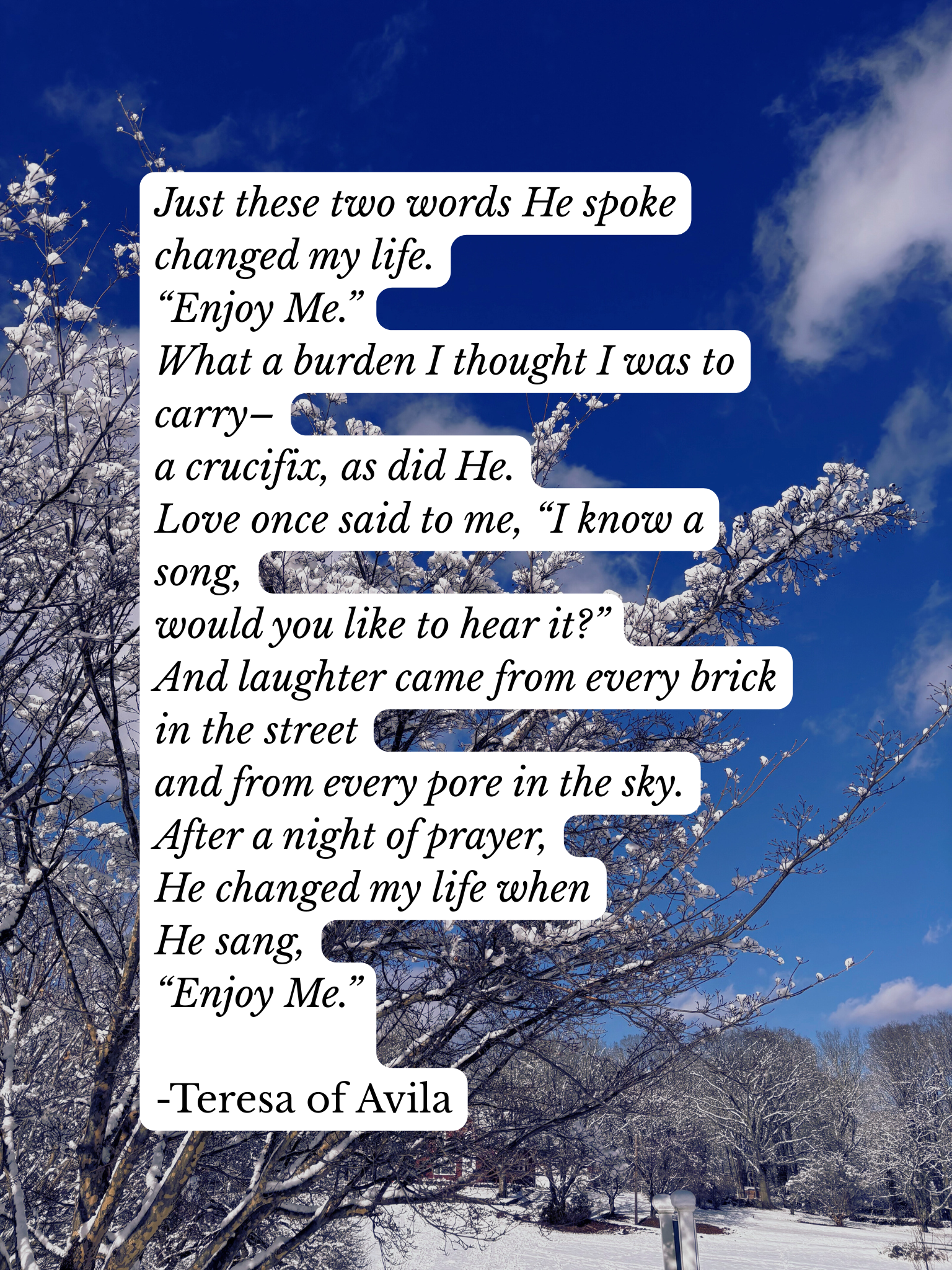
I’ve been meditating in this quote from Teresa of Avila recently. This is not the stuff of silver linings. This is the hard-fought joy, one that encompasses all our grief and sorrow and loss, that holds, sees, and loves. This enjoyment has grit and battle scars and so much laughter. I don’t know how it’s possible, but it’s the very real invitation on the table.
Making Space When It Feels Hard

We talk a lot about making space for God as if it’s a simple, quiet thing we can just decide to do.
But for many of us, making space alone is actually one of the hardest parts of the spiritual life.
Distractions pile up. Noise fills the room (and our heads). Productivity values whisper that we should be doing something useful instead. Anxiety hums in the background, making stillness feel unsafe or impossible. Even prayer itself can feel like one more task we’re failing to do “right.”
So we tell ourselves we’ll try again tomorrow. Or when life is calmer. Or when we’re less tired. Or when we feel more spiritual.
And the space never quite opens.
You’re Not Broken; You’re Human
If sitting alone with God feels hard, that doesn’t mean you’re doing something wrong. It means you’re human.
We are formed by a world that rewards speed, output, and constant engagement. Of course silence feels awkward. Of course listening feels unfamiliar. Of course prayer sometimes feels inaccessible.
God knows this about us.
Which is one of the reasons spiritual direction has existed in the Church for centuries.
Why Spiritual Direction Helps Us Make Space
Spiritual direction isn’t about fixing your prayer life or achieving spiritual goals. At its heart, it’s simply about making space—intentionally, gently, and with support.
When you make an appointment for spiritual direction, you are doing something powerful:
You are setting aside real time to be with God.
You are allowing someone else to hold the container so you don’t have to.
You are giving yourself permission to slow down, notice, and listen.
You don’t have to arrive calm. You don’t have to know what to say. You don’t even have to feel particularly prayerful.
The space itself does the work.
Together, we pay attention to where God is already present in your life, often in places you might overlook on your own.
Making Space in Gentle, Creative Ways
For some people, silence and words are enough. For others, they aren’t.
That’s why spiritual direction doesn’t have to look only one way.
In my work, I’m open to incorporating creative practices (simple art-making, reflective prompts, embodied practices) as well as reading and wondering together with children’s books.
Stories have a way of bypassing our defenses. Images can speak when words feel thin. Creative practices can open doors that effort alone cannot.
None of this replaces prayer. It is prayer, just offered in forms that meet us where we are.
An Invitation
If you’ve been longing for space with God but finding it hard to make on your own, spiritual direction may be a gift to receive, not a task to add.
I am trained and available for ongoing spiritual direction, and I welcome sessions that include creativity, story, and gentle exploration alongside conversation and prayer.
You don’t have to figure this out alone.
If you feel a quiet nudge of curiosity or desire, I’d love to talk with you about what spiritual direction could look like for you.
Holding grief, without fixing it
Sometimes I wonder if it still makes sense to talk about wonder, awe, play, and creativity during times of grief. Is there really space in these things for lament?
But grief doesn’t cancel out these things. It offers a way to hold it without trying to fix it. Sometimes they’re the only places that can adequately express our lament.
This is how they often show up in grief.
Wonder and Awe
In grief, wonder may get quieter: less “Isn’t this beautiful?” and more, “How can there still be beauty and laughter when everything feels so broken?” That question doesn’t need an answer, it’s already a way of naming grief.
Awe doesn’t always feel comforting. Sometimes it can feel overwhelming or even unsettling: standing before something you can’t make sense of (God, loss, love, mystery) is familiar ground when you’re grieving. The Psalms hold this kind of awe: honest, reverent, and unresolved.
Wonder and awe in times of grief allow room for lament and require honesty. But where do we put this kind of wonder and awe when we’re carrying grief?
Play through Creativity
Play in grief isn’t silly or escapist. It’s just about low-stakes presence. It gives your body and nervous system a place to rest without asking for meaning or productivity. It says, You’re allowed to be here without explaining yourself.
Creativity is one of the oldest ways people have expressed lament. Before grief has words, it often shows up as marks, movement, sound, silence, tears. We don’t create to feel better. We create to tell the truth, even when that truth feels raw or incomplete.
Lament belongs here because:
lament isn’t the opposite of faith; it’s honesty
lament doesn’t need resolution
lament needs space more than answers
Wonder, awe, play, and creativity don’t move grief along. They make room for it and remind us that:
you don’t have to be okay
you don’t have to have the right words
you don’t have to move on
This is why wonder, awe, play, and creativity matter so much to me. They aren’t extras we return to once we’re okay again. They are ways of staying present to God and to ourselves when life is hard. They make space for honesty, for silence, for unfinished prayers. And sometimes, that is what faith looks like, choosing to remain in relationship, even when all we have to offer is our lament.
A Gentle Practice for Lament
Settle your body. Take a few slow breaths.
Name what feels heavy, simply and honestly:
What is heavy right now is…
As you sit with that, choose one simple action:
make slow marks with a pencil, pen, crayon, or paint
move your hands through clay or dough
trace lines on paper without lifting your pen
Let your hands move without trying to make something good or meaningful.
When you’re ready, pause. Place a hand on your heart or the table.
Say quietly: Nothing needs to be fixed right now. I am already held.
Already Beloved (repost from 2023)
I’m resharing this reflection today, not because it’s old, but because it’s still very much alive in me. The patterns I write about here don’t disappear once they’re named; they soften through practice, grace, and repetition. This piece sits at the heart of the work I do now: creating space to release striving and to rest more fully in what is already true.
“May I invite you to drop the old names, come out from under the shame that tries to hinder your intimacy with God and others, and step onto the spacious path. Child of the living God, sing to the living God.”
—Tamara Hill Murphy, The Spacious Path: Practicing the Restful Way of Jesus in a Fragmented World
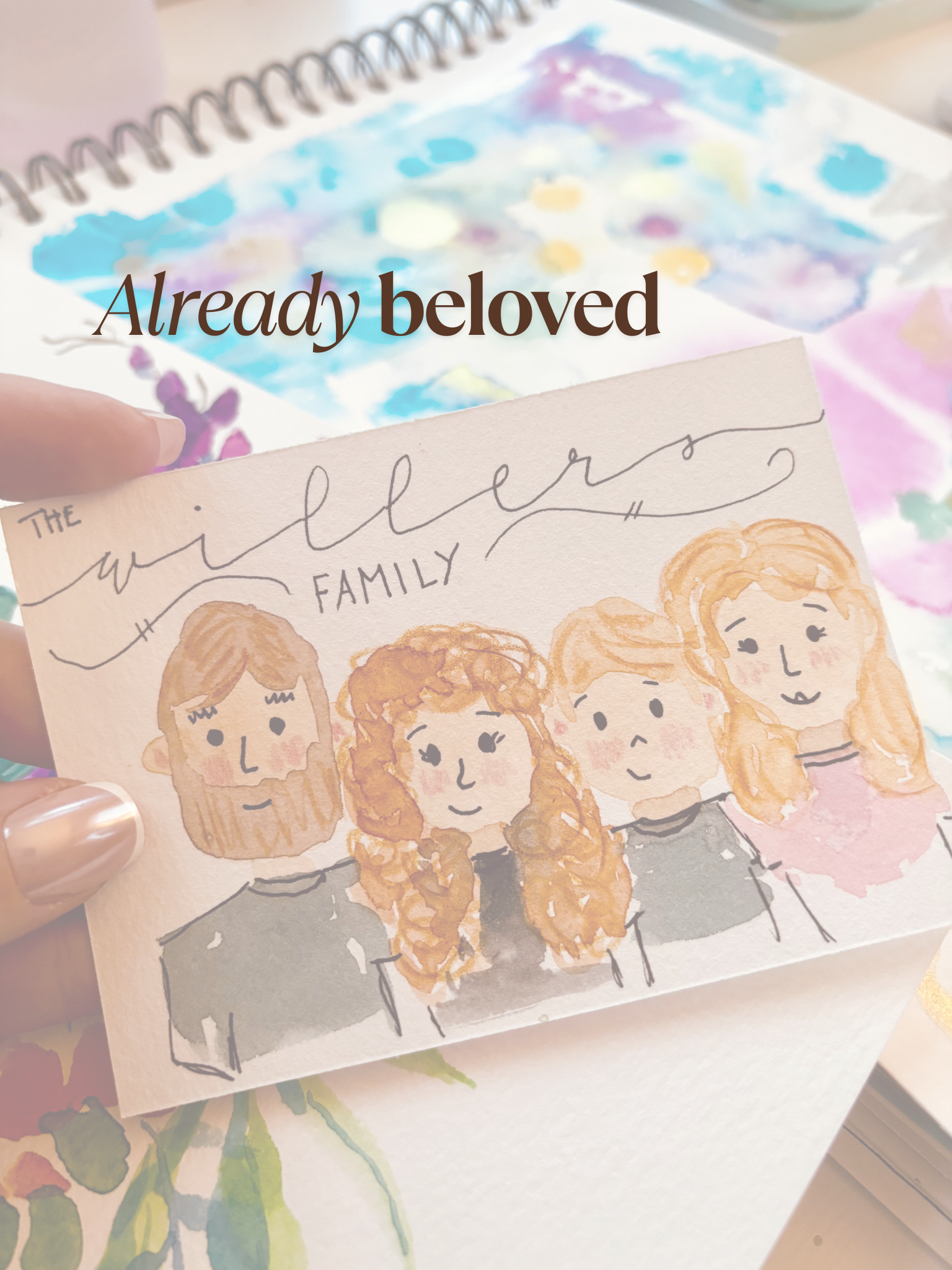
A couple of months ago, I wrote about shedding old coping mechanisms: learning to live more intentionally and to walk in truth. Today I want to write about another one. This has been a longer journey for me, with many iterations.
It began, as it so often does for me, with an awkward encounter with an acquaintance.
In the past, I would have left that interaction and verbally berated myself, cataloging how weird and awkward I am, asking myself what is wrong with me. Looking back, I feel sadness for how cruel I was to myself. If someone else had said those things to me, it would rightly be called abusive. I am grateful to say I’ve moved past that pattern, as it was a more obvious affront to God and His good work in me.
But as I fought that old habit, it morphed into something subtler. A thought crept in, embarrassing to admit: Wait until I lose weight. Then they’ll want to be friends with me. It lived mostly below the surface, but it offered a false hope that someday I’d be better, more deserving of love. As God slowly convicted me of loving myself as His image-bearer, I realized this too was unhealthy, and I began to fight it as well.
Eventually, that thought shifted again into something even quieter: Well, that was awkward, but wait until (fill in the blank). I had grown more comfortable with my body, but I still wasn’t content with simply being myself.
It took me a while to recognize this pattern. I had shed the verbally abusive thoughts and the fixation on my weight, but I was still placing my hope in a false promise: that someday people would love me for my accomplishments. I was idolizing a future version of myself to soothe the fear of offering my true self, right now, take it or leave it.
But the Holy Spirit is faithful. In time, He revealed this too, and I believe it was to lead me right here.
After another awkward encounter recently, I caught myself mentally scrambling for ways to prove I wasn’t actually a weird person. I can be fun. I am a good friend. I give good gifts! (Yes—these were literally the thoughts running through my head.) I imagined texts I could send, favors I could offer.
And then it hit me: I am already beloved.
I don’t have to prove myself to anyone. People can accept me (or not!) for who I am: broken, fragile, real. Because the good news is this: I am already beloved.
I am already beloved.
It has taken me a long time to feel how restful this truth is. I can stop striving and simply rest in my belovedness. And the beautiful irony is that the things I was trying to prove are already true. I am a good friend. I can be fun. I do give good gifts. I am a good and beautiful creation of the God of the universe. And most importantly, I was loved by Him before I ever came to be.
Tamara Hill Murphy puts it this way in The Spacious Path:
Our parents name us at birth, and God gives us our forever name at the second birth of baptism. In baptism, we step into the water of death with Jesus and are raised with him, the beloved. Because belovedness begins in God, we do not name ourselves beloved; instead, we receive the name—the reality of ourselves, fully seen and loved by God—as a gift.
Our temptation is to live as if we are beloved without letting the truth sink down into the true state of our souls. We may believe God loves us, but we haven’t allowed that love to help us discover the truth about ourselves. Any rest we feel that doesn’t help us discover the truth about ourselves is a false rest.
And oh! the rest and freedom that come from truly believing this. No more coping mechanisms after awkward encounters. No more striving to secure belonging. Instead, I am learning to settle into the truth of my belovedness.
I am grateful that my parents gave me the name that means beloved. And even more grateful that God calls me His beloved. And I am learning, slowly and imperfectly, to let that name sink from my head into my heart.
A gentle invitation: As you move through your own ordinary days, especially the moments that leave you replaying conversations or wishing you had been different, notice what name you give yourself. If you’re willing, try setting that name down. See what it might be like to rest, even briefly, in the truth that you are already fully seen and deeply loved. You don’t have to earn your place here. You are already beloved.
Invitation: A Creative Way to Walk Through Lent
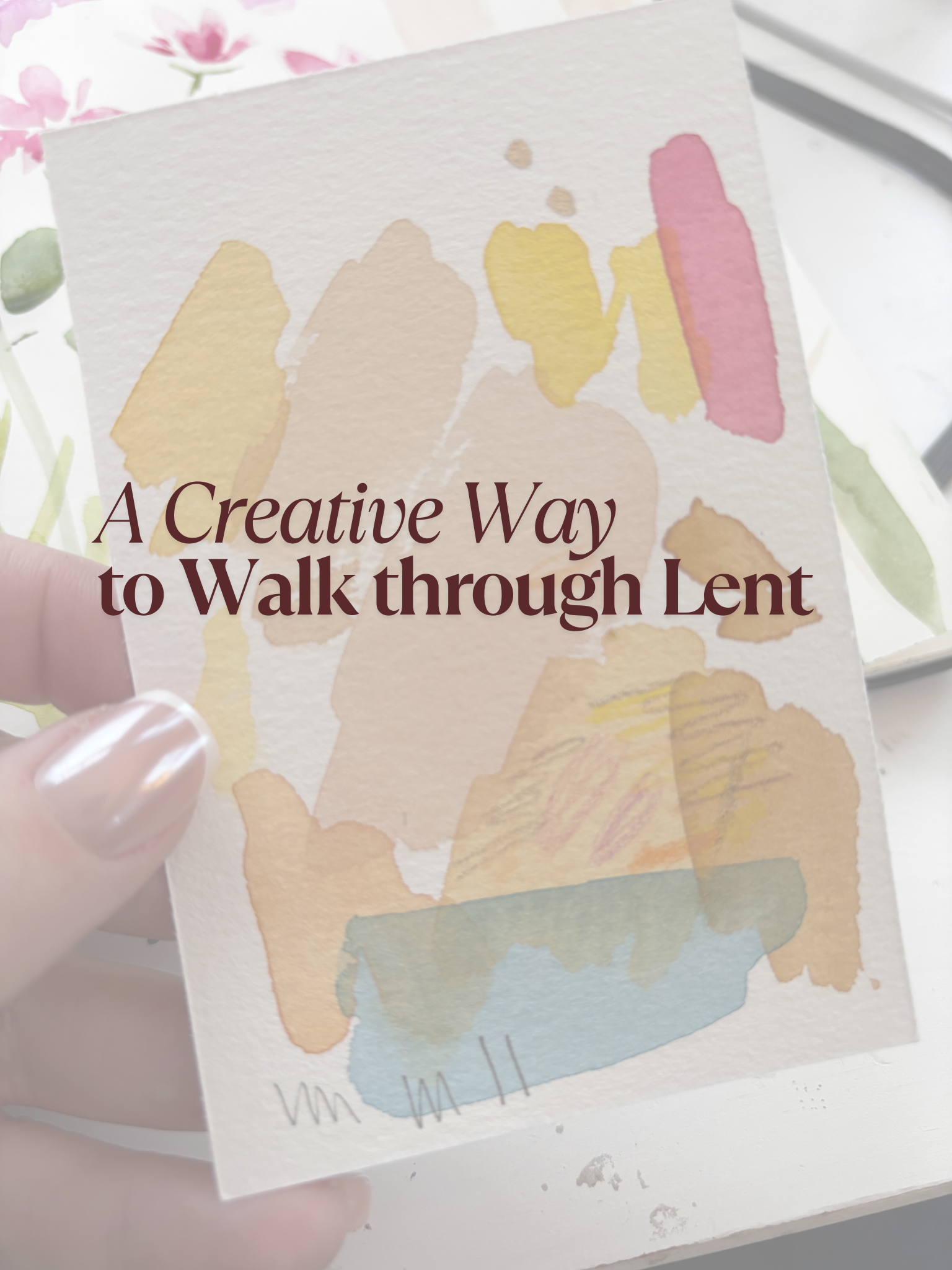
This year, I’m offering a four-week creative spiritual direction group for Lent for anyone longing to move through the season slowly, honestly, and with care.
We’ll gather once a week and work on one piece of artwork over four sessions, allowing it to change gradually as Lent unfolds. Each week has a simple theme:
Releasing – letting go and making space
Resting – honoring grief, weariness, and lament
Renewing – noticing quiet growth beneath the surface
Rejoicing – receiving words of hope as we look toward Easter
Each session will include:
a short spiritual reflection grounded in Scripture
quiet journaling (private; never shared)
a simple, guided creative practice
generous silence and space for wondering
optional sharing from the experience of making (not explanations or analysis)
You do not need to be an artist or know exactly what you want from Lent.
This is not about producing something beautiful or meaningful, though many people are surprised by how much they love what emerges. It’s about being present and trusting that God is already at work, even in what feels unfinished.
If you’re tired of striving but still want to stay attentive to God…
If you long for a gentle, embodied way to pray…
You are welcome here.
This group is small by design and held with clear guidelines around confidentiality, consent, and care. Sharing is always optional. Silence is honored.
A quick note about logistics
This group will be offered in person, with space intentionally limited so the experience can remain quiet and spacious. The cost for the in-person group is $30, which simply covers all art materials. No need to bring anything with you.
If there is enough interest, I may also offer an online version of the group. The online group would be free, with participants providing their own materials at home.
If you’re interested but unsure which option might work for you, you’re welcome to reach out or add your name to the interest list.
How do you create + play? Interview with Florie
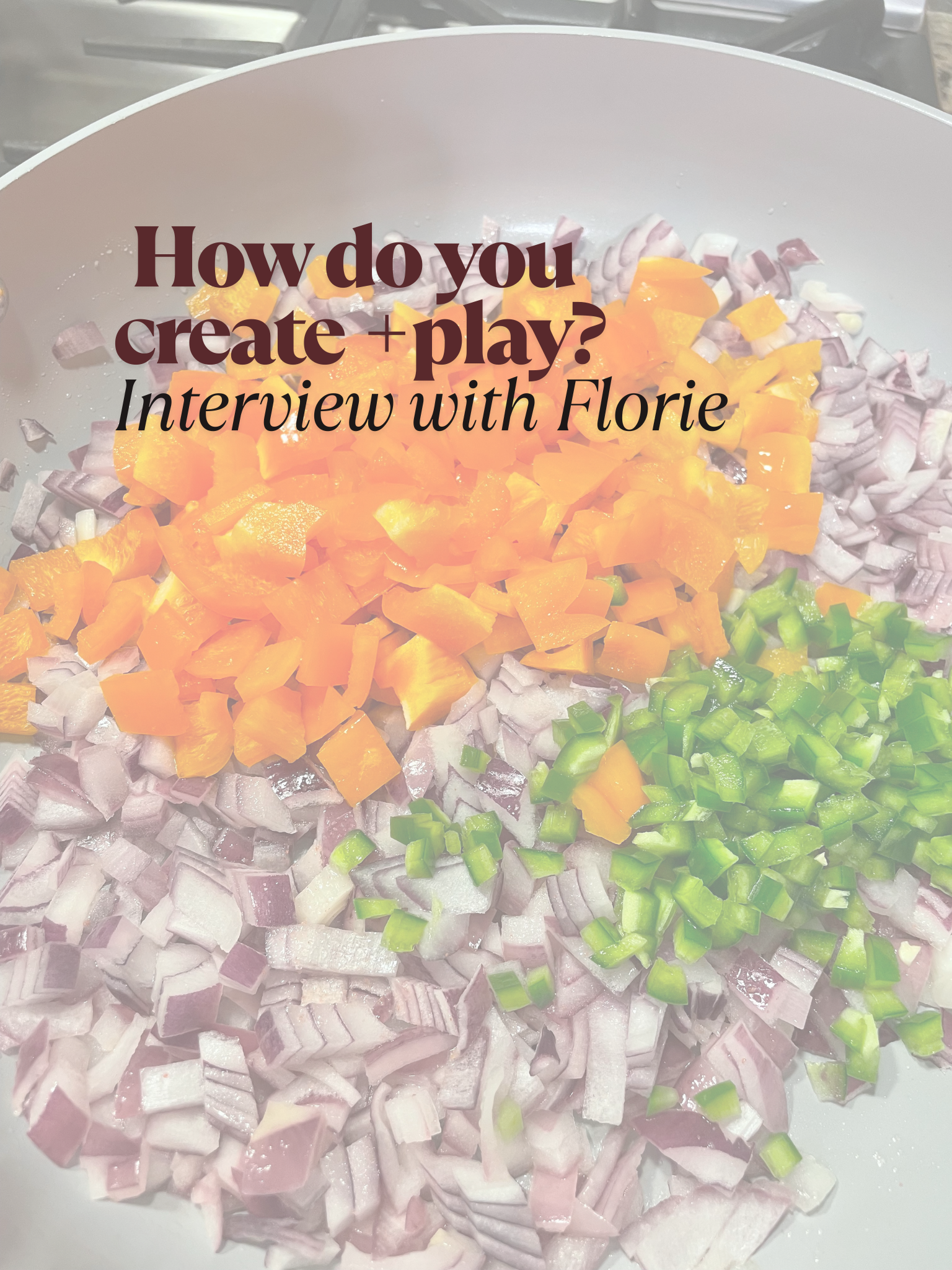
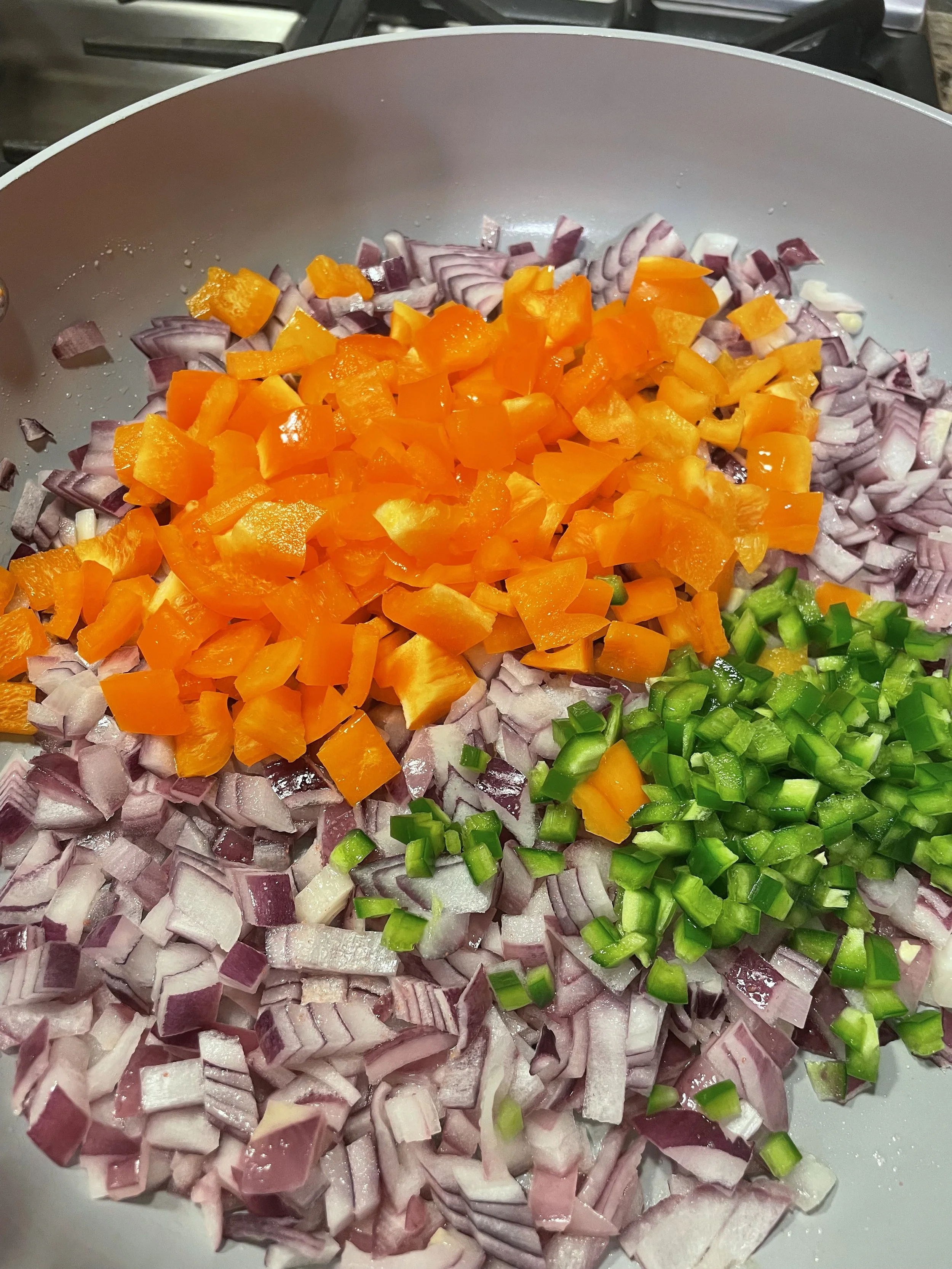
Creativity doesn’t always look like paint or paper. Sometimes it looks like a cutting board, a pot simmering on the stove, and hands moving slowly and attentively through familiar motions.
For this interview, I heard from someone whose creative practice is rooted in the kitchen, a place shaped by memory, hospitality, nourishment, and love. What began in childhood as helping with simple meals has become a way of caring for bodies and spirits, cultivating connection, and paying attention to the beauty woven into everyday ingredients.
Her reflections remind us that creating can be practical and sacred at the same time. That slowing down matters. That rhythm, care, and presence can transform ordinary tasks into acts of love. And that sometimes the most meaningful creative spaces are the ones we return to every single day.
What first drew you to cooking and what keeps you coming back to it now?
All seven of the children in my family learned to cook alongside our mother. I don’t remember a time when I wasn’t peeling potatoes or stirring a pot of sauce on the stove. Recipes were basic because finances were quite limited, but there was always enough to share, and friends were commonly found along with the family around our large kitchen table. This instilled a sense of cooking as a way to show love and foster community. That is still what draws me now, along with the belief that I am nurturing both the spirits and the bodies of my family and loved ones as I prepare healthful and beautiful food for them.
What happens in you when you’re cooking? What do you notice, feel, or pay attention to?
I enjoy every aspect of preparing a meal, which starts with my weekly planning. I usually try to make at least one or two new recipes each week, and often make foods from different cultures. I ask each family member if they have one request for the week and incorporate that into my menu. While I’m planning I make my shopping list and then do my weekly grocery shopping where I try to get the freshest and healthiest produce I can find.
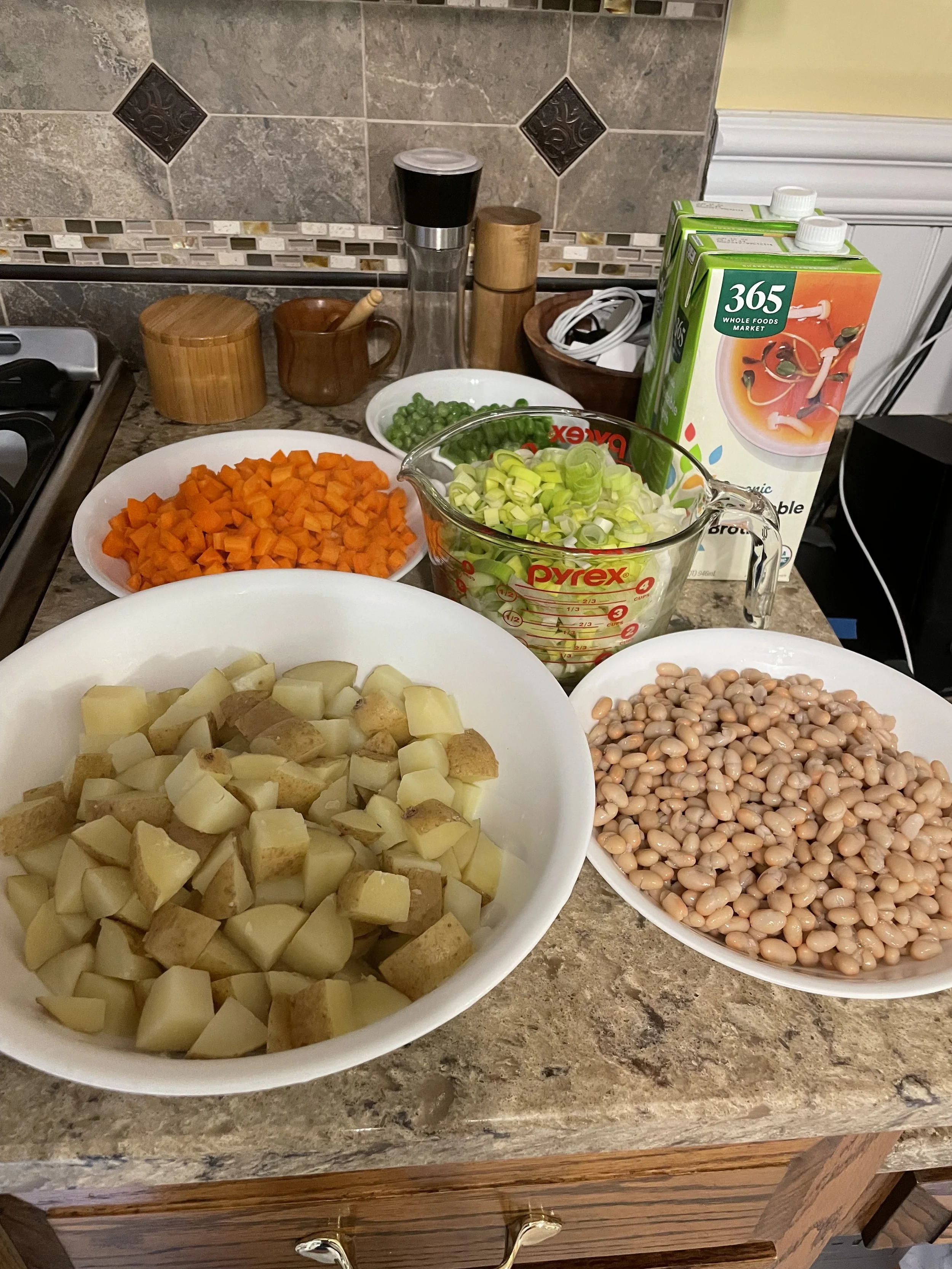
Dinner preparation is a peaceful time for me. I try to leave myself plenty of time so nothing is rushed. I prep all my ingredients in advance, and since we are fully plant-based and eat a lot of fresh produce, that is often the bulk of the cooking process. I love the fresh smells, the different colors and textures of the vegetables, and knowing that the phytochemicals that cause the beauty in them are the very ingredients that will nurture the bodies of those I love most.
I pay attention to the balance of the flavors and textures. A little fresh lime juice squeezed in at the end of the cooking time adds brightness, a little cilantro sprinkled on top of the bowl gives a fresh bite, beauty and added health benefits as do some toasted sesame seeds for textural contrast. The beauty is delicious and that makes me smile. We eat with our eyes first and I try to be conscious of that part as well.
You sometimes cook with your family members. What do you think happens when people create things side by side?
I love cooking alongside my children. My son Jacob is particularly interested in cooking and we work together well. There is a rhythm we fall into where we are making something delicious and nurturing together, and sharing conversation that nurtures our relationship. There is a shared sense of purpose while we work and the product is more pleasing and satisfying from the joint effort.
Has cooking ever helped you slow down, notice beauty, or connect with something bigger than yourself?
Almost always. If I’m rushed I am likely to cut or burn myself or the meal will suffer, so I have trained myself to slow down. I notice the beauty in the ingredients and the smells and textures and colors as they start to cook and change. I am mindful of the plants as created uniquely by God to feed and nurture our bodies and there is an air of reverence to the process. In a very real way my kitchen is the most sacred space in my home.
If you can imagine Jesus standing with you while you cook, what do you think he is doing/saying/thinking?
I often feel His presence as I’m cooking. I think He is pleased with the stewardship of my family’s health. I think he would say as my son often does when he walks in the kitchen, “It smells amazing in here.” I think He is pleased with the gift of love I am offering to my family and loved ones.
What would you say to someone who wishes they could create like that, but doesn’t know where to start?
Start simple. In the early years of my marriage I had a subscription to “Cooking Light” magazine. (My dad had his first heart attack when I was a freshman in college and Dan and I have always tried to eat in a way that protected our health.) I learned SO much from reading those issues for years and years and just trying recipes. The cultures of the world have incredible flavors and spices and smells to open your heart and mind and palate. Try new things. Don’t be afraid to “fail” and create a product that isn’t your favorite. Each recipe you try is a learning experience that prepares you for the next and then the next. Also, plants are amazing. Go to a farm or farmers’ market and try the weird looking alien purple vegetable you’ve never seen before. Embrace the full breadth of God’s creation because there is so much to enjoy. It’s nurturing and beautiful and your body and your spirit will thank you. Your family might, too.
Creative and generous God, thank you for planting your creativity in us, so that when we create we can feel closer to you and your delight in us. Bless Florie while she is in her kitchen. Renew her senses everyday to enjoy the smells, colors, textures, and tastes of the multitudes of different foods that you have provided. May every dish she makes be an act of worship, a sweet offering to you, Lord. Thank you for her example as she participates in your abundance. May your love and peace meet her, her family, and every guest around her table.



Do we have enough time to make space?
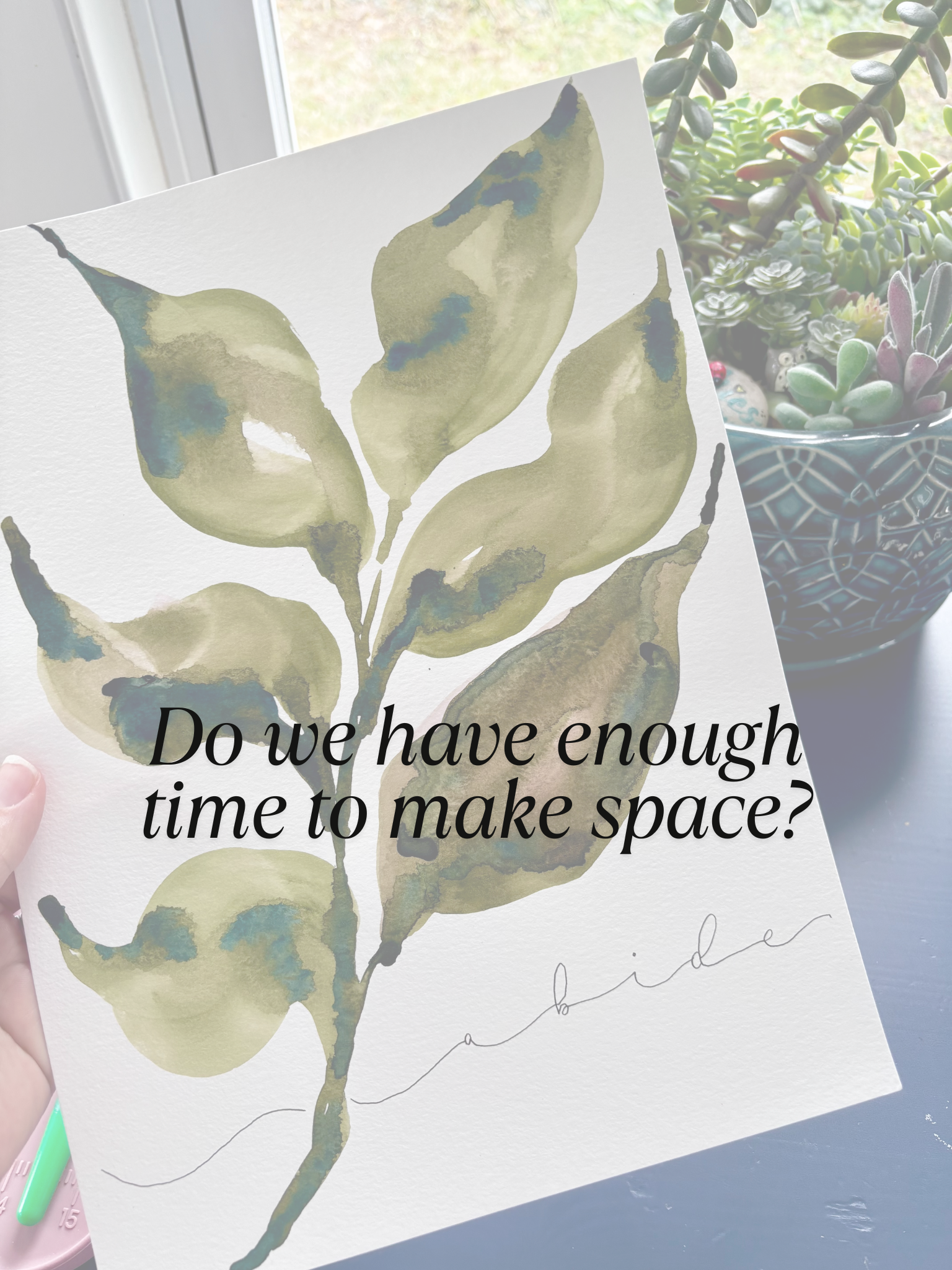
Sometimes when we talk about “making space,” it can sound unrealistic. We picture long stretches of quiet, a retreat center, or a life with far fewer responsibilities. Many of us wonder, Is it really true that I already have enough time to make space for myself and for God?
Surprisingly, yes. And here’s why.
1. God’s economy works differently than ours.
Scripture is full of stories where God provides abundantly from what looks like almost nothing:
A few loaves and fish feed thousands.
A widow’s tiny jar of oil never runs out.
Manna appears every morning in the wilderness.
These stories aren’t just about food. They’re about reality in God’s Kingdom: He is not limited by our limits. In His presence, scarcity gives way to abundance. If God is with you (and He is), then you already carry enough for this moment.
2. Making space isn’t about having ideal conditions.
Most of us imagine we need perfect quiet, a tidy house, or a cleared schedule before we can be still. But making space rarely comes in perfect packages. It often looks like:
Pausing for one slow, grounding breath
Speaking a short prayer in the middle of errands
Sitting with a cup of tea without scrolling
Doing something creative simply because it brings joy
Stepping outside for two minutes to notice the sky
Asking for spiritual direction
Turning your phone off for a short window
None of those require extra resources, only intention.
3. It’s true that it won’t feel productive.
We are so conditioned to measure our worth by what we produce that stillness feels uncomfortable, inefficient, or even pointless. But being with God is not meant to be productive; it’s meant to be formative. Over time, those quiet moments soften our hearts, steady our minds, and reshape how we move through the world.
4. Making space actually stretches time.
This is something people discover again and again: when we slow down, time feels different. There’s even neuroscience behind this: mindfulness and contemplative practices literally change the brain’s perception of time.
So yes, even a few intentional breaths can expand the space within us.
The truth is, making space isn’t about finding more time. It’s about learning to trust that God is already here, already offering enough for this moment.
You don’t have to wait for a perfect day. You don’t have to earn rest or stillness. You can begin right now, with whatever you have.
Ins and Outs for 2026

I love this trend that replaces the same old boring (and unachievable) resolutions with an “In and Out” list for the year. So after some reflection, here is mine:
In
Making space
Speaking the truth
Rest
Creating to play
Crying
Reading children’s books as spiritual direction
Pausing before saying yes
Humility
Side quests
Slowness
Delight
Out
equating busyness with self-worth
People pleasing
Phone time
Creating to perform
Holding back tears
Unnecessary urgency
Comparing myself to others
Desiring the praise and credit
Rushing the ending
Taking myself too seriously
What is on your ins and outs list?