
Archive
are you creative? take this test and see!

Take this test to find out if you are creative (even if you think you know the answer already!):
Have you noticed something lately that made you stop and pay attention?
A sunset, an interesting building, a funny-shaped mushroom, a song, someone's words, a really good color?Have you wondered about something just because you were curious?
How something works? Why something is the way it is? What would happen if…?Have you explored something recently?
A trail, a new recipe, a new idea, a different way home, a book, a hobby?Have you responded to something you've noticed?
Taken a picture, told someone about it, looked it up, written it down, changed something, tried something?Have you ever made something?
Dinner counts. So does a garden, a spreadsheet, a Lego tower, a doodle, a plan, a playlist, a solution to a problem, or an actual piece of art.Are you human?
Results:
If you answered yes to even a few of these (and especially that last one), congratulations: you're creative.
Because creativity isn't the same thing as being artistic. Creativity is our response to God's world through noticing, wondering, exploring, and making.
Creative Prompt: paint some houses
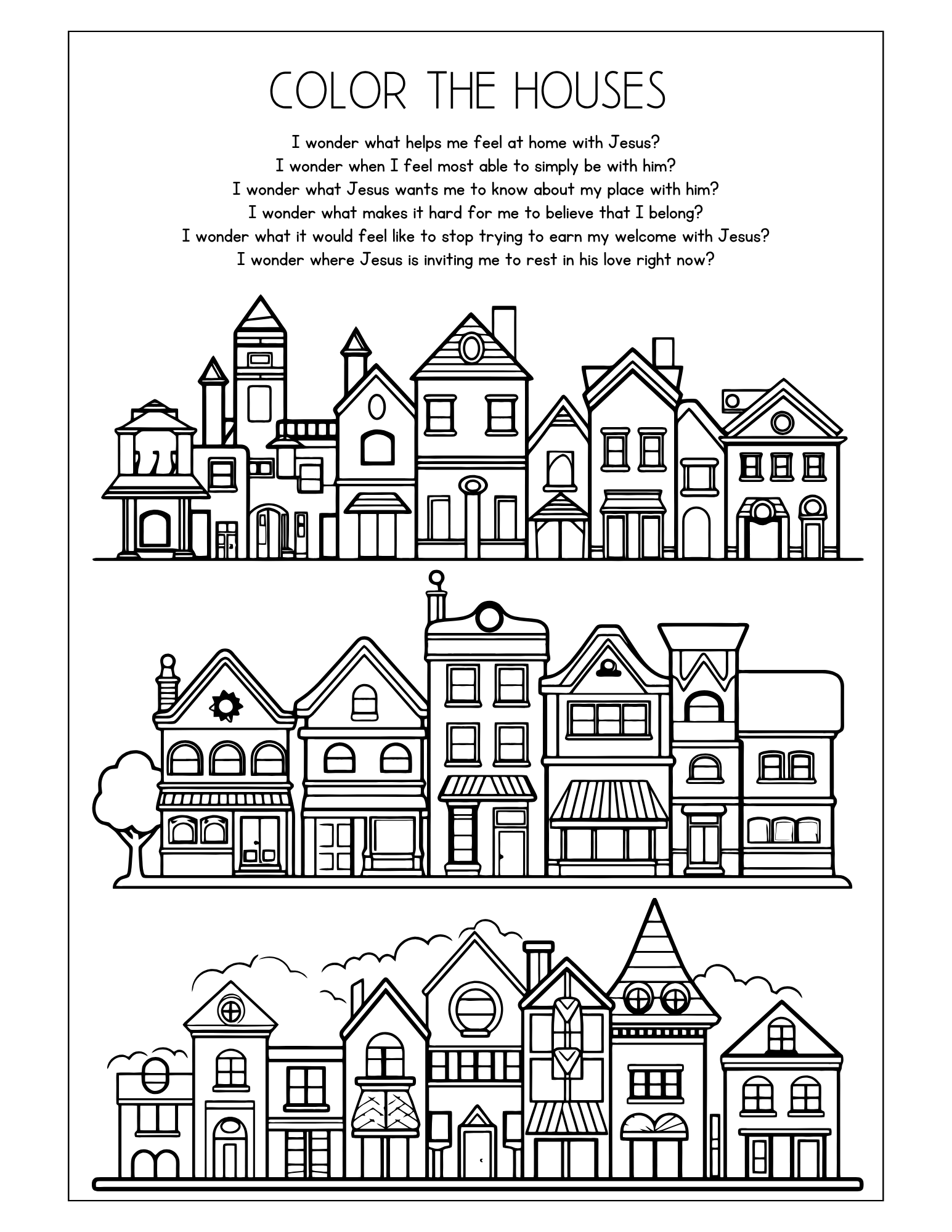
Paint a row of simple little houses or use this coloring page.
They don't need to be complicated: a square, a roof, a few windows and a door. Make them colorful and wonky. Add chimneys, flowers, trees, paths, curtains, or anything else you'd like.
As you paint, hold this wondering:
What does it mean for me to be at home with Jesus?
You don't need to come up with an answer. Let the question sit with you while you paint. Maybe you think about the places where you already feel close to Jesus or maybe you notice something you long for. Or maybe you just simply enjoy painting houses while remembering that you are already welcomed and loved by him.
As you work, you might wonder:
I wonder what helps me feel at home with Jesus?
I wonder when I feel most able to simply be with him?
I wonder what Jesus wants me to know about my place with him?
I wonder what makes it hard for me to believe that I belong?
I wonder what it would feel like to stop trying to earn my welcome with Jesus?
I wonder where Jesus is inviting me to rest in his love right now?
Don't try to answer them all. Notice if one question seems to stay with you.
You might even ask Jesus directly:
Jesus, what do you want me to know about being at home with you?
Then keep painting and listening.
A Kid-Friendly Version
Invite kids to draw a house they would really like to live in.
It can have whatever they want: a giant slide, a room for pets, rainbow windows, a swimming pool, a candy garden.
While they draw, you might wonder together:
What makes somewhere feel like home?
What makes you feel safe and loved?
I wonder what it is like to know that you always belong with Jesus?
I wonder what Jesus loves about having you close to him?
There doesn't need to be a lesson at the end. Give them room to wonder.
Making Our Home in Jesus
In John 15, Jesus tells his friends to abide in him, to remain with him, to make their home in his love.
I love that image because our life with Jesus isn't only about doing things for him. It is about being with him. We don't have to arrive at Jesus' door with everything figured out. We don't have to become more impressive or more spiritual before we're allowed inside. We are already wanted.
A Closing Invitation
When your houses are finished, look at them for a moment. Imagine one of those little houses as a picture of your life with Jesus. There is a light on. The door is open. You are expected and you belong there.
And sit for a moment with this wondering:
Jesus, what would it look like for me to make my home in your love today?
does attention really matter?

I firmly believe that our ordinary human lives can glorify God. He created us to live and glorify him, so the ordinary things that are part of our human calling—breathing, sleeping, eating—are not separate from a life that glorifies God. I also believe that our work, play, and rest can glorify God. They are extensions of our human callings, part of God’s vision for his creation that He gave us in the garden. Even people who don’t know God are still his beautiful creations, bearing his image as they live and breathe and work and play and rest.
We have a park and a good sledding hill across the street from us. Sometimes in winter I watch teenagers sled down that hill and laugh and laugh and I know in that moment God is delighted in them. I can feel it as I watch and laugh even just to myself. God is delighted that those teenagers are engaging with his creation in such a free and pure way.
This is why sometimes I tell people to just make art for play or make it ugly on purpose. Just let yourself be, without even thinking, just enjoy yourself! This, too, can be part of a life that glorifies God. We don’t have to turn it into something “spiritual” first.
So why do I talk about “contemplative play” so much, if we don’t have to turn every moment into a spiritual practice?Well, the fact of the matter is, God is so good and so loving that as we live our ordinary lives, He also invites us to know Him and love Him more and more. This is where the contemplative part comes in. If we take a moment in the play, in the work, in the rest, to notice what is going on inside, to surrender to God in that moment, to ask him for help, to praise him, in all of it saying, “this, too, is for you, God,” then we are working on a perspective shift, growing in our inmost lives and fostering a deeper love for Him in everything.
There is so much talk about self-reflection, and that is good and worth doing. But as Christians, our self-reflection should be more focused on Jesus, and as we reflect on Him, He reveals more and more of who we are.
When I was a teenager, I wrote in my journals something like the following:
I’ve noticed that when I am closer to Jesus and keeping my eyes on him, I feel more and more like myself. It doesn’t make sense, but it makes me think that somehow we were created to be more fully ourselves when Jesus is at the center.
I have never forgotten this. This is the point of the contemplative life: keeping Jesus at the center. And He is so good that He, in turn, makes us more and more of our true selves. That is the abundant life that He promises: to live fully as the people He created us to be. This is what I’m talking about when I say where we place our attention matters.
When we do surrender, our attention slowly begins to shift. This is where those good spiritual practices come in. We begin to make space in new ways, and over time we find ourselves noticing God’s abundance where we couldn’t see it before. Life may not have changed, but our eyes are more open to His presence, goodness, beauty, and love. (attention, surrender, and the life we have)
So don’t feel guilty when you are happy, or when you are playing, or when you are working and you aren’t always thinking about God. We won’t keep our conscious minds on God all the time, and it isn’t a failing; it is part of being human. (Isn’t this so freeing?) But do take time to do the good spiritual practices, do the examens, schedule spiritual direction, take a moment to make space, do some breath prayers through the day. Not because these practices make the rest of your life more holy, but because they help turn your attention toward the God who is already there. The attention matters because God is good enough to want us to grow in our love for him, and He will help us along the way.
prayer crafts: bookmarks
Prayer Crafts, where we make something, and it means something.
For this prayer craft, we’re making a simple bookshelf bookmark, a bookmark that can remind us to pay attention every time we open a book.
Start by coloring a whole bunch of rectangles. I used markers, but you could use paint, colored pencils, crayons, or whatever you have nearby. Don’t worry about making them look like books yet. Just play with color.
As you color, hold this question quietly:
Where have I been noticing God lately?
Maybe God has felt present in something beautiful, a conversation, a moment of rest, or something that made you laugh. You don’t have to come up with a profound answer. Just notice what comes to mind.
When you’re finished coloring, cut out your rectangles and choose some favorites. Arrange them on a darker strip of paper like books on a shelf. Turn a few sideways to make little stacks. Glue everything down, and add any extra details you’d like. I added a tiny cactus sticker and used a pen to give some of my rectangles little book details.
Then tuck your finished bookmark into whatever you’re reading.
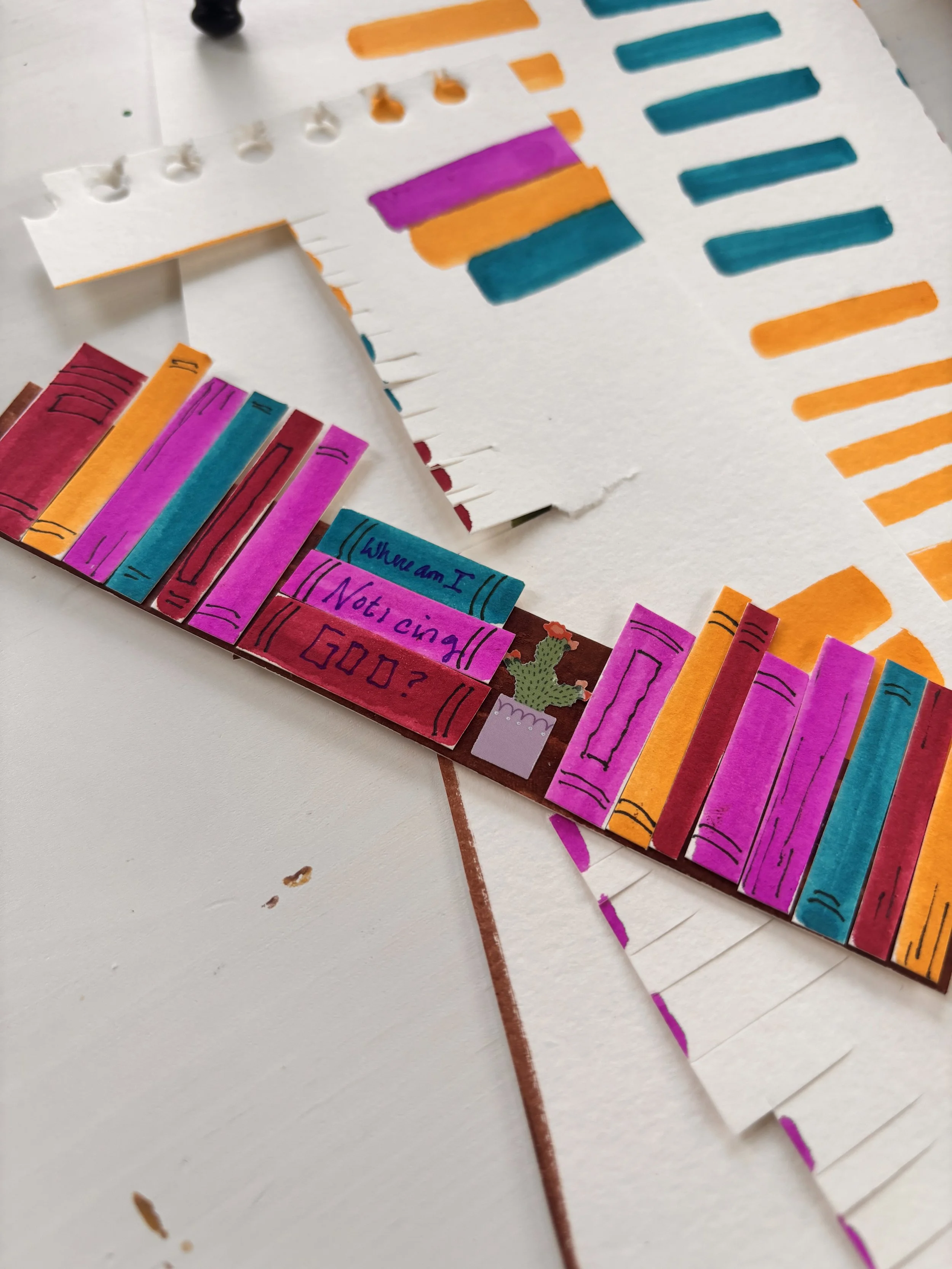
Each time you see it, let it become a tiny invitation to ask again:
Where am I noticing God?
Maybe it will be in the words you’re reading. Maybe in the room around you. Maybe in something that happened earlier that day. Or maybe you’ll simply sit quietly for a moment and notice what God brings to mind.
Sometimes making space for God can be as small as remembering to pay attention.
Creative prompt: Paint a Bowl of Impossible Fruit
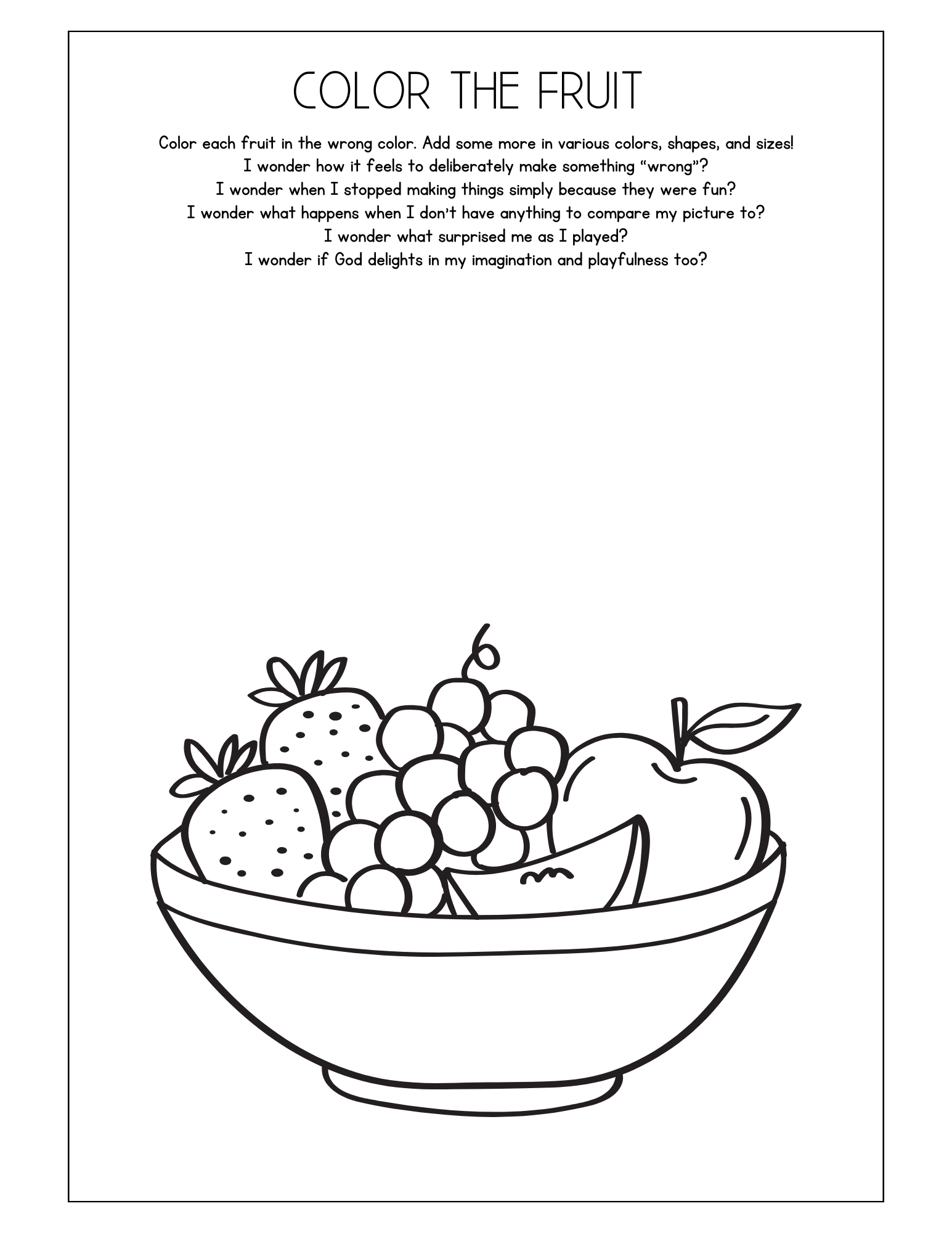
Begin by painting or drawing a simple bowl, then fill it with fruit, or use this coloring page. You can paint fruit you recognize, but use completely unexpected colors, a blue banana or a striped strawberry, or even invent fruit that doesn’t exist at all!
Try not to ask, Does this look right?
Ask instead: What would be fun?
Let yourself make something that couldn’t exist anywhere except on your page.
Wondering Questions
As you create, you might wonder:
I wonder how it feels to deliberately make something “wrong”?
I wonder when I stopped making things simply because they were fun?
I wonder what happens when I don't have anything to compare my picture to?
I wonder what surprised me as I played?
I wonder if God delights in my imagination and playfulness too?
You don't have to turn the practice into a lesson. You can simply notice what happens when you give yourself permission to play.
A Kid-Friendly Version
Kids may already be much better at this than grown-ups!
Draw a bowl and fill it with the strangest fruit you can imagine. Make up your own colors, shapes, and kinds of fruit. Then give your new fruits names. Maybe you've invented a Purple Fuzzberry or a Rainbow Crunch Melon.
You might wonder together:
What does your fruit taste like?
Where does it grow?
Which one would you most like to eat?
Can you invent a fruit that has never existed before?
Follow the silliness wherever it goes.
When you're finished, look at your bowl of impossible fruit. Notice which one makes you smile. Which one surprised you? Which one could only have come from you?
And then hold one final wondering:
I wonder what Jesus enjoys about the way I play and imagine?
You don't have to answer. Maybe today it's enough to enjoy the fruit.
If you feel comfortable, I’d love to see what you create. When I share these prompts, I’ll always try to share what I’ve made too. Tag me on Instagram or comment below with a photo or reflection.
Are you creative? Take this test to find out!

I absolutely adore non-traditional creative endeavors, like this troll made from all-natural materials by Thomas Dambo (finally got to see one in person recently!).
Take this test to find out if you are creative (even if you think you know the answer already!):
Have you noticed something lately that made you stop and pay attention?
A sunset, an interesting building, a funny-shaped mushroom, a song, someone's words, a really good color?Have you wondered about something just because you were curious?
How something works? Why something is the way it is? What would happen if…?Have you explored something recently?
A trail, a new recipe, a new idea, a different way home, a book, a hobby?Have you responded to something you've noticed?
Taken a picture, told someone about it, looked it up, written it down, changed something, tried something?Have you ever made something?
Dinner counts. So does a garden, a spreadsheet, a Lego tower, a doodle, a plan, a playlist, a solution to a problem, or an actual piece of art.Are you human?
Results:
If you answered yes to even a few of these (and especially that last one), congratulations: you're creative.
Because creativity isn't the same thing as being artistic. Creativity is our response to God's world through noticing, wondering, exploring, and making. It is part of who we are as humans. Maybe it’s time to embrace your creative calling...
photo prompt: something growing
Today’s Practicing the Presence invitation:
Photograph something growing where no one planted it.
Then ask yourself:
Where is something growing in my life that I didn’t plan?
Practicing the presence is about noticing where God is already at work. We can spend a lot of time thinking about what we need to make happen, fix, or figure out. But not everything good in our lives is something we planted ourselves.
Sometimes growth just appears. Maybe something in you is changing. Maybe a new relationship is forming. Maybe you’re discovering an interest, a hope, or a little bit of courage you didn’t have before.
Today, look for something growing where no one planted it. Let it remind you to notice what might be quietly growing in you, too.
Where might God be at work without you having to make it happen?
Arts and Crafts: a fun way to make space
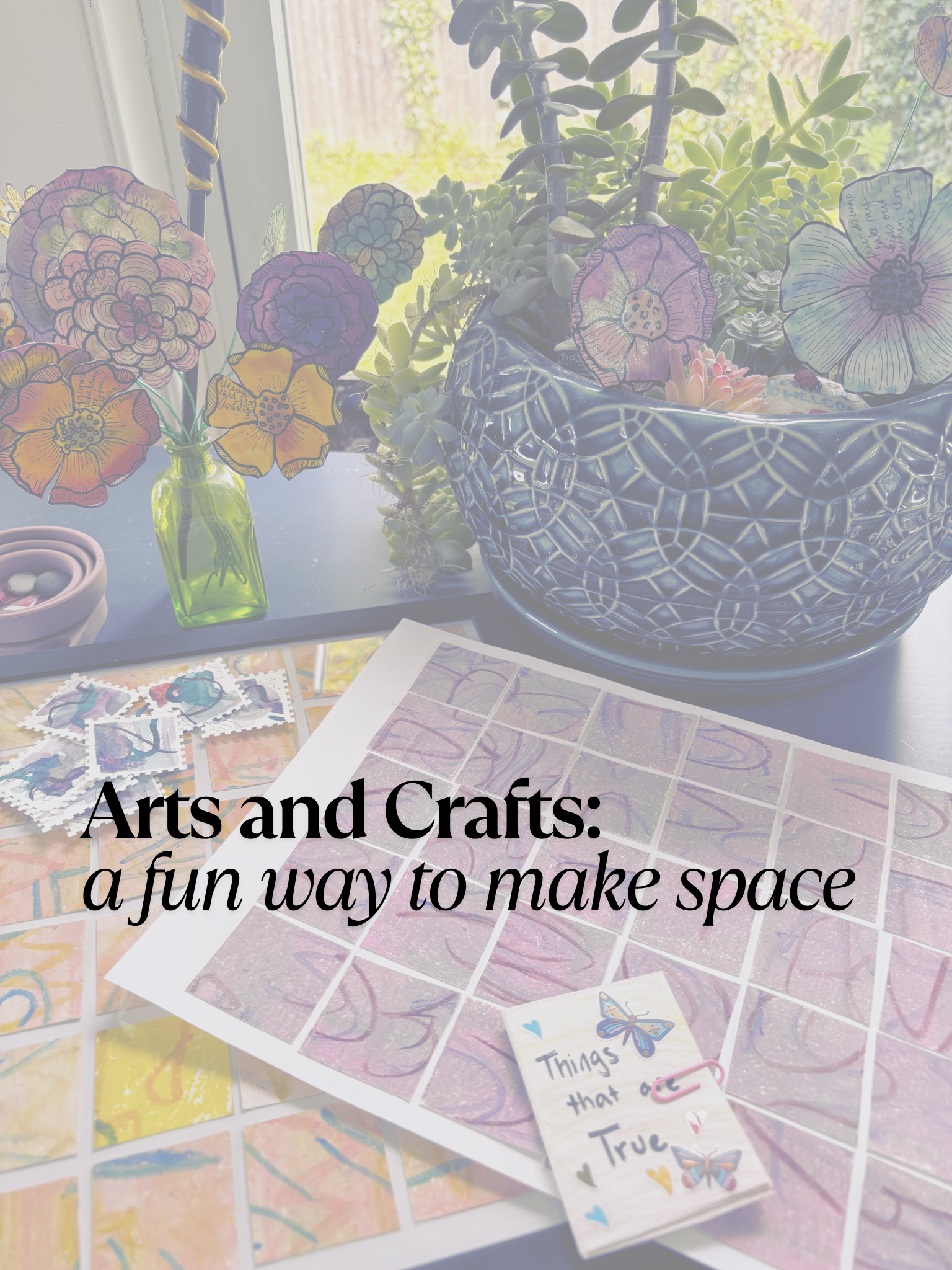
That’s a wrap on my summer Prayer Craft retreats!
It has been such a joy to use my love of arts and crafts to help people make space for God in their lives. (Seriously, someone pinch me!) And what a good God, that He wants to meet us in the fun and silly things of life, too.
So keep making space for arts and crafts. Let them help you slow down and notice God: His beauty, His goodness, and what He is doing in you. Let yourself sit in His delight in you. Listen for the good and true names He calls you.
There are more retreats to come, including two two-hour retreats this fall. But for now, I’ll leave you with the prayer that ended our time together today:
God, thank you for this little bit of time to play together and with you. Thank you for meeting us in hard things and also in fun things.
Help us carry a little of this spaciousness with us when we leave. And help us keep noticing the small ways you meet us in the middle of our ordinary lives.
Amen.
clearing the table: making space as hospitality
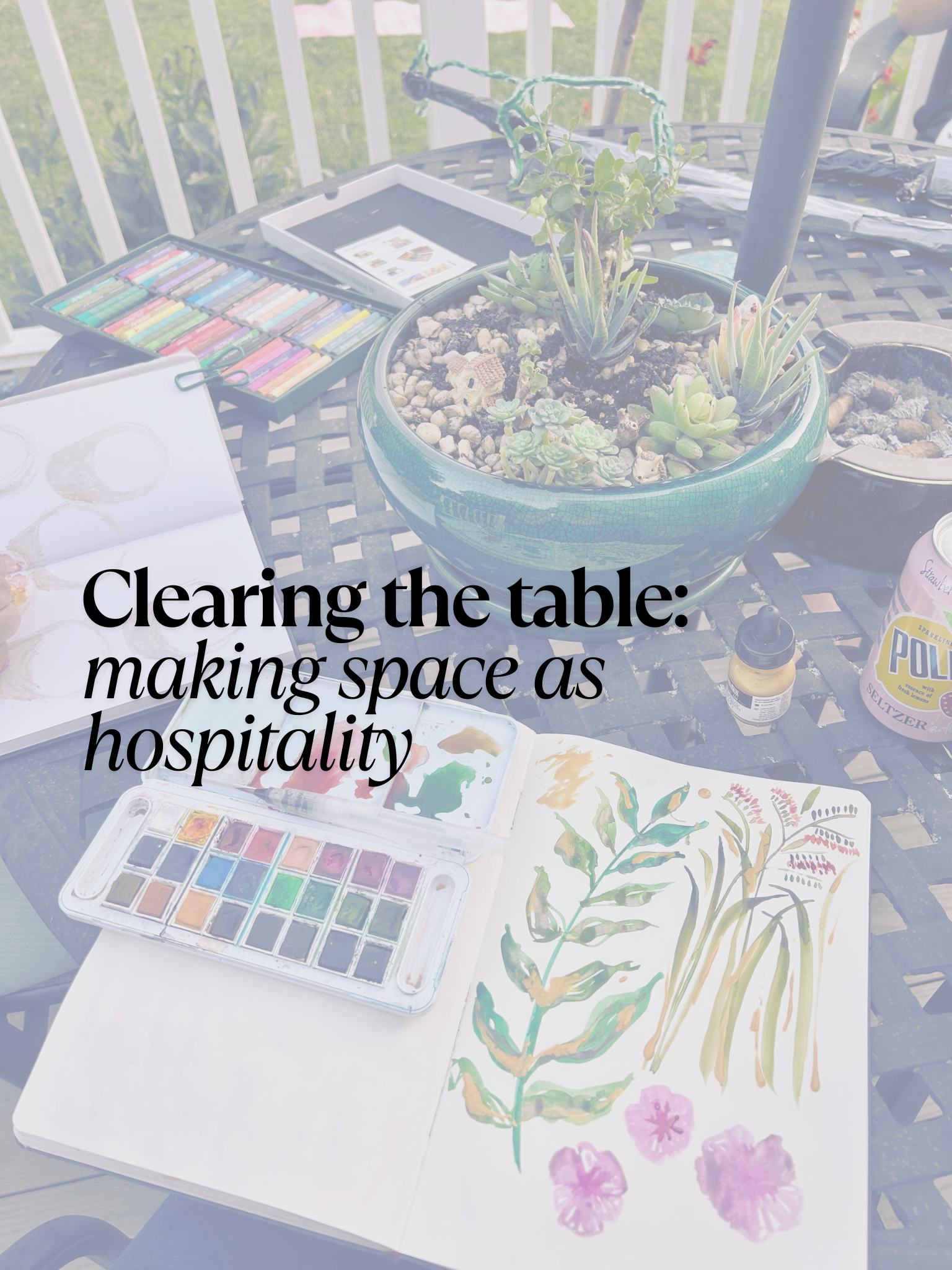
When I think of making space, I think of clearing the table before dinner.
If your house is anything like ours, the dining room table quickly fills up with crafts, homework, tools, or even plates from the night before. It's also the staging area for things we mean to take downstairs, return to someone, or pack for a trip. Somehow, it is always full.
But every evening, before we sit down to eat, we clear it. We put some things where they belong. We move other things aside. Sometimes we simply decide that a project can wait until tomorrow.
We don't clear the table because we just love empty tables (though we do!). We clear it because we're making room for something better. Clearing the table becomes an act of hospitality. We make space so we can rest, share a meal, laugh, listen, and simply be together.
Making space with God feels much the same. Our lives naturally fill up with responsibilities, good opportunities, unfinished projects, worries, and distractions. None of those things are necessarily bad. But every so often, we need to look at the "table" of our lives and ask what really belongs there right now and what can be set aside, even for a little while.
Making space is an act of hospitality. It's making room to notice God's presence. It's making room to receive instead of always producing. It's making room for the people we love, and for our own souls to rest. Making space isn't about creating an empty life. It's about making room for a relationship.
So what is sitting on your table today? What could be put away, moved to the side, or simply left until tomorrow, so there is room to sit with God, even for a few precious minutes?
What actually happens in spiritual direction?

What if you had an hour where no one tried to fix you, but simply helped you notice God?
I often get asked what actually happens in spiritual direction. It’s a wonderful question because spiritual direction is one of those things that’s difficult to explain until you’ve experienced it for yourself.
So instead of trying to capture the whole experience in words, here are a few things that make spiritual direction unique:
1. There’s no advice.
This is often the biggest surprise. My role isn’t to tell you what to do or help you solve a problem. Instead, I help you notice God’s presence in your life and listen more deeply for God's invitation.
2. Everything comes back to your relationship with God.
You can bring anything into spiritual direction, work, relationships, grief, joy, questions, or doubt. Whatever we talk about, we keep asking: Where is God in this? What might God be inviting you to notice?
3. Silence is part of the conversation.
We don't rush to fill every quiet moment. Silence isn't awkward; it's sacred. Together we make room to listen, not just to one another, but to the Holy Spirit.
4. You don't have to perform.
You don't need a polished story, a clear goal, or even the right words. You can come tired, hopeful, confused, joyful, numb, or grieving. You simply bring your honest self.
5. It's slow on purpose.
Our world values quick answers and constant productivity. Spiritual direction invites you to slow down, pay attention, and trust that God often works gently over time.
6. The Holy Spirit is the true director.
I'm not the expert on your relationship with God. I simply walk alongside you, trusting that God is already at work and helping you notice what may already be unfolding.
7. People often leave feeling lighter.
Not because everything has been fixed, but because they've remembered what is true: they are seen, deeply loved, and never alone. Sometimes that reminder changes everything.
Ultimately, spiritual direction isn't about fixing your life or finding all the answers. It's about noticing where God is present, how He may be inviting you to responhow deeply you are loved.
If you've ever been curious about spiritual direction, I'd love to answer your questions. It is one of the gentlest, most life-giving practices I know, and it's a privilege to hold this kind of sacred space with others.
prayer crafts: tiny booklets
Prayer Crafts, where we make something, and it means something.
I've been dreaming for a while about creating a series of simple prayer crafts, small, hands-on activities that give us something to do with our hands while making space for God.
This first one is wonderfully simple. As we fold a single sheet of paper into a tiny booklet, we'll slowly fill its pages with things that are true about ourselves. Not our accomplishments or failures, not the stories we tell ourselves on hard days, but the deeper truths that God speaks over us. Sometimes the act of making something small and quiet is enough to help us notice what has been true all along. You can view the video here.
Start with a plain sheet of paper and spend a few minutes making it your own. I used colored pencils and simply scribbled soft layers of color across the page. There isn't a right way to do this, just let your hands move while your mind begins to settle.
As you color and fold, begin to think about what you know to be true about yourself, even if those truths are sometimes hard to remember. You don't have to have the words yet. Just let them gently come to mind.
Next, fold the paper in half four times until you have a grid of 16 small rectangles.
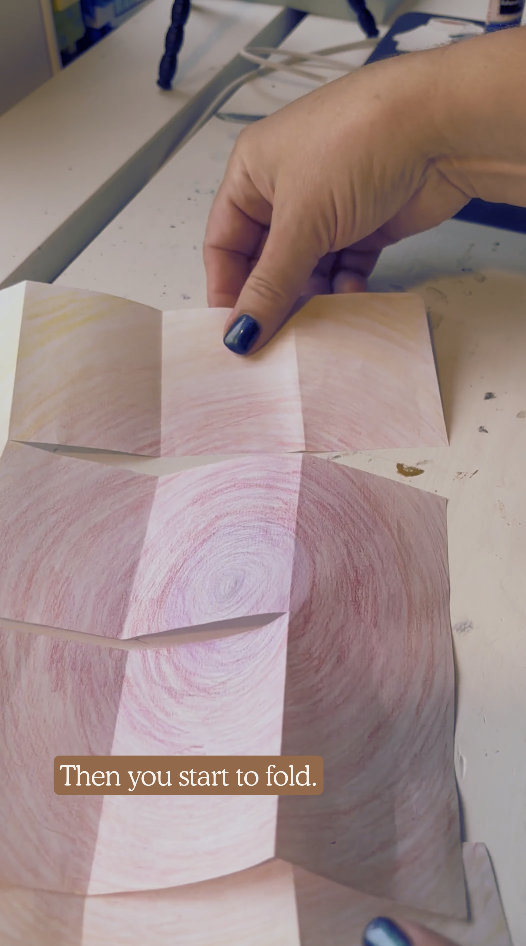
Now it's time to cut. Make three cuts, stopping before you cut all the way through the paper. When you're finished, you'll have one long strip.
Begin folding the strip back and forth, accordion-style, until it forms a tiny booklet. When you reach the last rectangle, I like to wrap it around to the front and glue it in place. It creates a simple little binding and helps the booklet stay together.
Now your tiny booklet is ready to fill. Think back to the truths that came to you while you were coloring and folding, and write one on each page. They might be reminders like I am loved, God is with me, I am not alone, or I am God's beloved. Decorate the pages if you'd like, I added a few tiny stickers I had on hand.
I love how this little booklet turned out. It's small enough to tuck into a pocket, purse, or journal, and I'm planning to keep mine nearby for those moments when I need to remember what is true.
Creative Retreat: July 16

My last creative retreat was such a lovely time, I couldn’t resist making the next retreat an in-person one, too. And I will even provide a simple craft for us to do together!
A friend of mine said “I love that I made something and it means something” and it hit me, that’s what I’m all about!!
Considering calling these short retreats “Prayercrafts”… thoughts?
So please let me know if you can make it (I promise to check all my DMs this time!!). 😅😘💕
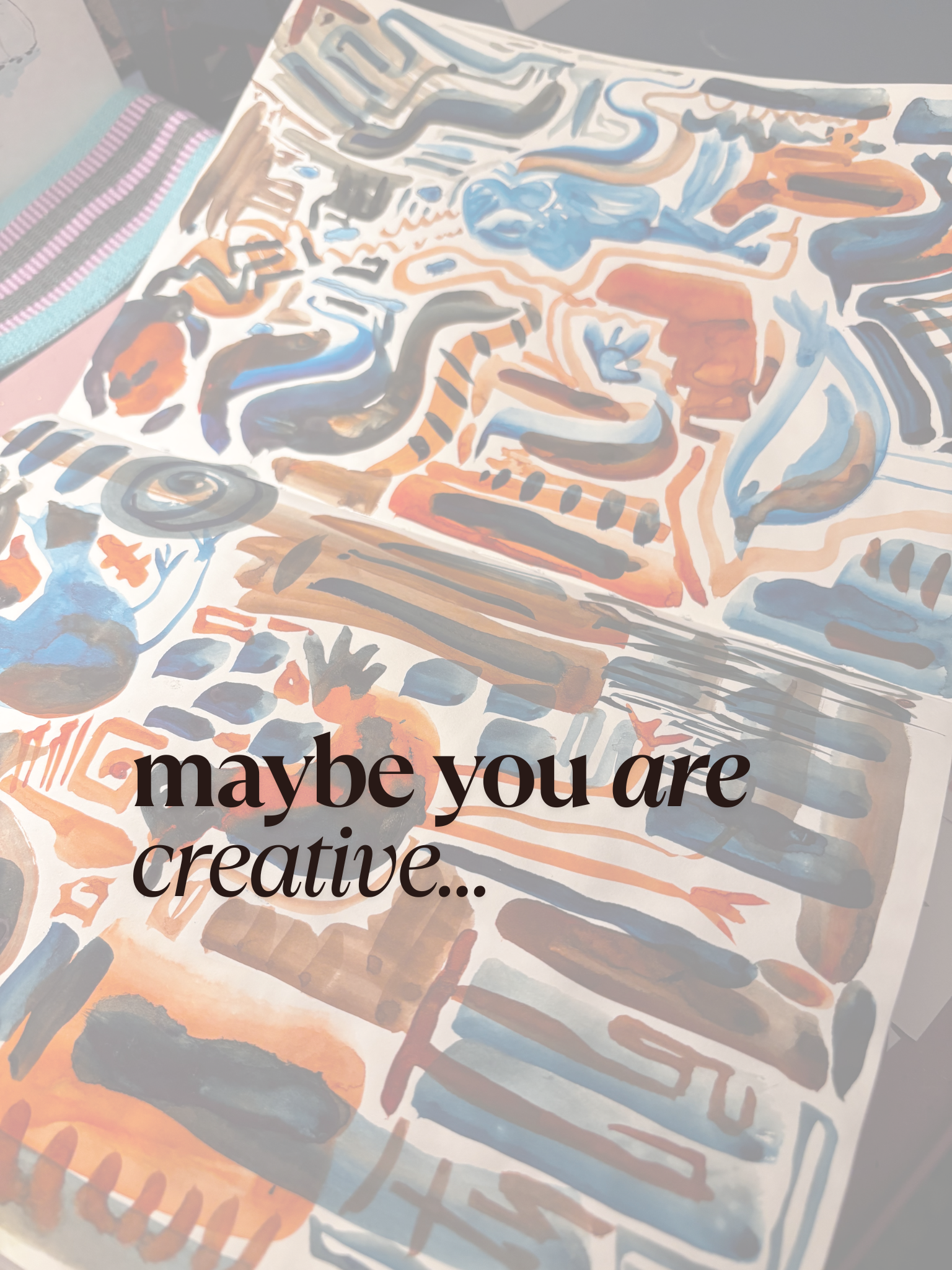
maybe you are creative…
Roughly every month, I share the story of someone who creates and plays as a way of joining God in His creative nature. Sometimes it's an artist. Sometimes it's someone making something with their hands. Other times it's someone finding joy in a hobby or simply paying attention to the world around them.
Then I usually ask people on Instagram how they create and play.
Or I'll share one of my watercolors or a craft I'm working on, and almost without fail, someone responds with the same sentence:
"I wish I were creative." Or some version of that sentiment.
Usually I tell them they probably mean they aren't artistic. Those aren't the same thing. Because truthfully, I believe everyone is creative in some way. (I also happen to think natural talent is a bit overrated. Most people simply become good at the things they enjoy doing and practice over time.)
So last month I decided it was time to introduce a new definition of creativity. Technically, creativity means having the ability to create. But what if we expanded our understanding of what it means to create? What if creativity wasn't only about producing art or making something beautiful? What if it was more about the way we engage with the world?
The more I've thought about it, the more I think creativity is a kind of call and response.
First, we receive.
We notice something that moves us, or a problem that needs solving, or an idea we can't stop thinking about.
Then we respond.
Maybe we paint it. Maybe we build something. Maybe we ask another question. Maybe we plant a garden, bake bread, learn calligraphy, or simply stop long enough to wonder.
Creativity begins with paying attention.
It starts by receiving the world as a gift and responding to it with curiosity, imagination, and care. That's why I don't think creativity is only for artists.
The more I've thought about it, the more I've landed on this definition:
Creativity is our response to God's world through noticing, wondering, exploring, and making.
When we define creativity this way, suddenly so many more people get to participate! Maybe that's what creativity has always been: not creating from nothing (that belongs to God alone) but responding to what He has already made. Maybe creativity isn't reserved for a gifted few. Maybe it's simply part of what it means to be human.
A Simple Examen
As you end your day, spend a few quiet minutes with Jesus.
Jesus, what did You invite me to notice today?
What filled me with wonder?
Where did I explore or discover something new?
How did I respond to the gifts You placed in front of me?
What did I make, build, or contribute today?
Where did I sense Your delight as I created or played?
What am I most grateful for today?
Perhaps you've been more creative than you realized.
The Tower of Pentecost

The godly play story for Pentecost has some powerful imagery. I used the story a couple weeks ago in Sunday school for 3 boys (it was a light Sunday), two boys age 8, one boy aged 12. The story starts with building blocks (this felt appropriate for 3 boys!) and as I was speaking, I was building a tower. But the tower is a bit precarious!
There was once a great tower. Everyone working on the tower spoke the same language and worked together. But as the tower grew taller and taller, they began to talk in different ways. The tower came close to God, but the people forgot why they were building it. They grew so proud of themselves that they began to think they were greater builders than God. Each group thought it was better than any of the others. They stopped working together.
At this point, I placed the final block. The tower wobbled for a moment and then crashed down with a loud clatter.
Soon the tower fell down, so it was called the “Tower of Babel.” The language of the people of the earth was shattered. It broke into splinters. Each one was beautiful, but it was broken.
The story goes on to talk about Jesus and his disciples and his last days on earth and then his ascension. At the end of the story, when we started to talk about the Holy Spirit coming, I decided to add something to the story! I thought it might be fun to show the tower being built again, only this time, the tower is completely stable. So while I spoke, I built it again:
They were so excited that people wondered what was going on. There were people there from many different countries. They spoke many different languages, but everyone could understand what they were saying. Everyone could see that the Twelve had come close to God—and God had come close to them—in a new way.
During that last sentence, I indicated the strong tower, the idea that God had redeemed Babel and through His Holy God made a new way for us to draw close to him and, through the Spirit, to one another.
At the end, when I asked about their favorite parts, one of the boys (who has spent the year telling me how much he doesn’t like godly play) (ok, it was my son) said:
I liked how the tower was unstable when the people tried to reach God in their own strength, but it was stable and strong when the Holy Spirit gave us a new way to be with God.
My friends, I was blown away, and not just because it was my kid! This is the power of story. If I had said to my son, “God gave us a way to meet with God that is so much better than anything we could do in our human strength” it would have had much less impact. My son didn't just repeat something I had told him. He made a connection for himself. The image of the tower stayed with him long enough for him to notice the contrast between Babel and Pentecost. He discovered the meaning rather than being handed an explanation.
Story gives us room to wonder. It lets us enter the mystery instead of rushing to explain it. Sometimes a falling tower can teach more than a hundred carefully chosen words.
So once again I think maybe this is what Jesus meant when he spoke about becoming like children. Children are often less interested in mastering a lesson than in entering it. They are willing to sit with a story, play with it, notice its patterns, and discover meaning for themselves, even a 12-year-old preteen!
As adults, we can be tempted to rush toward explanations. But the spiritual life often grows through attention rather than certainty. Perhaps this week, think about what story, image, or ordinary object might God be using to get your attention? And what might happen if, instead of trying to figure it out right away, you approached it with the curiosity of a child and simply wondered?
Creative Prompt: Draw a path of stones
Where does the path go?
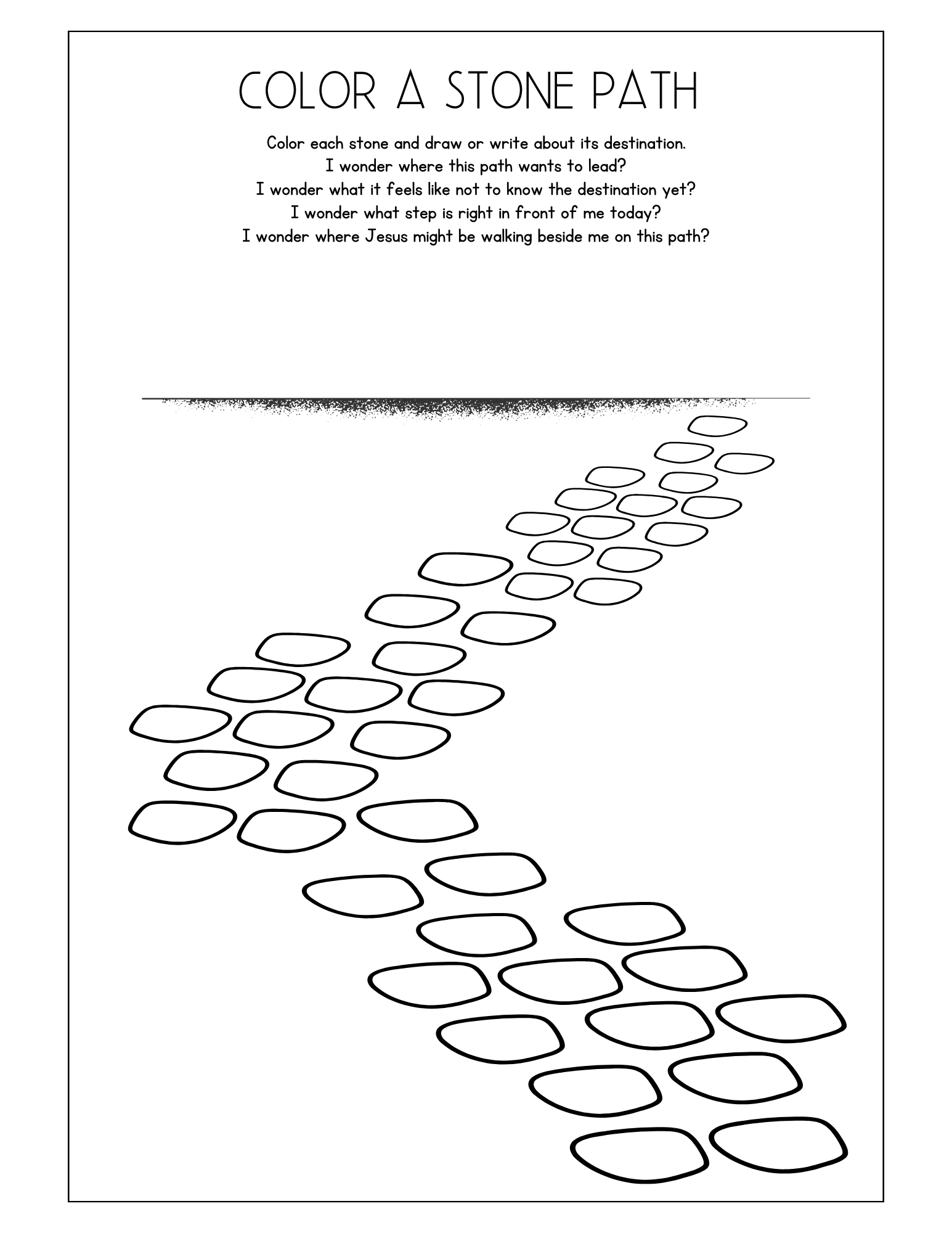
Most of us want to see the whole path before we begin but so much of life looks more like stepping stones than a paved road.
Draw, color, or paint a path of stepping stones (or use this coloring page) across your page and let the path travel somewhere. As you draw, hold this wondering:
Where does the path go?
Not necessarily where you think it should go, just notice what emerges.
After coloring, start adding details around the path. Does it have flowers? Grass between the stones? Are there trees along the way?
Wondering Questions
I wonder where this path wants to lead?
I wonder what it feels like not to know the destination yet?
I wonder what step is right in front of me today?
I wonder where Jesus might be walking beside me on this path?
A Kid-Friendly Version
Invite children to:
Draw a path of stepping stones.
Decide where it goes.
Maybe it leads to:
a castle
a treehouse
a dragon
a treasure chest
a giant ice cream cone
Wonder together:
Where does your path go?
What might you find along the way?
Who would you like to walk with you?
There are no wrong destinations.
When you finish your path, take a moment to look at it.
Notice: Does the destination matter most? Or do your eyes linger on the stones themselves?
What if Jesus isn't only waiting at the end of the path? What if He is present on every stone along the way?
If you feel comfortable, I’d love to see what you create. When I share these prompts, I’ll always try to share what I’ve made too. Tag me on Instagram or comment below with a photo or reflection.
How do you create + play? Interview with Audrey

This interview is a special one because today we get to hear from a teenager who is very special to me. She is someone who has taught me to create just for the fun of it, to play with different mediums, to take chances, and to keep going. I've never seen someone develop a style that is so distinctly her own and then continue to work at it, allowing it to grow and evolve while still remaining uniquely hers.
But beyond all of that, she reminds me of something I am often learning: children have much to teach us about how to play, create, and approach God.
As she shares about drawing favorite characters, trying new artistic mediums, and reconnecting with her inner child through watercolor, we are invited to consider how creating helps us notice who we are, what we love, and the ways God quietly meets us there.
What do you like to create? What brings you back to creating so often?
My favorite way to create is through drawing, especially drawing people, though I really enjoy drawing anything. I've spent years, from the time I was a little kid until now as a 15-year-old, developing my own unique style.
What usually brings me back to creating is a good character. Whether they're from a movie, book, video game, or TV show, I often become attached to a favorite character. The way I express my appreciation for that character is by drawing them.
What happens in you when you're creating? What do you notice, feel, or pay attention to?
When I'm creating, I notice that I feel content. I don't need to be anything more than I am in those moments. I can simply use the talent I have right now without feeling like I need to improve for myself or anyone else.
Do you ever create in a community? If so, what happens when you are creating with someone else?
I mostly create by myself as a way of expressing my thoughts, but I also take art classes at school. More than anything, those classes have helped bring me out of my comfort zone and encouraged me to try new mediums, subjects, and techniques.
Has creating ever helped you slow down, notice beauty, or connect with something bigger than yourself?
I think creating helps me connect with my innermost self more than anything else. My drawings are some of the rawest expressions of who I am. They show my interests, the things I love, and even things I sometimes struggle to understand or control.
One of my favorite parts of creating is connecting with my inner child. When I watercolor, I often feel like a little kid again, simply trying to make a beautiful picture with hands that may not have practiced enough. There's something freeing about that.
If you can imagine Jesus sitting with you while you create, what do you think he is doing, saying, or thinking?
I don't think Jesus necessarily says anything when He's with me. Instead, I think He uses my art to reveal deeper meanings and show me different parts of His grace and beauty.
I also think He's the source of that feeling of contentment I mentioned earlier. He helps me know that I don't need to be anything else in those moments. I can simply be myself.
Creative and generous God, thank you for planting your creativity in us, so that when we create we can feel closer to you and your delight in us. Bless Audrey, that every time she creates just for love of creating, she would feel your delight in her. May the people who receive her beautiful gifts, feel not only her love, but yours as well. Help her to feel your delight in her as she creates.


Creative Prompt: Paint Balloons
Write tiny joyful moments inside each one.
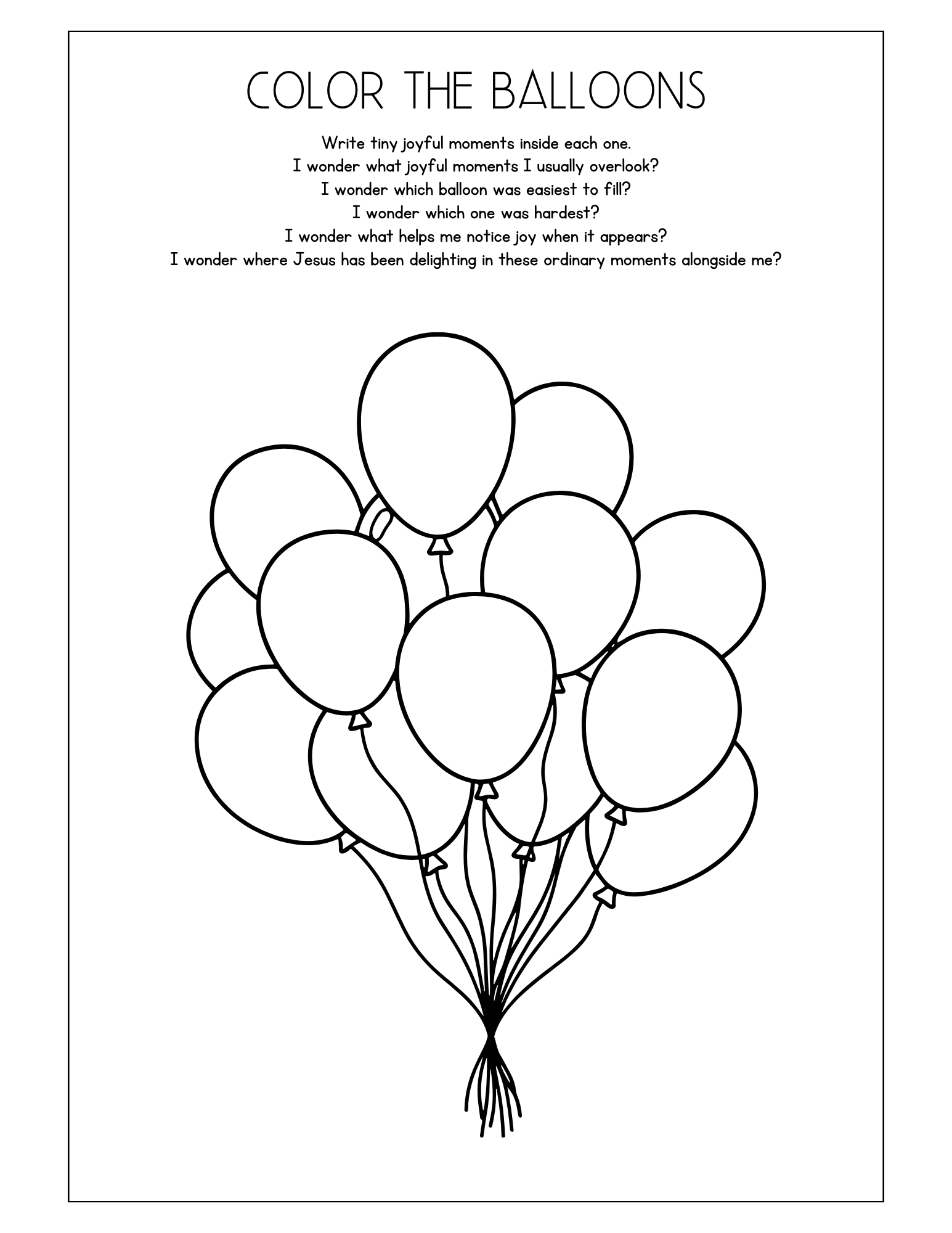
Today's creative practice is an invitation to notice them all the tiny moments of joy through an ordinary day.
Paint or color a page full of balloons or use this coloring page. As each balloon takes shape, write a tiny joyful moment inside it.
You might fill your balloons with things like:
hearing birds outside your window
fresh sheets
a good conversation
finding something you thought was lost
sunlight on the floor
finishing a project
a favorite song
a moment of quiet
Let each balloon become a small celebration.
Wondering Questions
I wonder what joyful moments I usually overlook?
I wonder which balloon was easiest to fill?
I wonder which one was hardest?
I wonder what helps me notice joy when it appears?
I wonder where Jesus has been delighting in these ordinary moments alongside me?
A Kid-Friendly Version
Invite children to paint or draw lots of balloons.
Inside each balloon, help them:
write something fun they did
draw something they love
add a favorite memory from the week
Wonder together:
What made you smile recently?
Which balloon would float the highest?
What is one small thing that made today better?
There's no wrong answer.
A Closing Invitation
When your balloons are finished, step back and look at the whole page, a collection of ordinary joys. As you look at your balloons, you might carry this wondering with you:
I wonder what joy Jesus is inviting me to notice today?
And perhaps that noticing is its own kind of celebration.
Attention, Surrender, and the Life we Have

I worry that by using the term “make space” I’m portraying a false idea that the way to the abundant life with God is to somehow just carve out time for ourselves and for God during the day. Yes, I do encourage setting aside time to be creative and to play so that hopefully, bit by bit, our perspectives shift to begin to see the abundance that was already there.
But abundance is not something we can simply carve out time for. That is an exhausting and unfulfilling road. This month I wanted to say “make space for abundance,” but that’s wrong. We don’t make space for abundance. The abundance is already a given. God has already filled our lives with His presence, goodness, beauty, and love. What we do every month is make space to notice that abundance by recognizing beauty, practicing hospitality, releasing certain expectations, and so many more things that I’ve talked about on here.
I can give you tips and tricks and creative prompts and prayers and examens, and all of that, added up over a long period of time, might help us slowly shift our attention. But none of those things create abundance. At their best, they help us notice what God is already doing and receive what He is already giving.
God has promised us an abundant life, but so often we wonder where it is. We continue to strive and strive and wonder why God has let us down. Our attention is so focused on our to-do lists, our plans, our worries, and all the things we think we need to accomplish that it is no longer focused on God and how He might actually want us to live.
Where we place our attention matters. Are we paying attention to God’s abundance? Can we stop wherever we are, in whatever we are doing, and notice God’s abundance all around us?
If it were as simple as deciding to pay attention, we would probably all be doing it already. Most of us know what it feels like to catch glimpses of God's abundance one moment and then lose sight of it the next. We know what it is like to want to notice more deeply and yet find ourselves distracted, anxious, striving, or simply asleep to what God is doing.
So what can we do to be able to really, really notice?
And that right there is the problem.
There is nothing we can do to manufacture it, because it is the work of the Holy Spirit in our lives. It is grace from beginning to end. Even our ability to notice is a gift. Not to say the practices are meaningless, but they are not the source. In our humanness, we think it would be easier to just do a few creative prompts and suddenly become aware of the abundance all around us. We want a formula, a checklist, or something we can control.
But the only way to even notice the abundant life of God is path of surrender. It feels hard because surrender always does. It requires us to let go of our striving, our plans, and the illusion that we can somehow create the life we are longing for. Maybe before we ask whether we can notice God’s abundance, we have to ask something simpler: can we receive the life we actually have right now, without resisting it or wishing it were different? And from that place, can we begin to notice God’s abundance already here, in the very life we are living?
When we do surrender, our attention slowly begins to shift. This is where those good spiritual practices come in. We begin to make space in new ways, and over time we find ourselves noticing God’s abundance where we couldn’t see it before. Life may not have changed, but our eyes are more open to His presence, goodness, beauty, and love.
So try the creative prompts. Carve out time for attention and reflection with God. But hold them gently, not as a formula or something that you can fail and will bring shame, and not as something that will force clarity. They are simply ways of making space to receive what is already being given.