
How do you create + play? Interview with Florie
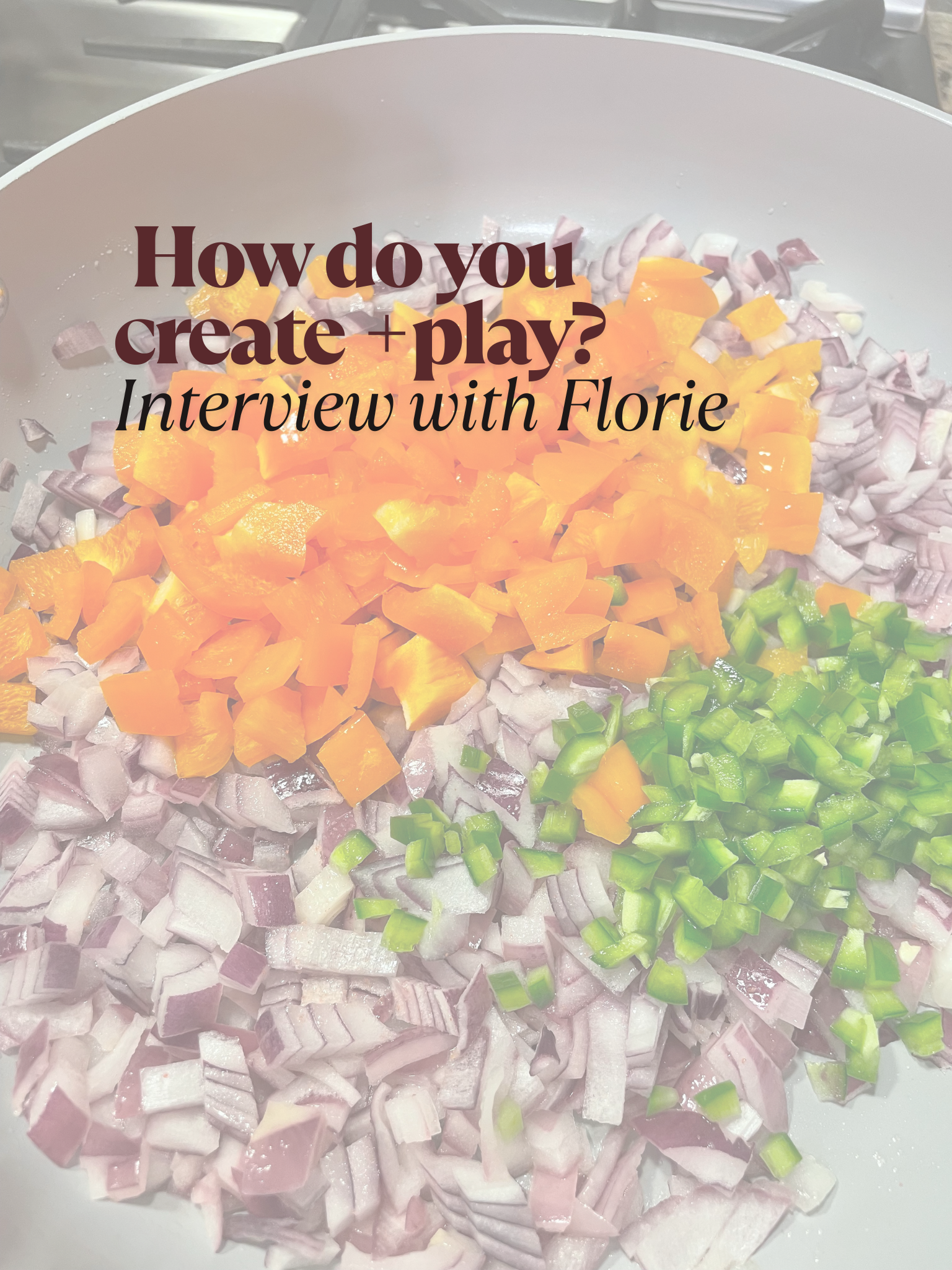
Creativity doesn’t always look like paint or paper. Sometimes it looks like a cutting board, a pot simmering on the stove, and hands moving slowly and attentively through familiar motions.
For this interview, I heard from someone whose creative practice is rooted in the kitchen, a place shaped by memory, hospitality, nourishment, and love. What began in childhood as helping with simple meals has become a way of caring for bodies and spirits, cultivating connection, and paying attention to the beauty woven into everyday ingredients.
Her reflections remind us that creating can be practical and sacred at the same time. That slowing down matters. That rhythm, care, and presence can transform ordinary tasks into acts of love. And that sometimes the most meaningful creative spaces are the ones we return to every single day.
What first drew you to cooking and what keeps you coming back to it now?
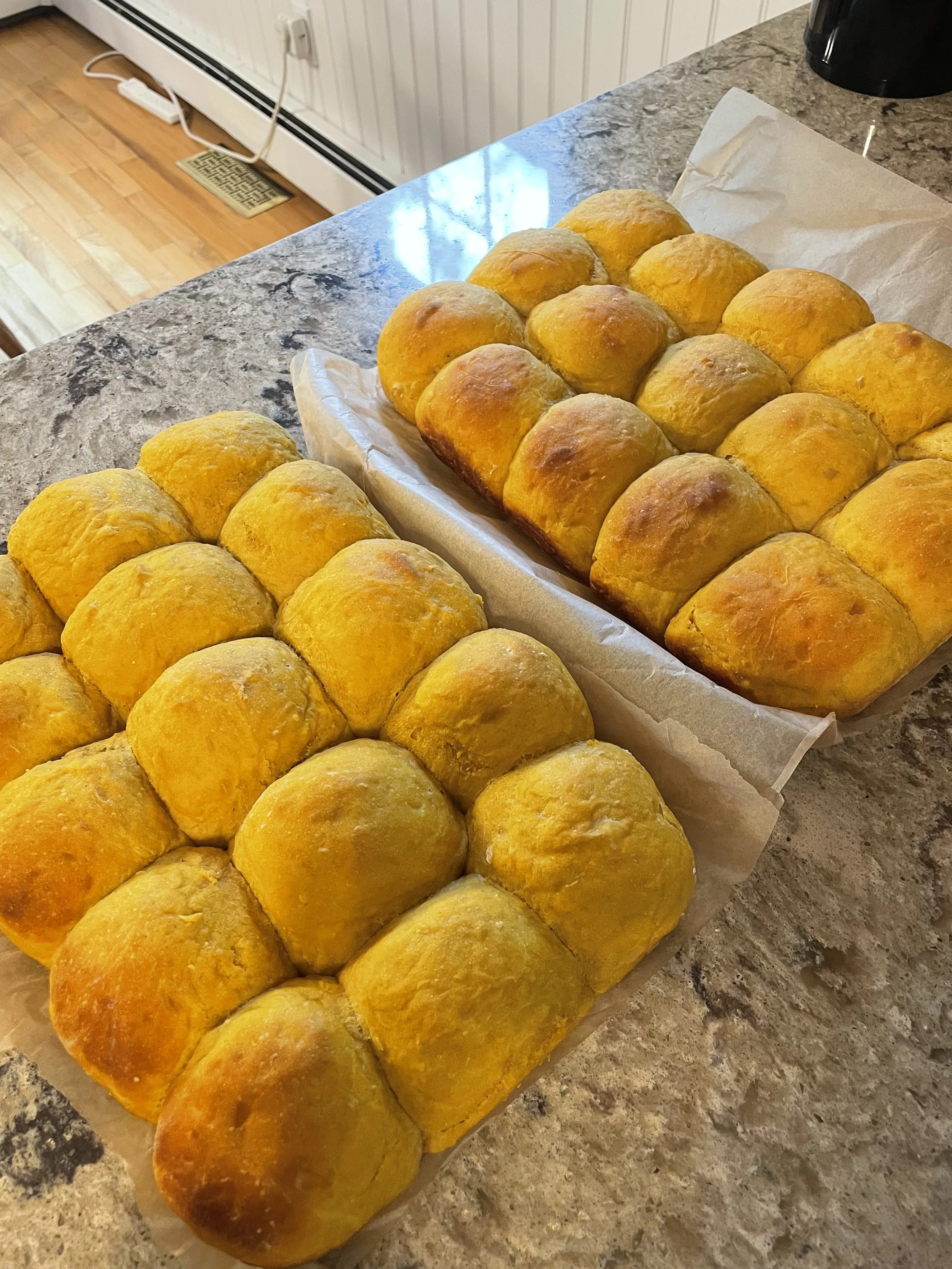
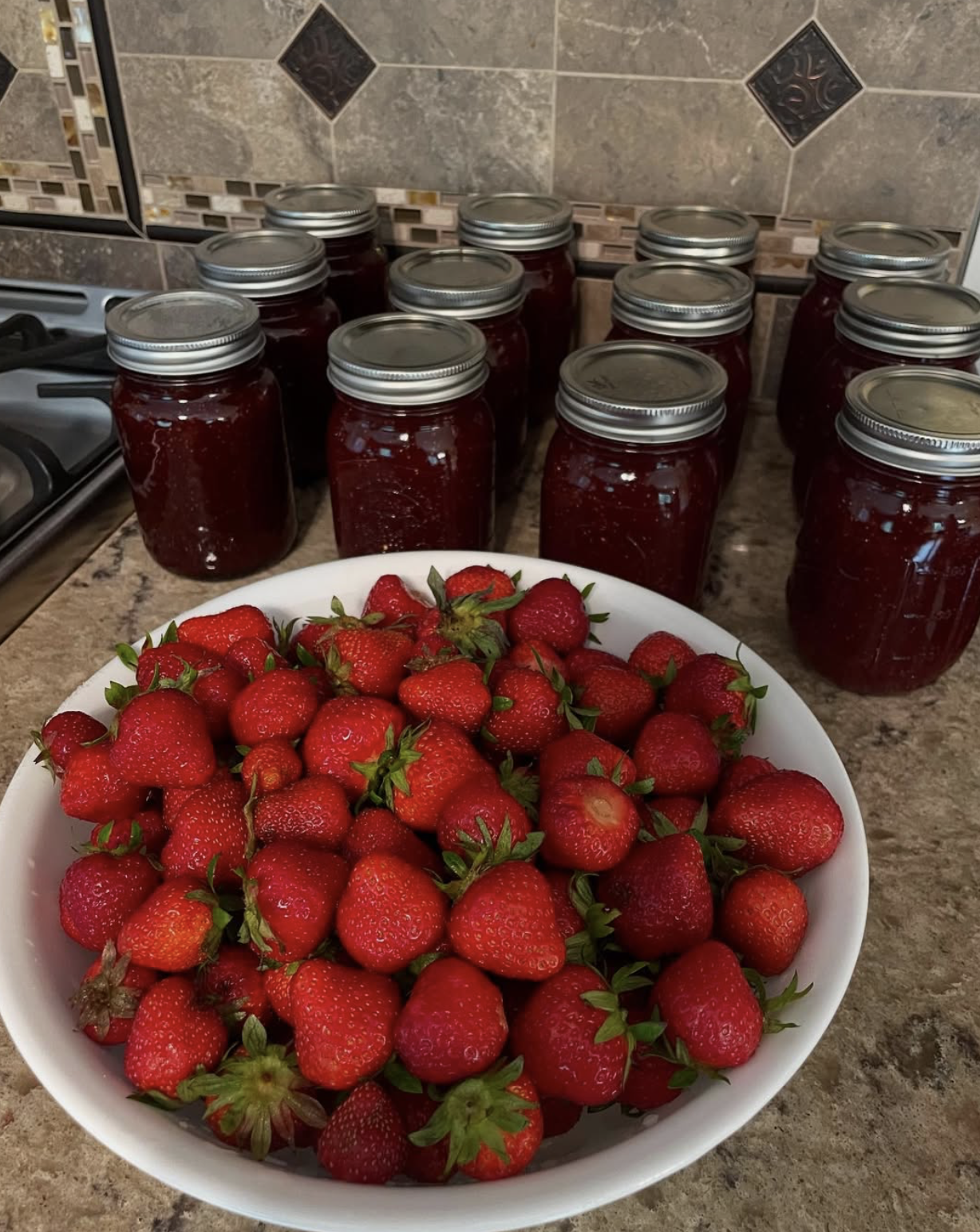
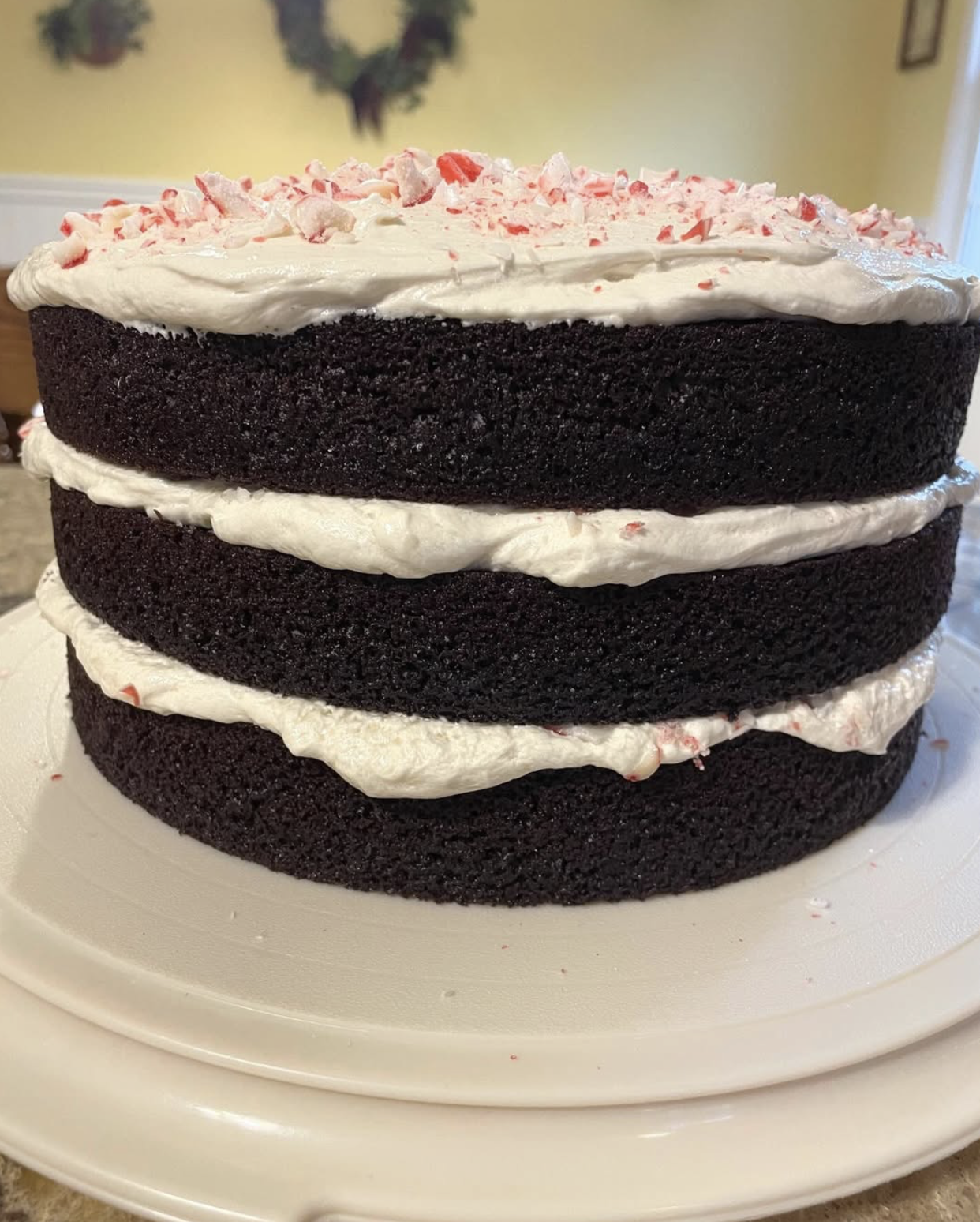
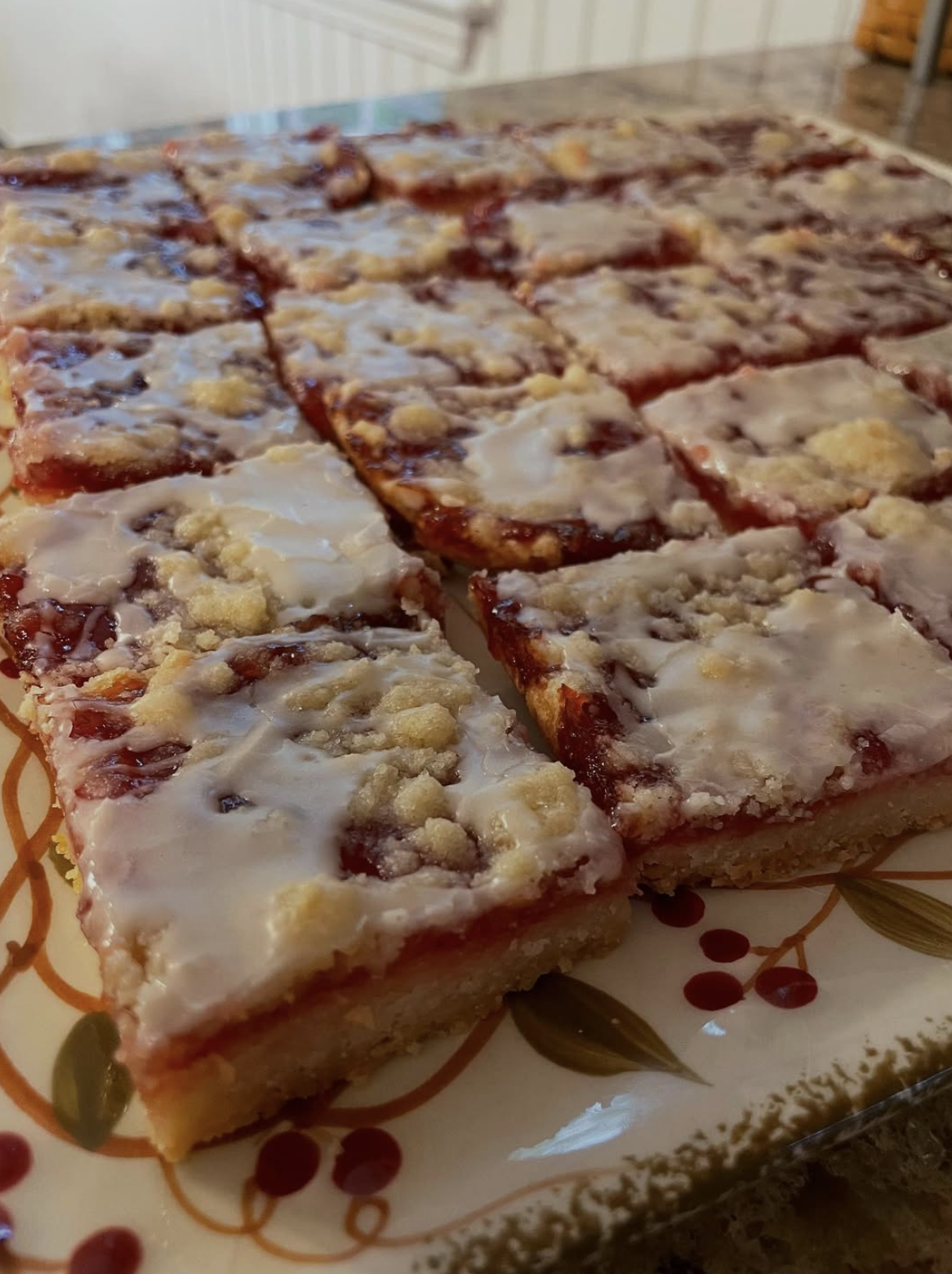
All seven of the children in my family learned to cook alongside our mother. I don’t remember a time when I wasn’t peeling potatoes or stirring a pot of sauce on the stove. Recipes were basic because finances were quite limited, but there was always enough to share, and friends were commonly found along with the family around our large kitchen table. This instilled a sense of cooking as a way to show love and foster community. That is still what draws me now, along with the belief that I am nurturing both the spirits and the bodies of my family and loved ones as I prepare healthful and beautiful food for them.
What happens in you when you’re cooking? What do you notice, feel, or pay attention to?
I enjoy every aspect of preparing a meal, which starts with my weekly planning. I usually try to make at least one or two new recipes each week, and often make foods from different cultures. I ask each family member if they have one request for the week and incorporate that into my menu. While I’m planning I make my shopping list and then do my weekly grocery shopping where I try to get the freshest and healthiest produce I can find.
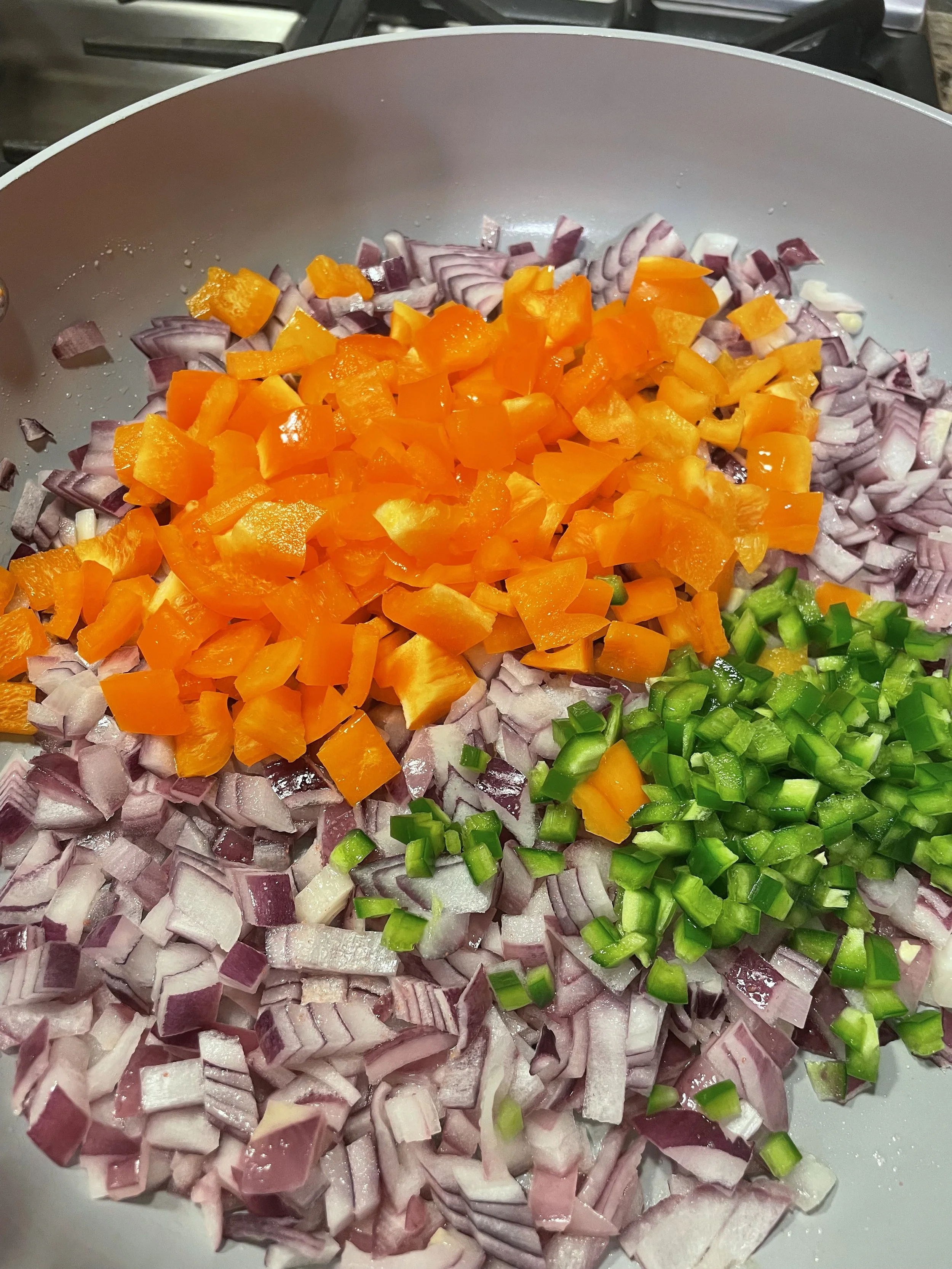
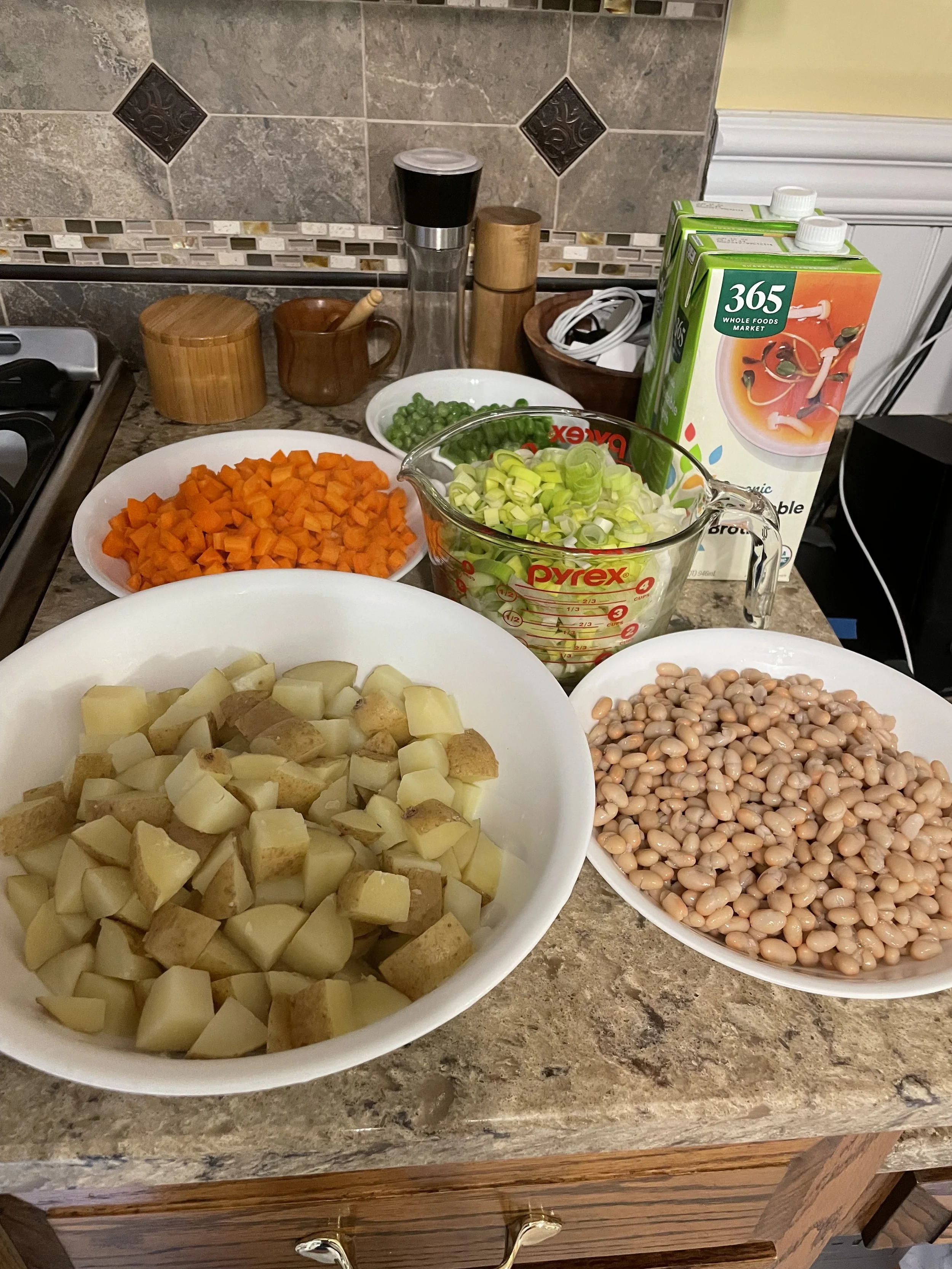
Dinner preparation is a peaceful time for me. I try to leave myself plenty of time so nothing is rushed. I prep all my ingredients in advance, and since we are fully plant-based and eat a lot of fresh produce, that is often the bulk of the cooking process. I love the fresh smells, the different colors and textures of the vegetables, and knowing that the phytochemicals that cause the beauty in them are the very ingredients that will nurture the bodies of those I love most.
I pay attention to the balance of the flavors and textures. A little fresh lime juice squeezed in at the end of the cooking time adds brightness, a little cilantro sprinkled on top of the bowl gives a fresh bite, beauty and added health benefits as do some toasted sesame seeds for textural contrast. The beauty is delicious and that makes me smile. We eat with our eyes first and I try to be conscious of that part as well.
You sometimes cook with your family members. What do you think happens when people create things side by side?
I love cooking alongside my children. My son Jacob is particularly interested in cooking and we work together well. There is a rhythm we fall into where we are making something delicious and nurturing together, and sharing conversation that nurtures our relationship. There is a shared sense of purpose while we work and the product is more pleasing and satisfying from the joint effort.
Has cooking ever helped you slow down, notice beauty, or connect with something bigger than yourself?
Almost always. If I’m rushed I am likely to cut or burn myself or the meal will suffer, so I have trained myself to slow down. I notice the beauty in the ingredients and the smells and textures and colors as they start to cook and change. I am mindful of the plants as created uniquely by God to feed and nurture our bodies and there is an air of reverence to the process. In a very real way my kitchen is the most sacred space in my home.
If you can imagine Jesus standing with you while you cook, what do you think he is doing/saying/thinking?
I often feel His presence as I’m cooking. I think He is pleased with the stewardship of my family’s health. I think he would say as my son often does when he walks in the kitchen, “It smells amazing in here.” I think He is pleased with the gift of love I am offering to my family and loved ones.
What would you say to someone who wishes they could create like that, but doesn’t know where to start?
Start simple. In the early years of my marriage I had a subscription to “Cooking Light” magazine. (My dad had his first heart attack when I was a freshman in college and Dan and I have always tried to eat in a way that protected our health.) I learned SO much from reading those issues for years and years and just trying recipes. The cultures of the world have incredible flavors and spices and smells to open your heart and mind and palate. Try new things. Don’t be afraid to “fail” and create a product that isn’t your favorite. Each recipe you try is a learning experience that prepares you for the next and then the next. Also, plants are amazing. Go to a farm or farmers’ market and try the weird looking alien purple vegetable you’ve never seen before. Embrace the full breadth of God’s creation because there is so much to enjoy. It’s nurturing and beautiful and your body and your spirit will thank you. Your family might, too.
Creative and generous God, thank you for planting your creativity in us, so that when we create we can feel closer to you and your delight in us. Bless Florie while she is in her kitchen. Renew her senses everyday to enjoy the smells, colors, textures, and tastes of the multitudes of different foods that you have provided. May every dish she makes be an act of worship, a sweet offering to you, Lord. Thank you for her example as she participates in your abundance. May your love and peace meet her, her family, and every guest around her table.



Do we have enough time to make space?
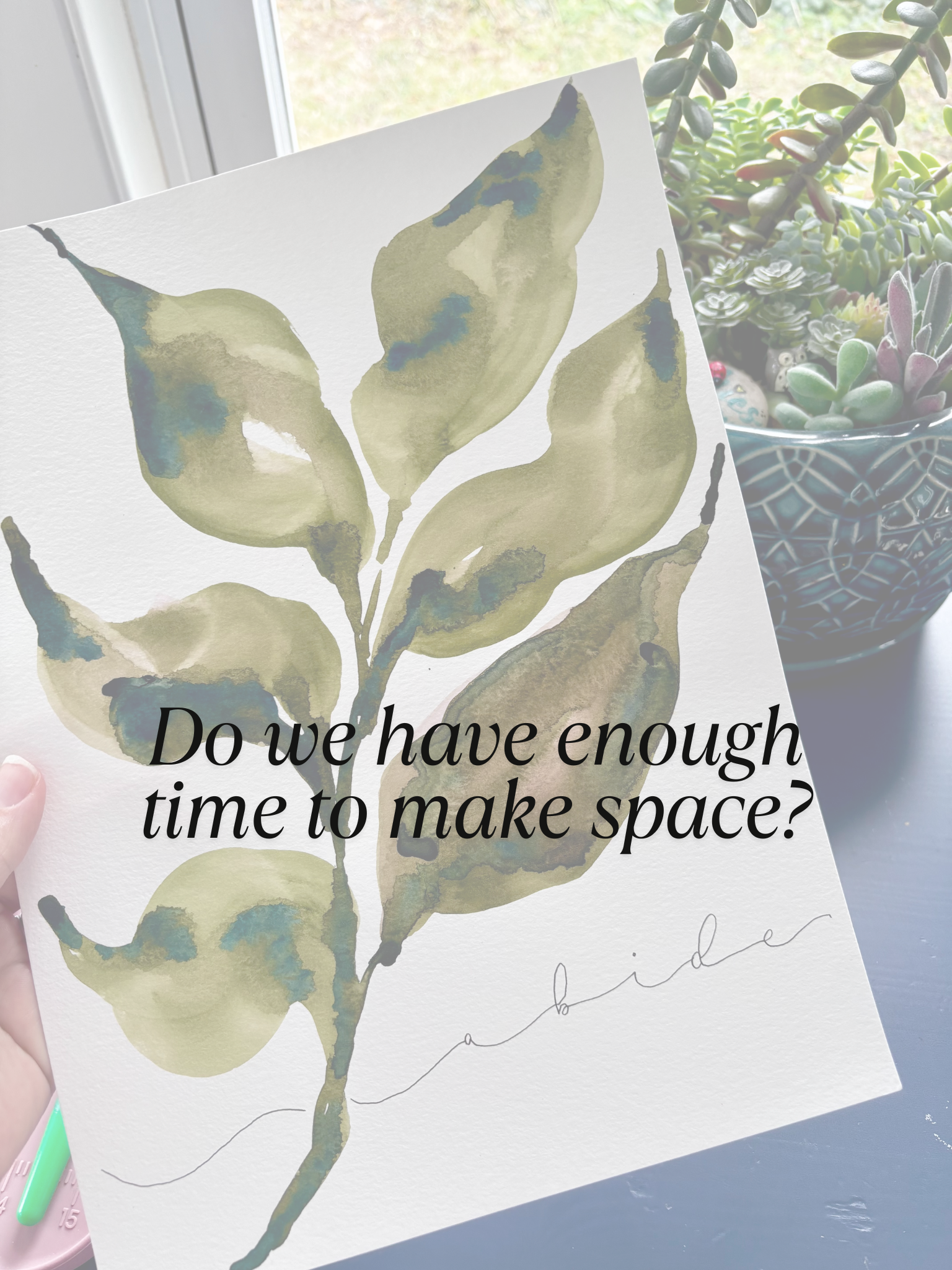
Sometimes when we talk about “making space,” it can sound unrealistic. We picture long stretches of quiet, a retreat center, or a life with far fewer responsibilities. Many of us wonder, Is it really true that I already have enough time to make space for myself and for God?
Surprisingly, yes. And here’s why.
1. God’s economy works differently than ours.
Scripture is full of stories where God provides abundantly from what looks like almost nothing:
A few loaves and fish feed thousands.
A widow’s tiny jar of oil never runs out.
Manna appears every morning in the wilderness.
These stories aren’t just about food. They’re about reality in God’s Kingdom: He is not limited by our limits. In His presence, scarcity gives way to abundance. If God is with you (and He is), then you already carry enough for this moment.
2. Making space isn’t about having ideal conditions.
Most of us imagine we need perfect quiet, a tidy house, or a cleared schedule before we can be still. But making space rarely comes in perfect packages. It often looks like:
Pausing for one slow, grounding breath
Speaking a short prayer in the middle of errands
Sitting with a cup of tea without scrolling
Doing something creative simply because it brings joy
Stepping outside for two minutes to notice the sky
Asking for spiritual direction
Turning your phone off for a short window
None of those require extra resources, only intention.
3. It’s true that it won’t feel productive.
We are so conditioned to measure our worth by what we produce that stillness feels uncomfortable, inefficient, or even pointless. But being with God is not meant to be productive; it’s meant to be formative. Over time, those quiet moments soften our hearts, steady our minds, and reshape how we move through the world.
4. Making space actually stretches time.
This is something people discover again and again: when we slow down, time feels different. There’s even neuroscience behind this: mindfulness and contemplative practices literally change the brain’s perception of time.
So yes, even a few intentional breaths can expand the space within us.
The truth is, making space isn’t about finding more time. It’s about learning to trust that God is already here, already offering enough for this moment.
You don’t have to wait for a perfect day. You don’t have to earn rest or stillness. You can begin right now, with whatever you have.
Ins and Outs for 2026

I love this trend that replaces the same old boring (and unachievable) resolutions with an “In and Out” list for the year. So after some reflection, here is mine:
In
Making space
Speaking the truth
Rest
Creating to play
Crying
Reading children’s books as spiritual direction
Pausing before saying yes
Humility
Side quests
Slowness
Delight
Out
equating busyness with self-worth
People pleasing
Phone time
Creating to perform
Holding back tears
Unnecessary urgency
Comparing myself to others
Desiring the praise and credit
Rushing the ending
Taking myself too seriously
What is on your ins and outs list?
Making Space might mean Releasing
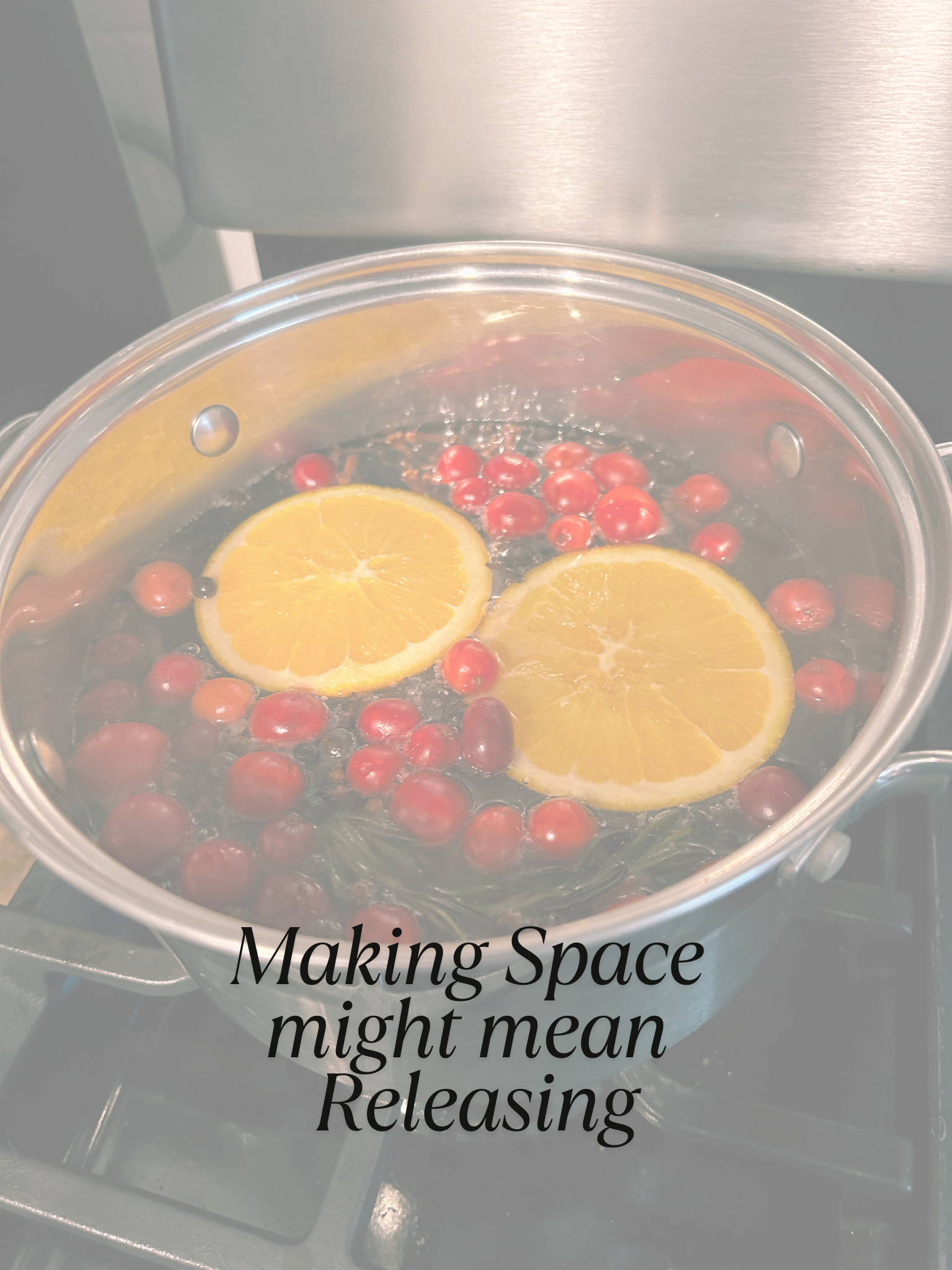
It’s the beginning of the month, and we return again to the idea of making space. It sounds simple, even inviting, but it is rarely actually easy. Making space isn’t just about clearing our calendars or carving out a quiet moment. Sometimes it asks something more costly: to loosen our grip, to release expectations, to lay down ways of being that once felt necessary but no longer give us room to breathe. Before we can experience deeper intimacy with God, we may need His help to notice what we’re still holding and what He is inviting us to lay down.
I had a humorous experience in spiritual direction last month that brought this home for me. As I was reflecting on releasing expectations I carry for myself, I remembered a time when God was gently showing me I didn’t need to do something. I was deep into Christmas pageant planning when it occurred to me that I should make cute programs to hand out before the show. I immediately sensed that this was an extra task I didn’t need to take on, but I resisted and made them anyway. They took about two hours to design, print, and cut. Pageant day came and went, and I had completely forgotten about them. Not a single person saw one or took one home as a memento. When I remembered this, I laughed out loud.
It’s a funny example, but it revealed something deeper in me. Even though I’ve grown in many ways, I’m still sometimes trying to prove myself. In making those programs, I wanted people to see that I was capable. This is where it gets tricky, because they would have been a sweet extra for the day, a meaningful keepsake for the kids. I wasn’t wrong to want to make something beautiful. But this is where discernment matters, because God sometimes invites us to stop, not because the thing is wrong, but because it isn’t required.
The issue wasn’t the action; it was the attachment. Releasing is hard work. It often takes more than one gentle prompting from the Spirit.
Here are some common examples of what we might need to release in order to make space for God, for ourselves, and for others:
Releasing expectations we place on ourselves
Releasing real or imagined expectations others place on us that are unfair
Releasing control and the need to manage outcomes
Releasing urgency, the sense that everything is pressing and must be decided now
Releasing certainty by loosening our grip on having the right answer, the right words, or a neatly wrapped theology
Releasing comparison (this one hits deep)
Releasing noise, both internal and external
Releasing the belief that productivity equals worth, or that there is an “ideal version” of ourselves we could reach if we just tried harder
Releasing our hold on self-protection, lowering the guard just enough to be honest with God, with ourselves, and with trusted others; letting tenderness exist without immediately armoring it
As we begin this month, perhaps making space doesn’t require a dramatic shift or a perfectly named practice. Maybe it begins with noticing, not just what we’re doing, but how tightly we’re holding it. The invitation may not be to stop doing good or beautiful things, but to release the attachments that weigh them down. We don’t have to loosen our grip all at once. We can open our hands just a little, trusting that God is patient and kind, and that the space created, however small, is enough for Him to meet us there.
A Simple End-of-Year Examen

A few years ago, I participated in an end-of-year online retreat that was essentially an examen, a guided time to look back over the year with God. We were invited to notice where the year held joy and grief, where we felt God’s presence, where we felt His absence, and then to gently turn our attention toward the year ahead by naming our hopes.
It was a simple, two-hour retreat, hosted by Tamara Murphy. And yet, I have never forgotten it.
I remember being genuinely surprised by what the Lord brought to mind during that time. Moments I might have dismissed as small rose up with meaning. Threads I hadn’t noticed before became visible. God felt near, not because the year had been easy, but because I was finally slowing down enough to see.
I don’t usually make New Year’s resolutions. I resist the idea that one day is more important than another, or that change must wait until January 1 (or the start of a month, or a Monday!). That belief runs deep in our culture and honestly, I still fall for it sometimes.
But I want to keep practicing this truth:
Every day is sacred. Every day is a chance to begin again.
In that sense, an examen doesn’t belong only at the end of the year. I can do a short examen each evening, looking back over the day, noticing where I felt God’s presence or resistance, gratitude or sorrow. This daily practice reminds me that God is already here, already at work.
And still… there is something uniquely powerful about doing an examen over a longer stretch of time.
Looking back over months instead of moments helps us notice patterns. It gives us space to reflect on what lingered, what surprised us, what kept returning. It allows gratitude to deepen and naming to become more honest. Often, it shows us that God was present in places we didn’t recognize at the time.
While a year-end examen can be done at any natural boundary, a school year, an anniversary, a season of life, the end of the calendar year often offers a gentle and natural pause to look back and look ahead, held together by prayer.
A Simple Year-End Examen
You don’t need a lot of time or special words. Just a willingness to be honest and attentive, and to trust that God meets us there.
1. Become aware of God’s presence.
Begin by settling in. Take a few slow breaths. Ask the Holy Spirit to guide your remembering, to bring to mind what God wants you to notice, not just what feels loud or obvious. Rest in the truth that God is already with you.
2. Review the year with gratitude.
Slowly walk back through the year. You might move month by month, season by season, or simply notice what rises to the surface.
Where did you experience joy, delight, or connection?
Where did you feel God’s nearness in moments of grief, loss, or lament?
Even if the year felt heavy, ask gently: What gifts were present, even here?
3. Notice moments of absence or resistance.
Where did God feel distant? Where did you feel numb, rushed, or closed off? This isn’t about blame, it’s about honesty. God can meet us even in what feels unresolved.
4. Watch for patterns.
As you reflect, notice what repeats. Is there a theme that emerges, a longing, a fear, an invitation, a place of growth or fatigue? Choose one pattern and bring it to prayer. Ask God what He might be showing you through it.
5. Look toward the year ahead.
Finally, turn your gaze forward. What hopes do you carry into the coming year? What do you desire, not just to do, but to receive? Hold these hopes lightly before God, trusting that the One who was faithful in the past will meet you again in what’s to come.
An examen doesn’t give us tidy answers. But it does give us something better: awareness, gratitude, honesty, and hope. It helps us remember that God has been with us all along and that He is already waiting for us in the days ahead.
Fostering Spaces of Wonder
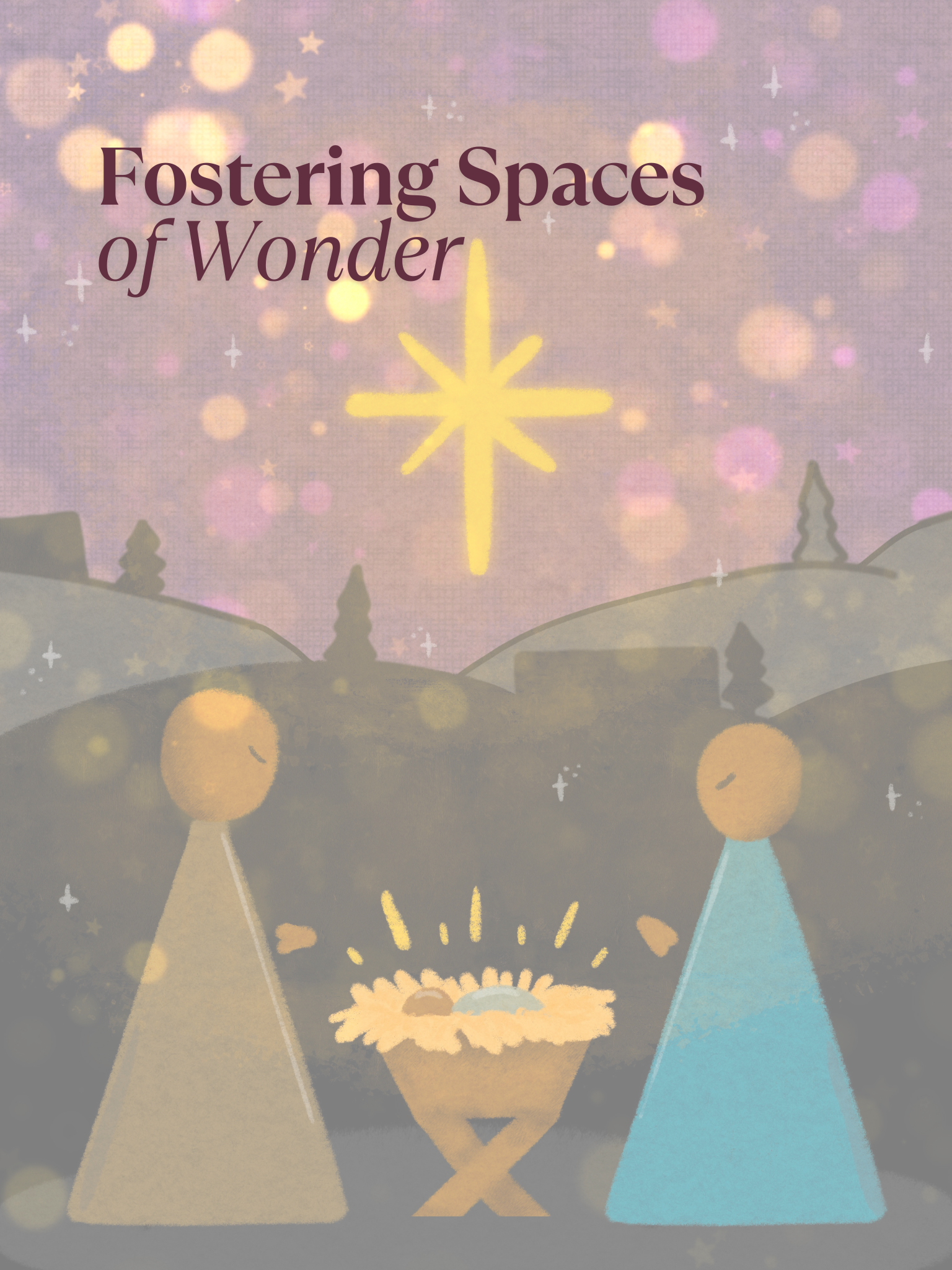
I’ve been thinking a lot about wonder lately and how to foster it in every day spaces. As I’ve been holding these questions during Christmas, I found myself returning again and again to Mary. And only just now did I realize: Mary shows us how to foster spaces of wonder.
When Scripture tells us that Mary “pondered these things in her heart,” it’s describing exactly what I mean by wonder. She doesn’t rush to explain or resolve what’s happening. She makes room. She holds the mystery gently. She takes a quiet step of trust without demanding clarity.
To foster spaces of wonder is simply this: to make room.
This is what I mean when I talk about contemplative play. Yes, it includes time to create, imagine, and play but it goes a step further. It invites us into wonder by slowing down enough to notice what’s stirring within us, by asking gentle questions, by imagining what God might be inviting us into beneath the surface.
Contemplative play is not about producing something meaningful; it’s about being present to what is already unfolding. It’s choosing attentiveness over efficiency, curiosity over certainty. In that way, it becomes a spiritual practice, one Mary models so beautifully for us.
I suspect I’ll keep returning to this theme in the coming months, because I’m increasingly convinced that wonder itself is a spiritual discipline, one that our modern day faith desperately needs. But for now, I want to leave you with a few simple ways to begin fostering these kinds of spaces in ordinary, everyday life.
Simple ways to foster wonder in everyday life
Slow the pace. Leave margin in your day to linger, notice, and pause instead of rushing to the next thing.
Practice not-knowing. Replace quick answers with wondering questions: What do I notice? What surprises me?
Lower the stakes. Engage in activities that can’t be done “right”, like free drawing, playful movement, and contemplative or imaginative prayer.
Use your senses. Light a candle, touch natural materials, listen closely, breathe deeply.
Welcome silence. Even brief moments of quiet create space for God to speak beyond words.
Pay attention to small beauty. A patch of light, a child’s question, a line of poetry, a moment of peace.
Model curiosity. Say your own wonder aloud, about God, Scripture, people, and the world. Even better, be curious together in a group.
Like Mary, we may not always understand what God is doing. But when we make space to ponder, to wonder, to stay open, we create room for faith to grow.
What Is God Inviting Me to Notice?
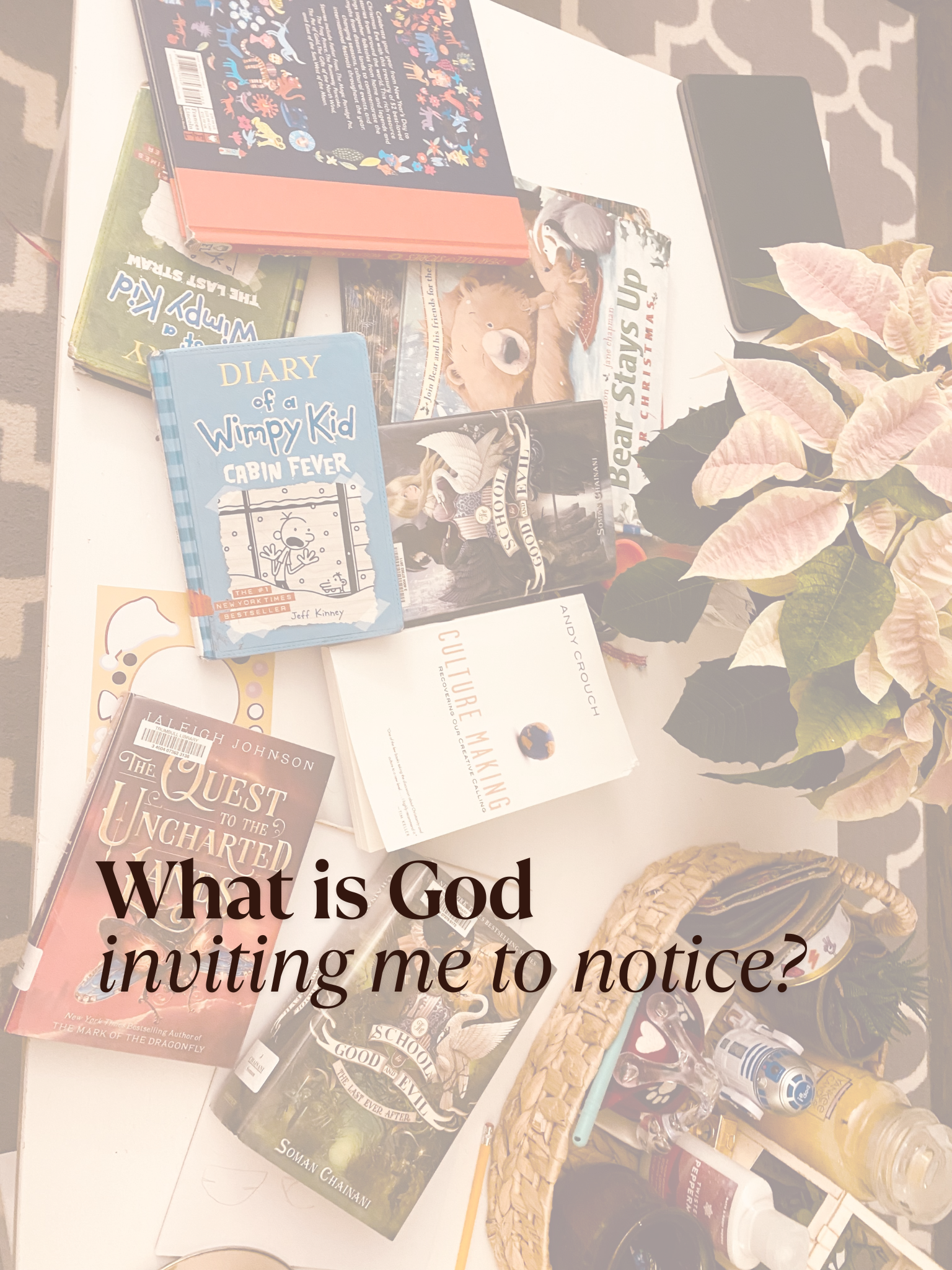
During my training in spiritual direction, we practiced a lot of directing. Often it looked very simple: meeting in groups of two or three for as little as five minutes. One person would share, one would listen as the director, and sometimes a third would simply hold the space.
We were given a simple instruction each time: share something real, even if it’s small.
Over the course of the two-year program, I probably participated in an exercise like this twenty times or more. And every single time, God showed up.
Nothing flashy was happening. We were just practicing listening to one another and to God. But it was real. Consistently, unmistakably real.
That may be the biggest thing I took away from my training: with even a small amount of intentionality, we can meet with God. Not because we are especially skilled or holy, but because God is already there, waiting for us, pursuing us, and loving us.
This is why I talk so much about contemplative play.
When we make space for rest and play, and then take one small step further by bringing intention into it, we create room to hear from God. These practices don’t have to be heavy or complicated. They can be gentle, playful, and embodied. Sometimes they are easier with others, which is why I believe so deeply in spiritual direction and shared practices of noticing. But they can also be woven into ordinary moments of daily life.
This is also why I’ve shifted the way I do book reviews and now call them Sacred Story Time.
For years, I reviewed children’s books because I wanted to help adults and children learn to see Jesus in their everyday lives, in their work, their play, and their rest. Children’s books are a surprisingly accessible doorway into that kind of noticing, even when the books themselves aren’t explicitly Christian. Stories train our attention. They soften us. They help us practice seeing meaning, beauty, and presence everywhere.
Going forward, my book reviews will always include playful, contemplative prompts. I may even revisit some reviews from the past through this lens. But you don’t need a specific book, or even a book at all, to begin.
You can start right where you are. With the story you’re reading. The game you’re playing. The moment you’re living.
Simply ask:
What is God inviting me to notice here?
God is trustworthy. Attention does not change God; it changes us. As we practice noticing through story, play, and rest, we are formed to recognize the grace that was already there.
Showing Up Without Knowing: A Spiritual Discipline of Wonder
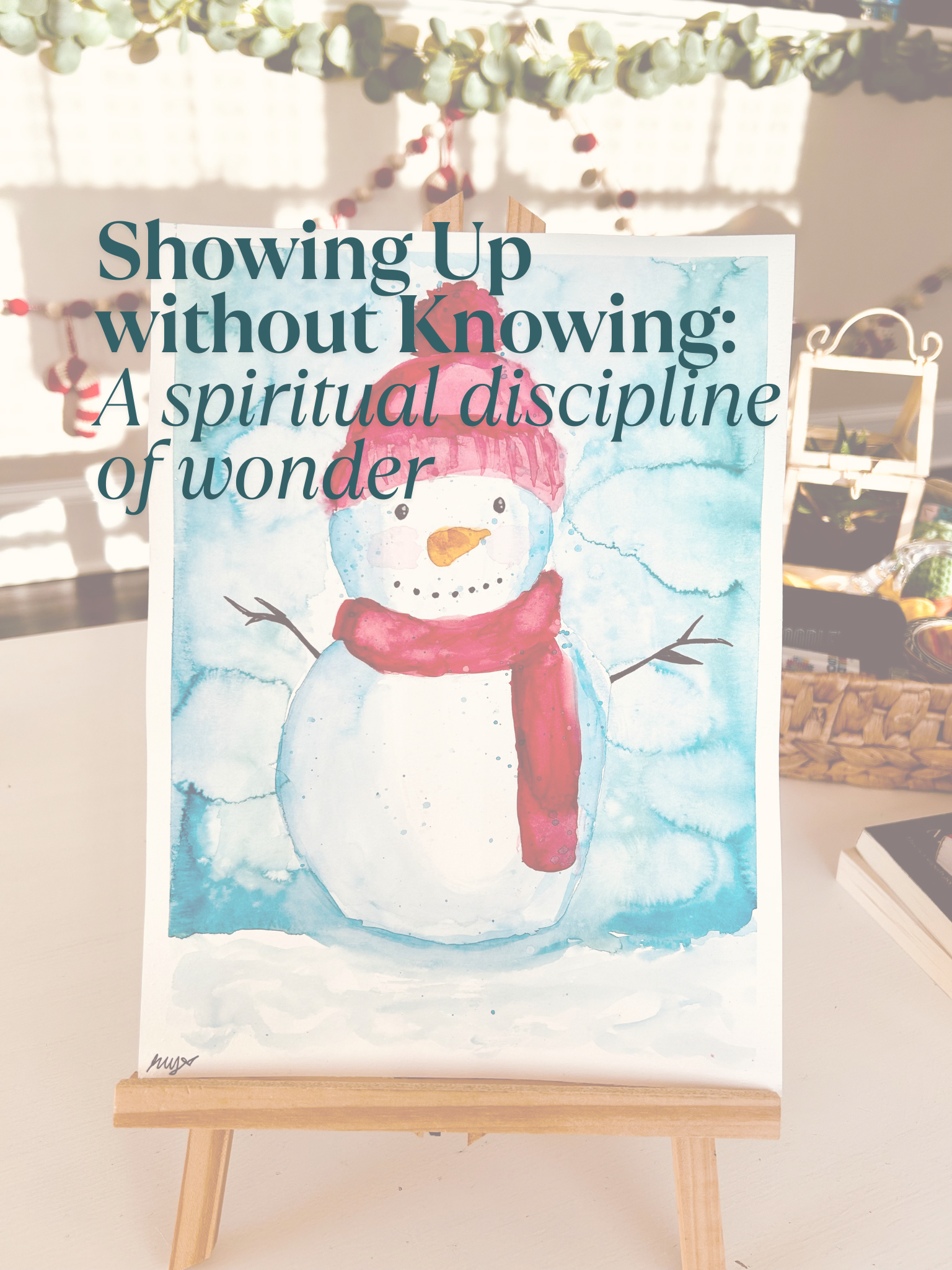
I keep asking the same question: how do you create and play?
This is not a soft question or one I just ask for fun. I ask it because I want us all to foster spaces of creating and playing. These habits shift our posture from certainty to wonder and help us approach God that way, too.
Wonder is not the absence of faith; it is a way of practicing it. It loosens our grip on mastery and polish, releases the need to be right, and allows us to stay open to God, to ourselves, and to what is still becoming.
Practices like creating, playing, and simply being with God in silence are profoundly formative. They teach us to come with curiosity instead of control, to listen more than we explain, and to trust that God meets us not only in clarity but also in beginnings, questions, and unfinished places.
Jesus pointed to a childlike posture not because children understand more, but because they receive more. They enter without needing certainty first. They engage before they comprehend.
Yesterday, in my spiritual direction group, we spent a long time in silence (a gift in itself) before I shared. They listened, cried, and prayed with me. When we ran out of time, I felt a pang of panic: I was the only one who got to share, and I wanted to repay them somehow. But they gently reminded me that perhaps God was inviting me to simply receive that day, from Him and from a safe, trustworthy group of friends.
Wonder restores that posture toward God in us. Intellectual knowledge and theology certainly have their place. I am deeply grateful for my years of studying Scripture through Christian education; I don’t think I would discern God’s voice as I do without it. Yet we are often tempted to approach God with certainty because of all our knowledge: answers already formed, conclusions already drawn, or outcomes already imagined. Certainty feels faithful. It feels responsible. But certainty can quietly turn into control, and control leaves very little room for God to move.
Wonder creates room.
As a spiritual discipline, wonder looks like creating without knowing the outcome, praying without demanding answers, and trusting God enough to remain open. It is choosing presence over polish, receptivity over mastery, and faith over control.
In a world that rewards certainty, wonder becomes a quiet act of trust, and practices like creating and playing help us cultivate it, shaping our hearts to stay open and receptive to God in all moments.
How do you create + play? Interview with Adiel
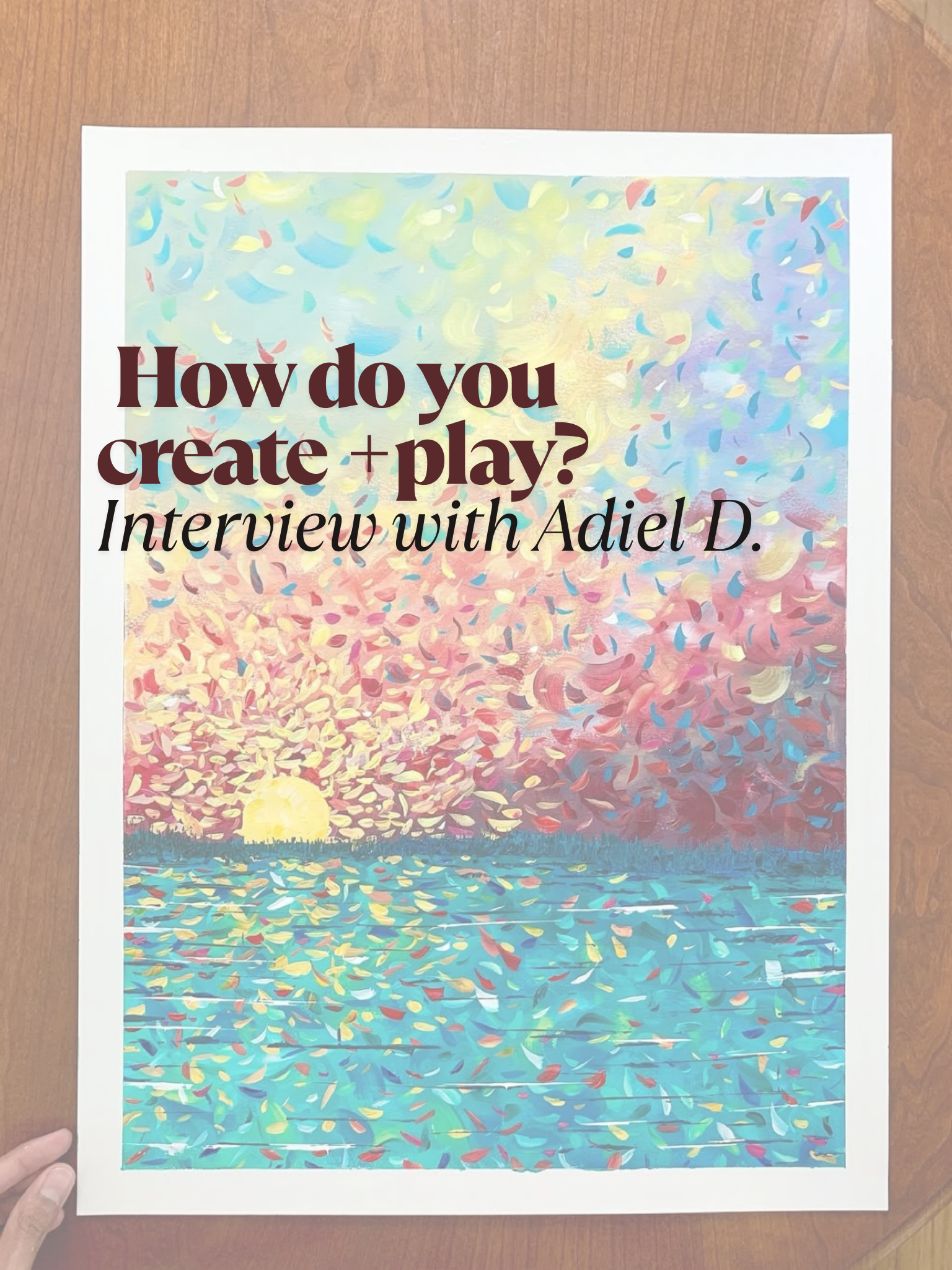
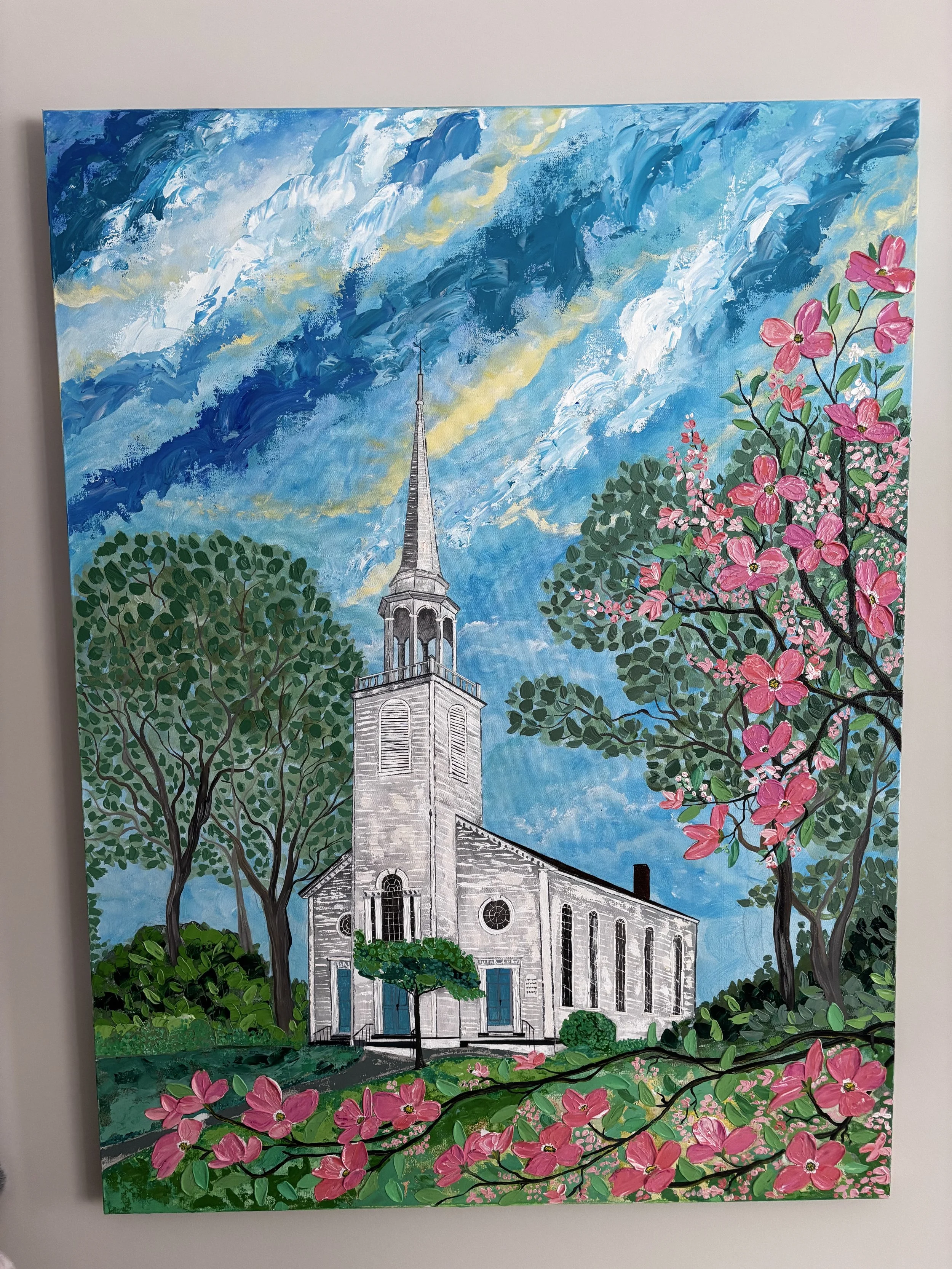
So often, we think of creativity as something we produce, like a finished piece, a result, or something to show. But what if creativity is just as much about how we pay attention? How we notice beauty, feel freedom, and make space to be fully present?
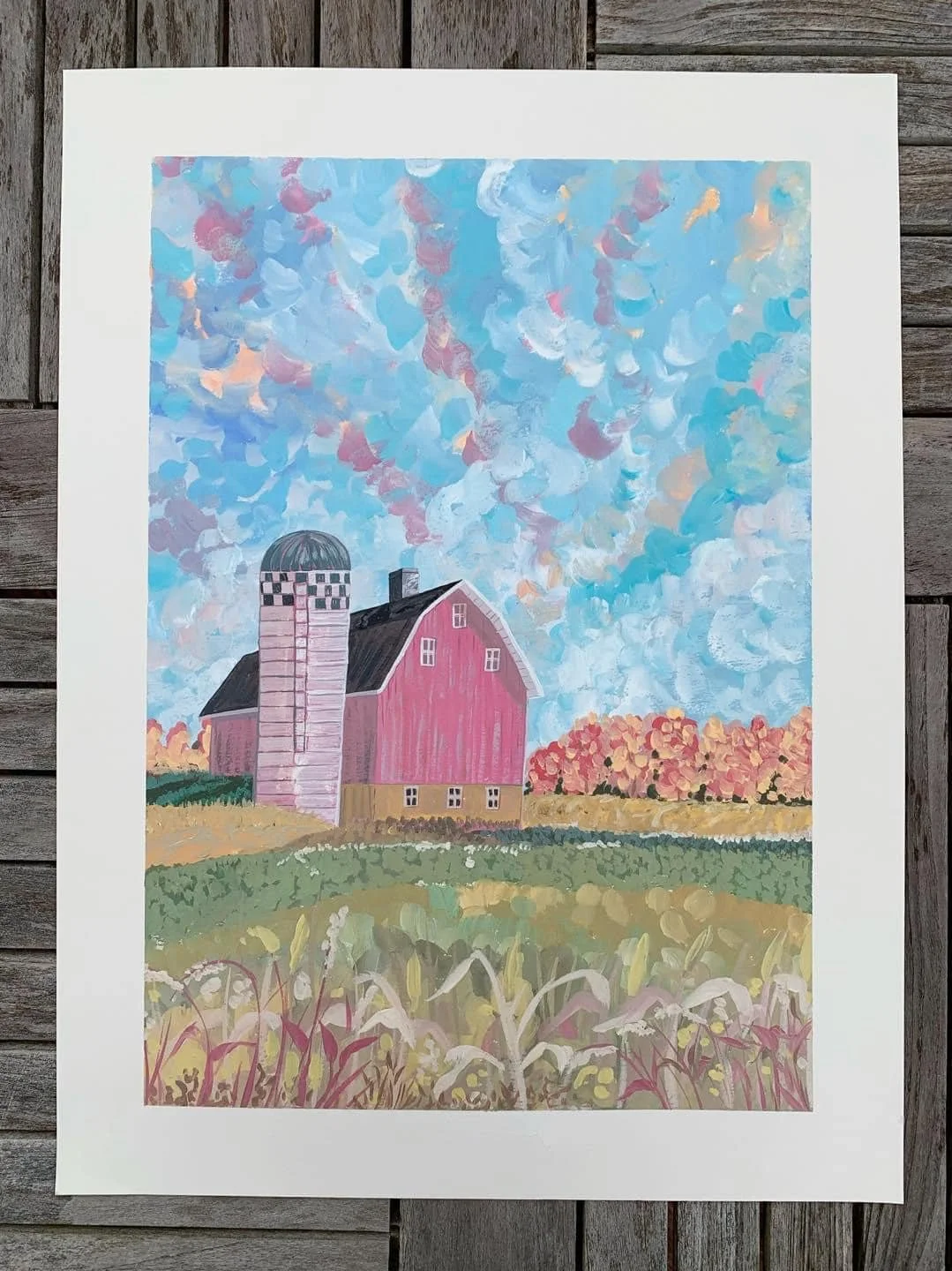
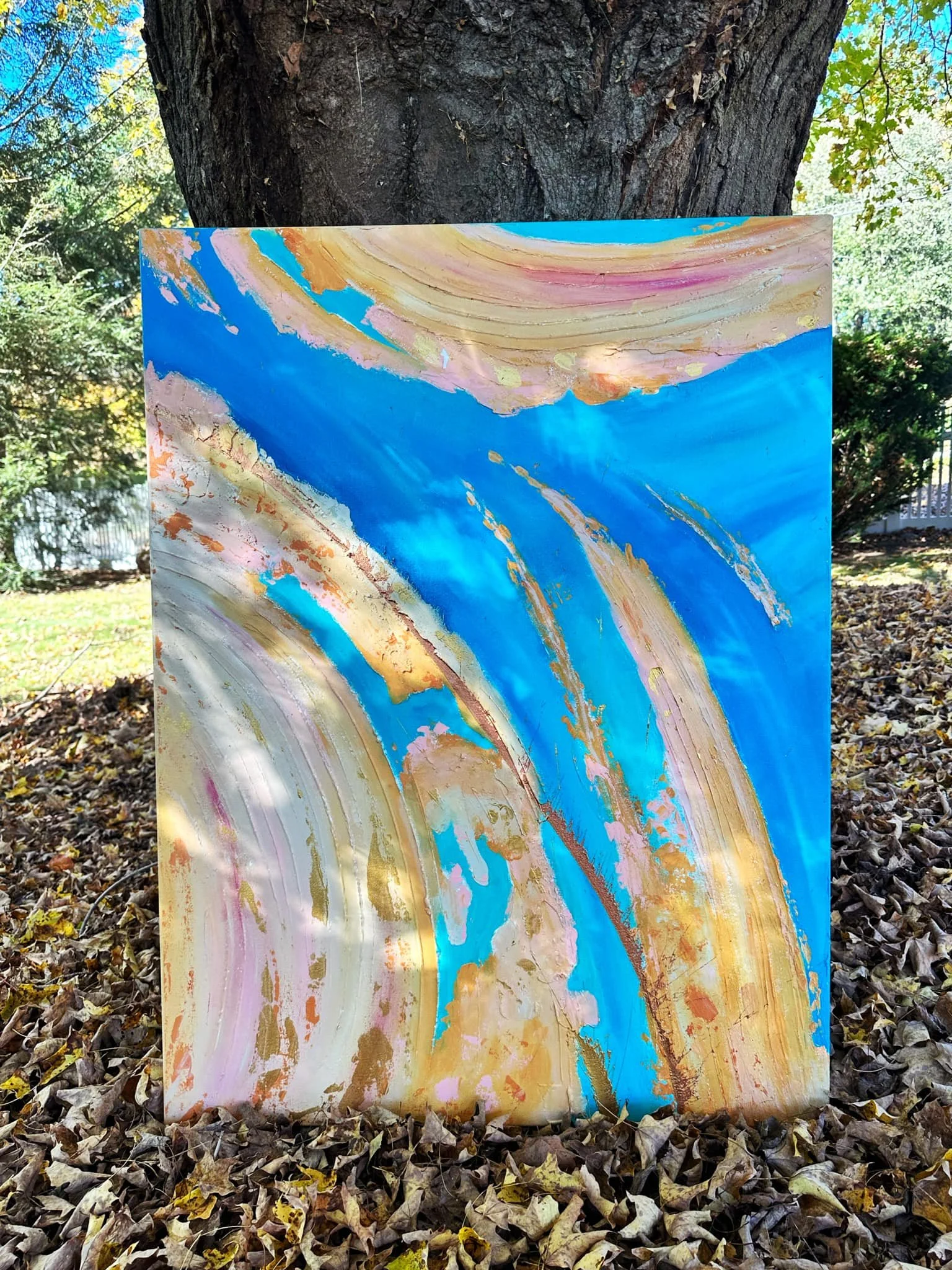
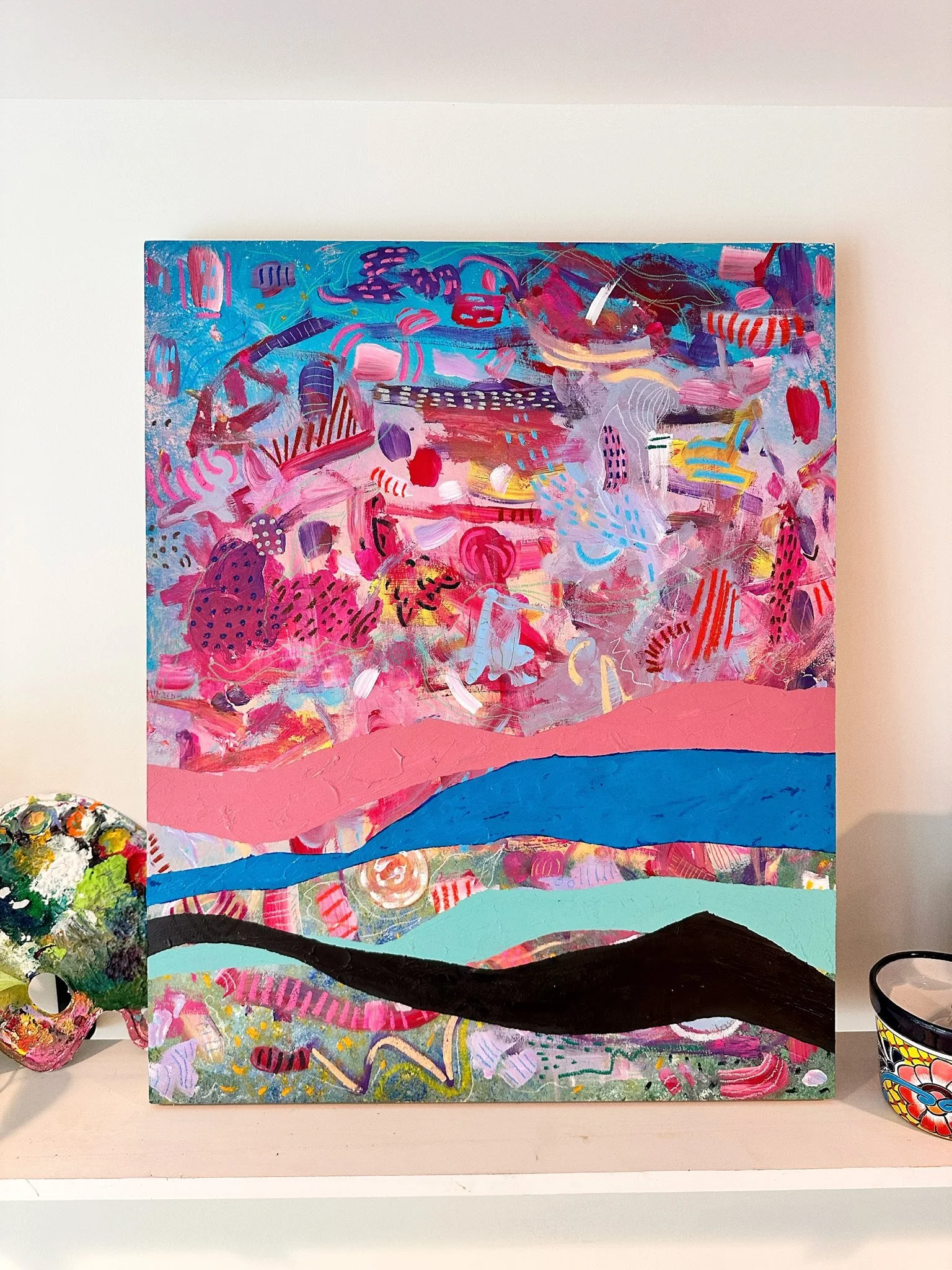
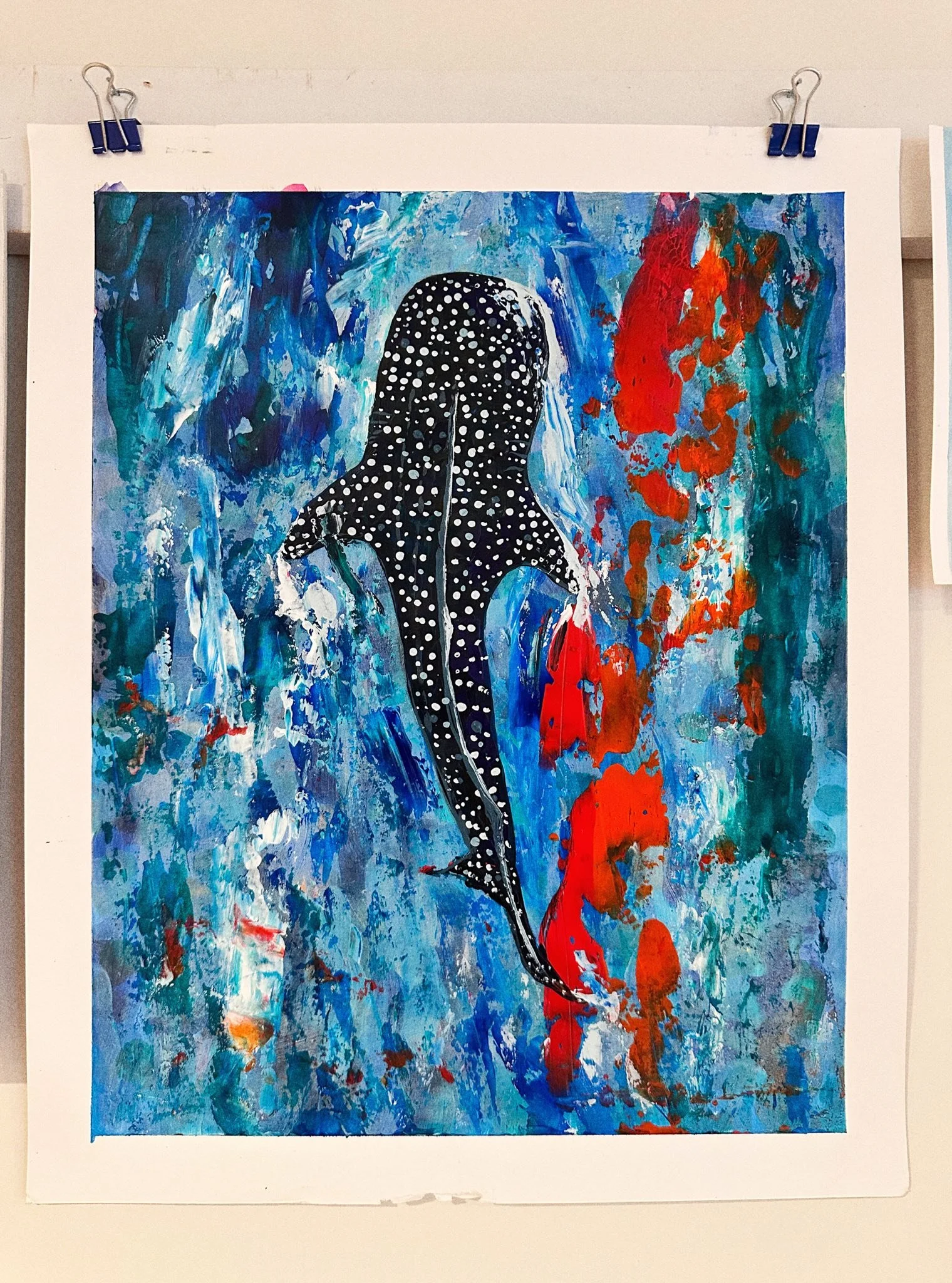
In this interview, I spoke with an artist whose painting practice began as a way to express himself and has grown into something much deeper. Through paint, texture, color, and even the joyful interruptions of his children, he has found a rhythm of creating that holds peace, connection, and faith, sometimes without many words at all.
His reflections are a reminder that creating doesn’t have to be perfect or polished to be meaningful. It can be messy, embodied, shared, and holy in the quietest ways. This conversation is an invitation to linger, to notice, and to trust that simply showing up to create is enough.
What first drew you to painting and what keeps you coming back to it now?
It’s hard to say just one thing that draws me to painting. I started painting, as far as I can remember, when I was 10 years old. At first, it was the need to express myself in a different way. As I grew older, I began noticing simple but beautiful things. Painting is like an outlet for me to feel freedom and peace; it helps me highlight the beauty I find in the simple things around me.
What happens in you when you’re painting? What do you notice, feel, or pay attention to?
When I paint, my mind just flies. I feel light, and I can clearly see the picture my hands are creating, even though it’s not finished. The colors I use, the textures, the smell in my studio, and the giggles of my daughters—who often distract me—are all part of the process. Those moments are good, because I come back with fresh ideas.
You sometimes paint with your little girls. What do you think happens when people create things side by side?
I think this is one of my favorite things to do as an artist: sharing my tools and knowledge with little ones. Art is so important for young people. Creating with my daughters is chaotic and, at the same time, beautiful. They see things that I don’t see, mix colors that make no sense, and draw things that feel out of this world. When we are creating, we are together not only physically but also spiritually—if that makes sense. We don’t talk much; we just get lost in the midst of colors, splashes of paint, and more.
Has painting ever helped you slow down, notice beauty, or connect with something bigger than yourself?
As an artist, sometimes it’s hard to slow down—we are always thinking about the next project and what else we can paint or build. Painting does help you slow down when you allow it to. I use the time when I’m alone in my studio to connect with my faith and talk to God about how He wants me to use my talents. I ask for guidance, or sometimes I simply thank Him.
If you can imagine Jesus sitting beside you while you paint, what do you think he is doing/saying/thinking?
This is a beautiful picture. After I finished reading this question, I immediately pictured this scene: God beside me, looking at me with loving eyes, observing—not saying anything, just being—and that is enough for me.
What would you say to someone who wishes they could create like that, but doesn’t know where to start?
Art is not perfect—it’s messy, and most importantly, it’s for you. It’s about how it makes you feel. So if you have the thought or curiosity to draw, paint, or simply create something, please go for it. I started painting with charcoal because it was inexpensive and all my parents could afford. Hopefully this motivates you to create and inspire others.
Thank you again, Adiel, for sharing your painting and wisdom with us!
I am hoping to continue with this series and send each person off with a blessing of their hobby. So Adiel, here is my prayer for you:
Creative and beautiful God, thank you for planting your creativity in us, so that when we create we can feel closer to you and your delight in us. Bless the holy work of painting for Adiel. Help him to continually feel your pleasure as he joins you in creating beauty. Thank you for his eyes that see beauty in the world, and the way he helps us see it, too. Bless the time he spends painting with his daughters, and may it instill in them a love of you, as they feel your delight, too. And may your love and peace surround Adiel and his family with every brushstroke of paint.
Making Space: Hospitality, Presence, and Spiritual Direction
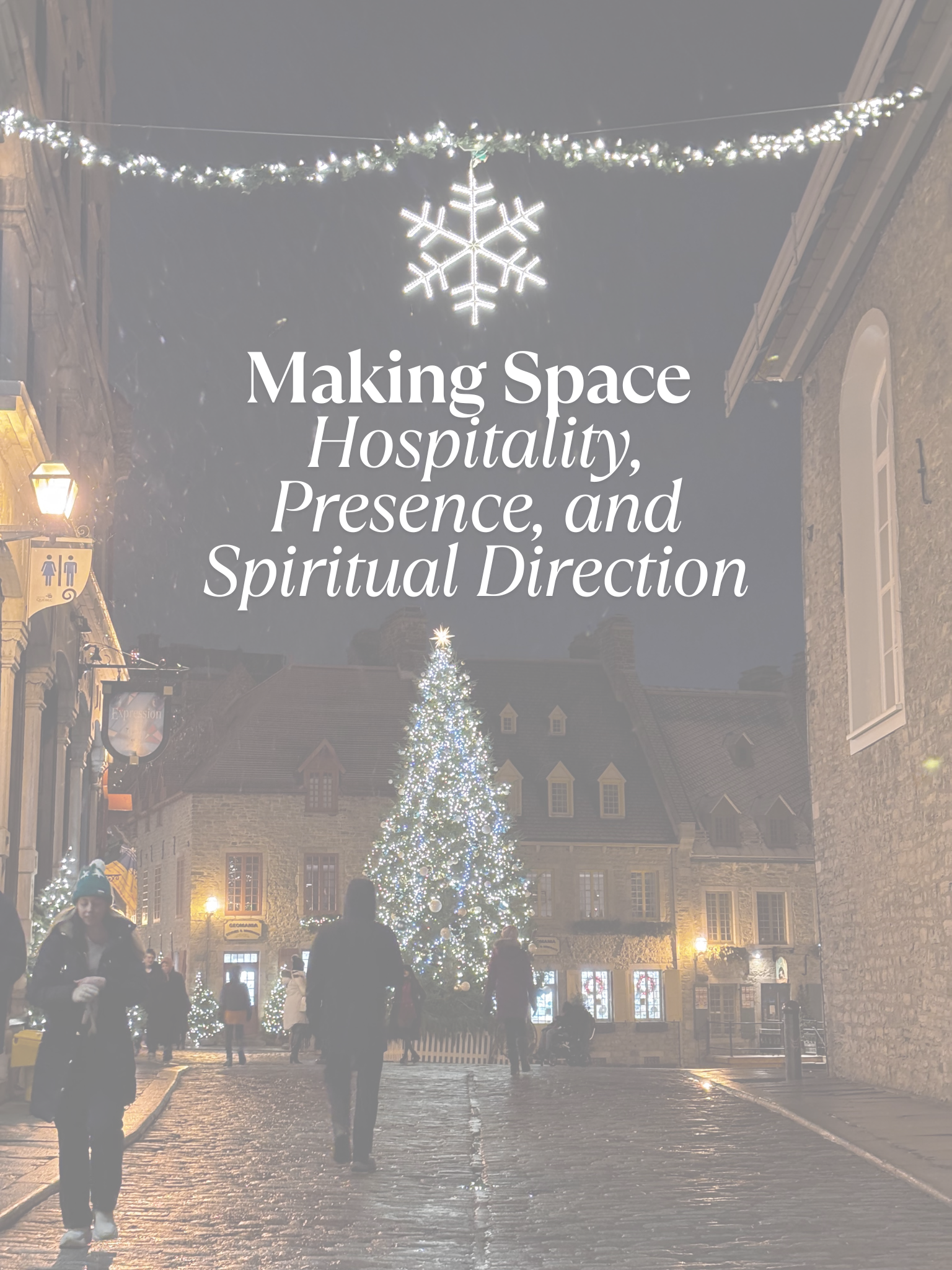
Hospitality in Scripture is fundamentally about making space: in our homes, around our tables, in our hearts, our schedules, and our communities. We see this again and again in the Bible. Abraham welcomes strangers with open hands and an open tent. Martha opens her home to Jesus. And Jesus Himself invites the weary and burdened to come and rest.
Hospitality, at its core, is not about impressing or performing. It is about presence.
When we have space, both inner and outer, we are actually more available to love. But when we are hurried, stressed, or overscheduled, we tend to miss the needs around us. Not because we don’t care, but because we are stretched too thin. Our attention is divided. Our energy is spent. Our hearts are crowded.
This is where margin matters.
Margin creates capacity. Capacity to notice, pause, respond, and be present.
Jesus modeled this way of living. He regularly stepped away to pray, to rest, to be alone with the Father. Those quiet spaces were not a retreat from love, but the very thing that made love possible. Because He made space, Jesus could move with compassion when the crowds showed up, when someone tugged at His robe, when a friend needed healing.
This is also the heart of spiritual direction.
Spiritual direction is not about fixing your life or adding more spiritual tasks to your to-do list. It is a practice of making space to notice where God is already present and at work, space to listen to your own life with gentleness, space to tend your relationship with God without hurry or pressure.
In spiritual direction, you are received just as you are. Your questions, longings, exhaustion, and hopes are all welcome. Together, we create a small pocket of holy space where your heart can stay soft, attentive, and open to love.
So making space is really an act of hospitality. Not in a productivity sense (You must clear your schedule so you can do more!) but in a deeply spiritual sense: I make space in my life so love has somewhere to land.
It’s not the only expression of hospitality, but it is a real and important one, especially in a world where so many of us are overwhelmed and overcommitted. And sometimes, making space is something we don’t have to do alone.
Making Space as Holy Hospitality
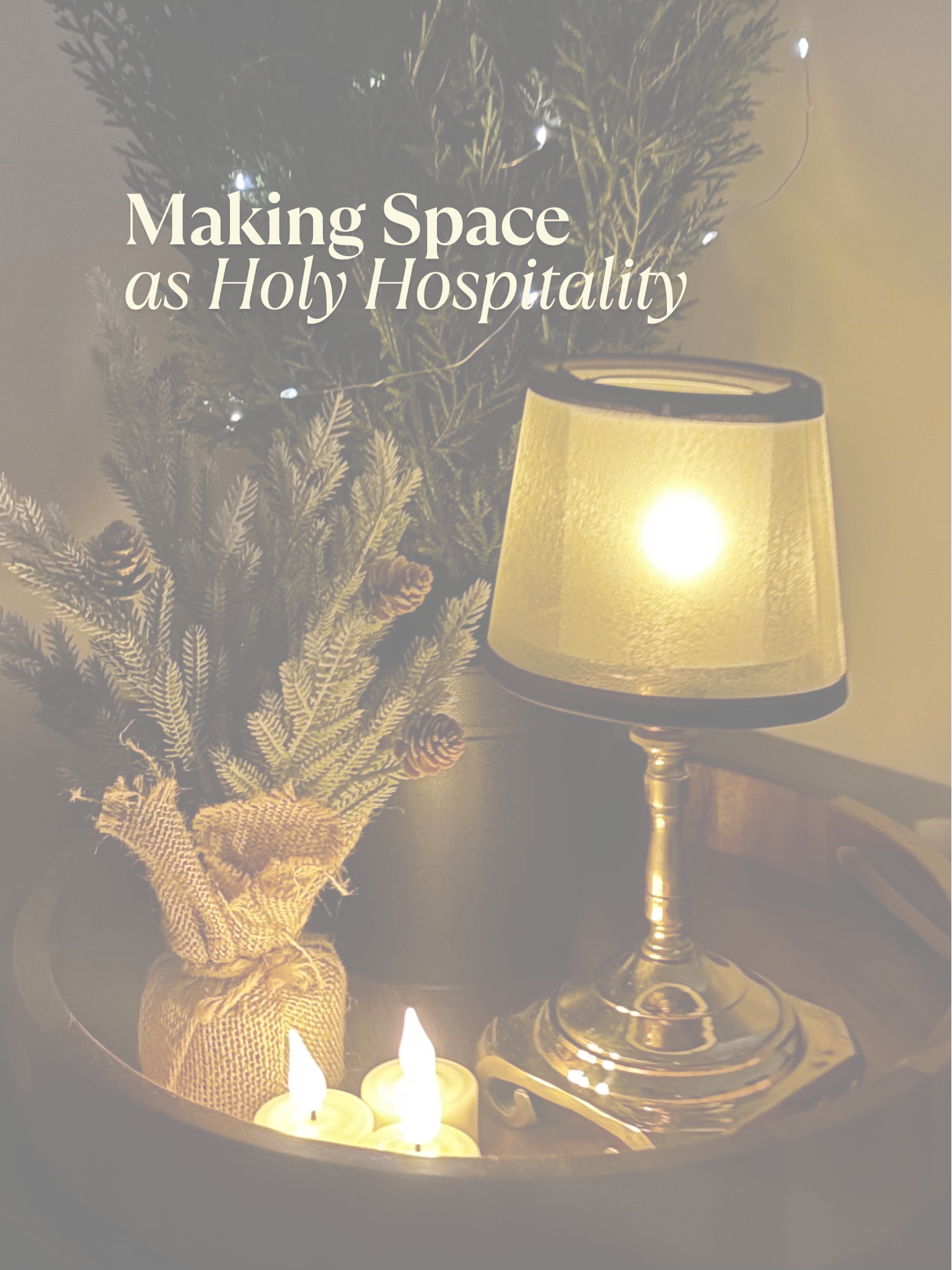
So often, when we talk about “hospitality,” we imagine setting a table, opening our homes, or planning something special. But lately I’ve been wondering if the deepest form of hospitality starts long before any of that, long before a meal is cooked or an invitation is sent.
Maybe the truest hospitality begins with making space.
Because the truth is: most of us are doing so many things we don’t actually need to be doing. We rush from one commitment to the next, carrying invisible to-do lists in our minds, tending tasks that no one asked us to carry. And without realizing it, we end up with lives so full that there’s no room left for God, for others, or even for our own souls.
But when we gently begin to release what is unnecessary something beautiful happens. We discover that making space is hospitality.
It is the quiet, intentional choice to create room for God to speak, room for rest to restore us, room for someone else’s need to enter our life without knocking everything over.
When we have margin, we can actually respond to others with joy instead of resentment. We can pause and listen instead of rushing past. We can notice the child who seems “off” today. We can bring a meal, offer a ride, pray with a friend, or sit with someone who is grieving. We can say “yes” at the moments when our “yes” might genuinely make a difference.
And maybe this is what Jesus meant when He said, “Come to Me… and I will give you rest.” His invitation is not to do more, but to open more space to receive His rest so we can extend it to others.
Making space is not laziness. It’s not quitting. It’s not neglect. Making space can be holy hospitality, an act of love that begins with making space for God in the heart and spills out into the world.
So as you move through this week, maybe wonder:
What is one small thing I can release?
Where might God be inviting me to make room?
How could this little bit of margin become a gift for someone else?
And when you do make space, trust that God will fill it with His presence and His purposes. Always.
Small Ways I’m Making Space Right Now
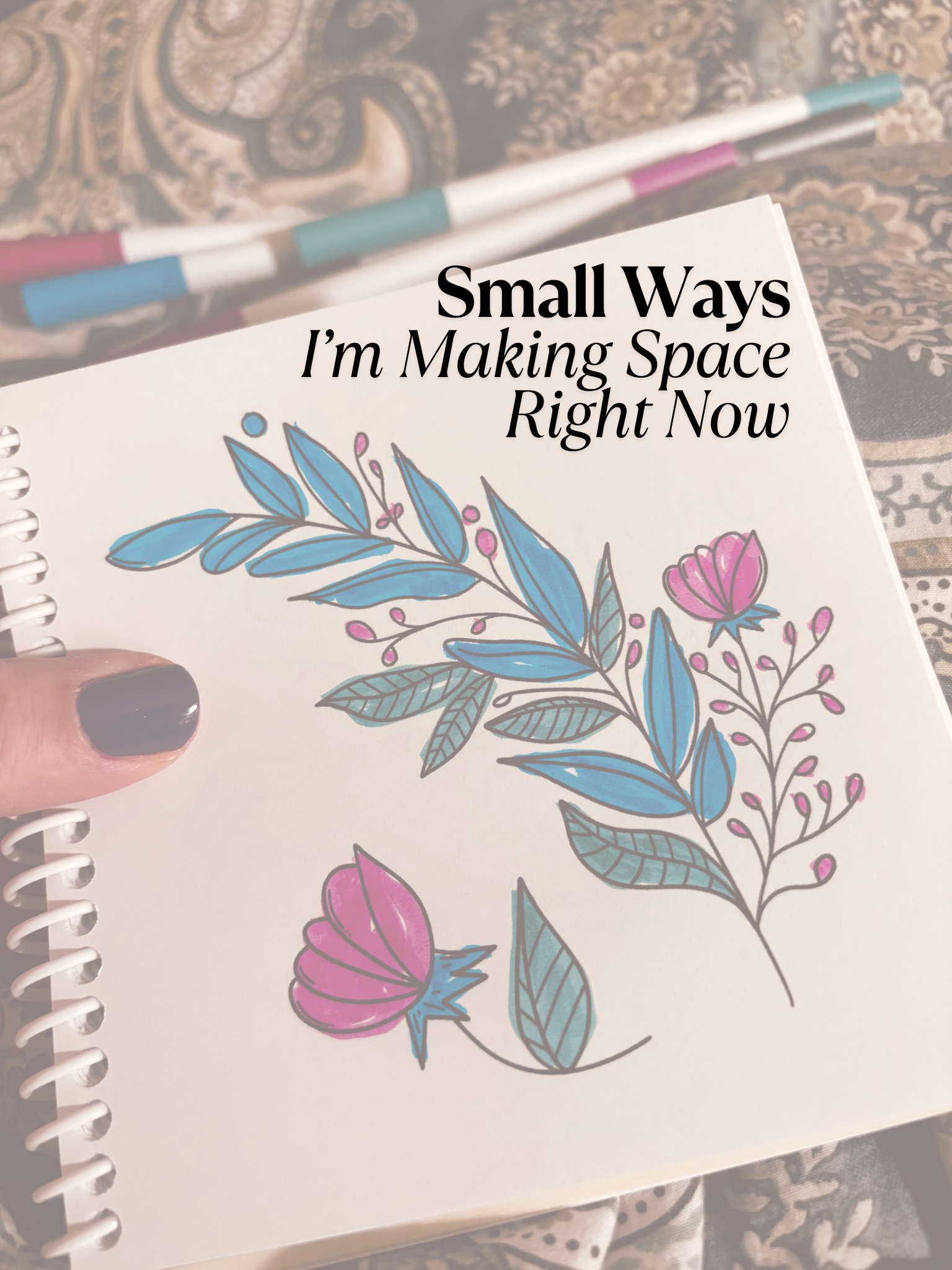
I’ve been struggling to make space this month. Ironically, even to write about making space. So I finally decided to take my own advice and remember that creating room for God and my own well-being doesn’t have to be big or impressive; it just has to be a priority. Here are a few small, grounding ways I’ve been practicing “making space” in this very full season:
• Daily coloring pages. I committed to coloring one tiny page a day. It takes only a few minutes, but it feels fun, soothing, and doable. I use just one or two colors to keep it simple, and I don’t worry about staying in the lines. It’s a pocket of creativity I actually look forward to.
• Spiritual direction. I made an appointment with my spiritual director. Spiritual direction offers so many gifts (which I know I’ve talked about before!), but one of the biggest is the simple commitment of showing up for someone else. I’m far more likely to honor a space I’ve set aside with another person than one I promise only to myself.
• Going to the gym. I’m an incredibly inward person with a rich inner world, so tending to my body has never come naturally. But we are embodied people, and moving my body matters. I recently joined a gym so I could bring my daughter a few times a week. Even when I don’t feel like going, I still go for her; and it turns out it clears my mind and gives me energy, too.
• Baking bread. This one is new for me. After a year and a half of trying to get a sourdough starter going, I finally have a thriving one… and now I’m a little obsessed. Sourdough forces me to slow down. Each loaf takes about 24 hours, and I’m making around three a week. With every stretch and fold, I find myself praying for whoever will eat that loaf (I give many of them away). It feels beautifully countercultural to move at the pace of fermentation. Maybe that’s why sourdough has become so popular: we’re hungry for slowness and we long for spaciousness. Sourdough demands both.
If you’re finding it hard to make space right now, space for God, for rest, for listening, I’d be honored to come alongside you. Spiritual direction can offer a gentle, structured place to breathe and pay attention. If you need help creating that space, you can always make an appointment with me.
An Examen for the Holiday Season

Take a deep breath. Let your body be still.
Notice the way your breath settles you, drawing you into the present moment.
What gratitudes are stirring in you this holiday season?
Who or what makes you smile right now?
What small joys, traditions, or moments do you wish you had more time for?
Think over previous holiday seasons.
What is the predominant feeling you remember? Joy, stress, longing, warmth, something in between?
How does recalling that feeling sit with you now?
Is there anything you wish you could release, or something you wish you could do differently this time around?
Where or when has God met you during past holiday seasons?
Can you remember moments when God felt close, surprising, comforting, or steady?
Has there been a time when God felt absent or far away? Gently lift those moments to God, trusting that they are held.
Now look forward to the holiday season ahead.
Hold all that you’ve noticed, your gratitude, your longings, your memories, and your prayers, and carry them with you as you step toward what is to come, open to the ways God might meet you again.
A “Hidden Prayer” Collage: A Creative Spiritual Direction Practice
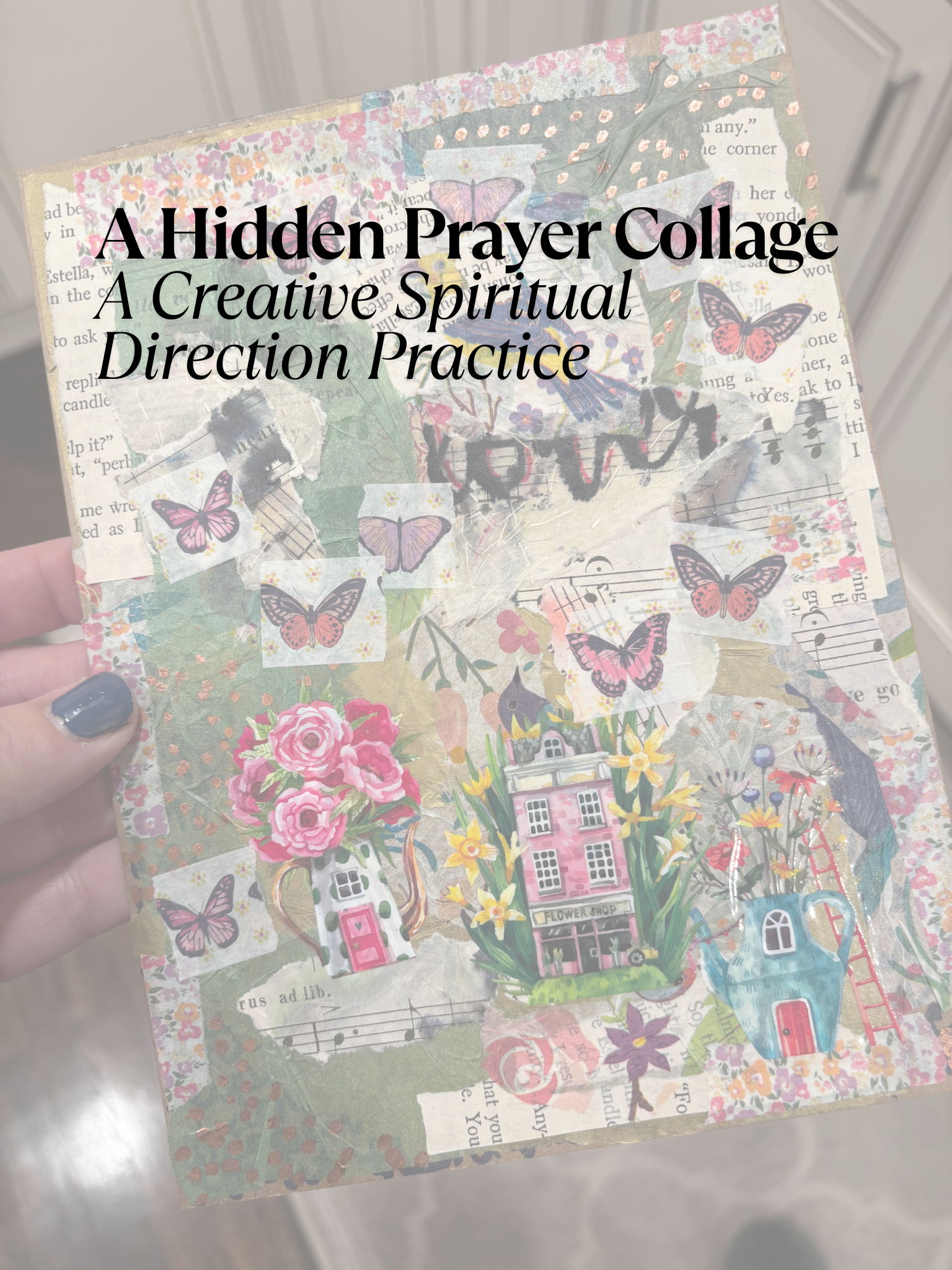
This past week, I was trying to think of a creative activity for my spiritual direction group. I wanted something that still felt like spiritual direction, with shared silence and listening to God together, while also giving us a way to use our hands. What we ended up doing was such a gentle, beautiful experience that I thought I’d share the process here. You can do this alone or with a group.
This practice allows you to express something true in writing, “release” it into God’s hands by layering over it, and then let something new and beautiful emerge. It holds depth, gentleness, and a bit of contemplative mystery.
Materials Needed
Mixed media or watercolor paper
Pen, pencil, or marker
Tissue paper
Other collage elements (book pages, old music sheets, pretty napkins, wrapping paper, etc.)
1–2 of the following: stickers, metallic markers, gold leaf, washi tape, stamps
Step 1: Begin in Silence and Start Journaling
Give each person a small piece of heavy mixed-media or watercolor paper. Invite them to settle into silence for a moment, and then begin journaling directly on the page whenever they’re ready.
You can offer a few prompts:
What is stirring in me?
Where am I feeling invited?
What am I resisting?
What do I long for from God?
What am I tired of carrying?
Let them know that this writing will be covered, so they can freely write what is real and unedited. This becomes their “hidden prayer” layer.
Step 2: Scripture Reading: 2 Corinthians 4:6–7, 16–18 (NRSV)
“For it is the God who said, ‘Let light shine out of darkness,’
who has shone in our hearts
to give the light of the knowledge of the glory of God
in the face of Jesus Christ.But we have this treasure in clay jars,
so that it may be made clear that this extraordinary power belongs to God
and does not come from us…Even though our outer nature is wasting away,
our inner nature is being renewed day by day…Because we look not at what can be seen
but at what cannot be seen;
for what can be seen is temporary,
but what cannot be seen is eternal.”
Paul reminds us that the most precious things God is doing in us are often unseen, like treasure held in simple clay jars. As we begin adding layers to this page, we are not erasing our words and we are not hiding them from God. We are honoring them, entrusting them to His care. We are letting God hold what is true and allowing Him to continue His gentle, quiet work beneath the surface.
Step 3: Begin Layering
When you’re ready, begin tearing and placing your pieces of tissue paper and collage elements over the journaling. There is no right or wrong way to do this. As you layer, imagine God holding everything underneath, healing, redeeming, comforting, and tending to what you wrote. Let your hands move without overthinking. Choose colors and shapes that feel right for the moment.
Step 4: Add a Symbol of Blessing
Once the layers are dry, add one small element of blessing on top.
This could be:
a metallic mark
a sticker or stamp
a bit of gold leaf
a single brushstroke
a small shape or symbol
Let this represent what God will do, is doing, and has already done.
Step 5: Reflection
Take a moment to look at your finished piece. Gently notice what rises in you.
You might ask:
What surprised me while I was creating?
What did the process feel like in my body?
What part of my finished piece draws me the most? Why?
What might God be whispering through the layers?
Did anything shift inside me as the layers were added?
Hold gratitude for whatever God stirred in you today.
The Quiet Surprise of Godly Play

This year I’m trying something new in Sunday school. Every three weeks or so, I gather all the kids, ages 5 through 6th grade, for a Godly Play story. Their attention is rapt, and honestly, I don’t entirely know why. It’s not exciting. It’s not new. It’s quiet and slow and simple.
But I’m starting to realize that might be exactly why it works.
Kids live in a world full of noise, hurry, and constant stimulation. The calm, spacious rhythm of Godly Play feels different to them. The slow unfolding of the story gives their minds room to breathe. The quiet voice, the careful movements, the gentle wondering questions all of it creates space for mystery, which seems to pull them in more than any “exciting” activity ever could.
Kids are naturally contemplative. When a story invites them to wonder instead of rushing them along, they lean in. Every time it surprises me. And every time, it reminds me that children are often drawn to quiet holiness far more than we expect.
But my favorite part comes next.
After the story, I get to tell the kids that art can be a kind of prayer. When we move into craft time, I know they’re thinking about glue sticks and markers and making something fun, not prayer. And that’s okay! Because maybe someday, when they need it, they’ll remember that being with God doesn’t have to fit inside a narrow box. Prayer can look like drawing, building, coloring, imagining, and taking joy in creating. It can be playful, messy, and full of wonder.
This is something I’m still learning as an adult. Even today, as I led my spiritual direction group through a creative practice, I was surprised again when God met me right there, in the paper and the color and the quiet. He invited me to let myself be drawn into Him, to find safety in Him, to play with Him, and to rest in Him.
So I try to tell that to the kids, even though our art time often dissolves into happy chaos. I’m hoping I’m planting a theology of prayer they probably do not understand yet but will carry with them. Many adults discover later in life that prayer isn’t limited to kneeling and speaking. How beautiful if children could grow up already knowing that truth.
Being with God can look like creating, playing, and making beautiful things. And maybe, in these small moments, we’re helping them discover that slow, quiet holiness for themselves.
How do you create + play? Interview with Julie
Oftentimes what we think of as “only a hobby” is really a gentle pathway to prayer. I’ve been so delighted by how often simple, hands-on making becomes a doorway into presence, wonder, and connection with God.
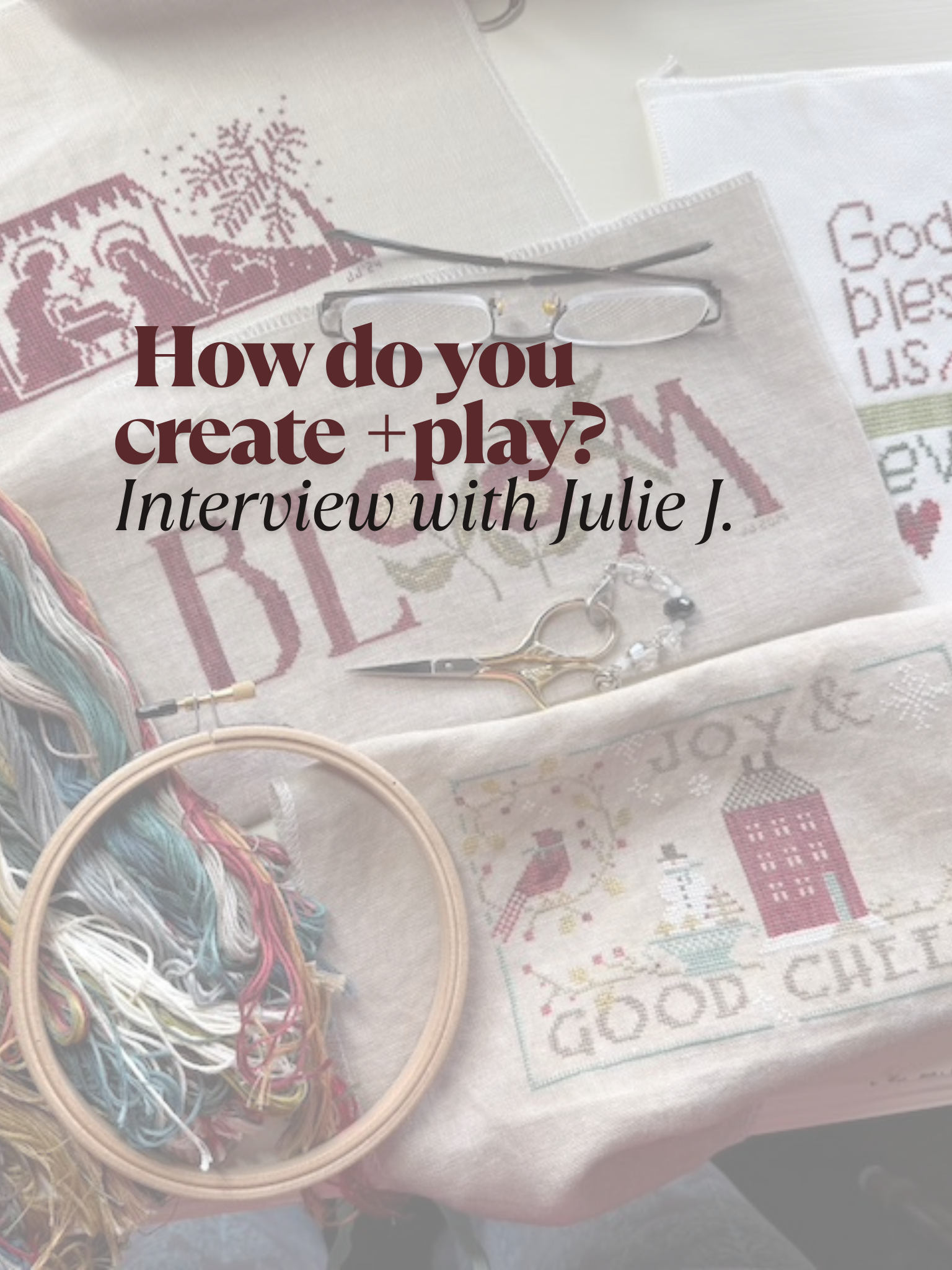
This month, I interviewed someone whose practice has quietly become all of those things. Through cross-stitch, she has discovered a rhythm that helps her slow down, notice beauty, remember her seasons, and connect with others in meaningful ways.
Her story is a reminder that creativity is sacred. Sometimes the slow, repetitive work of making something with your hands becomes a way of making space in your soul. I hope you enjoy and are encouraged.
What first drew you to cross-stitching — and what keeps you coming back to it now?
I learned to cross stitch when I was in high school. My cousin picked up the hobby, and I was drawn to her pieces. There was something peaceful about it, perhaps reminding me of times long ago. I recognized beauty in the labour of it - the hours of handwork it requires. So, she taught me. I stitched for a time, but life got busy and I lost interest.
Years later, I visited a friend in her home and noticed a gorgeous, cross-stitched piece on her wall. It sparked my interest again.
Today my stitching is different. Tastes/preferences change, of course, but I have also become much more creative with it. I love the variety of textures and colors. I've discovered beautiful hand-dyed linens and flosses that allow me to design or adapt projects. Also, some projects just make my heart happy. I know that sounds silly, but it's true. I have completed projects on occasion that left me sad to be finished. I just enjoyed working on them. I think that is what draws me back.
What happens in you when you’re stitching — what do you notice, feel, or pay attention to?
Stitching is rhythmic, almost like breathing. It is comforting, calming and orderly, requiring only a bit of focus to count stitches and follow a pattern. It usually doesn't require too much brain power, allowing my mind to ponder other things alongside. They say that when we do repetitive tasks, we think more clearly. I believe this is true! Going for a walk can clear your head and so can stitching.
You sometimes stitch in community — what do you think happens when people make things side by side?
This is new for me within the last 18 months. We have a local cross stitch store that is always buzzing with ladies AND men (yes, men cross stitch too). It is a place of encouragement and conversation. Our particular group meets weekly to stitch, usually for 3 or 4 hours. We admire each other's WIPs (work-in-progress), inspire one another to expand our abilities, and mostly just chat about life. I find connection with people I have nothing else in common with except stitching, and we have a wonderful time!
The cross-stitch community is big. There are large stitching retreats in conference centers and ballrooms all over the US, Canada and Europe. Stitch-Con, one of the largest, sells out every year. These retreats feature designers who share their purposeful designs alongside stories of meaning. And of course, these retreats offer hours and hours of time to stitch with others.
Has cross-stitching ever helped you slow down, notice beauty, or connect with something bigger than yourself?
Absolutely! Whatever I am stitching sets a mood. When I stitched a "names of Christ" sampler, I pondered each name. When stitching the wisdom prayer, I was in prayer. When stitching a gift for someone, I am mindful of that person and grateful for that relationship. And of course, stiching flowers, bees, trees, birds etc. give me a sense of beauty that is all around us. It reminds me to notice.
It's interesting, my completed pieces are reminders of life's past seasons. One piece was calming to me when nervous on an airplane. There is a piece I worked on while at the hospital bedside of my father-in-law. The stitching was slow and lingering that day, stitching while he slept. I can probably tell you when I stitched most of my projects and can relate them to what was happening around me.
If you can imagine Jesus sitting beside you while you cross-stitch, what do you think he is doing/saying/thinking?
Is there anything better than sitting with Jesus and simply enjoying His presence? I imagine Him just being there, enjoying the moment with me. Nothing needs to be said because His presence is deeper than words. Mostly, I feel His pleasure, and I am assured of His love.
What would you say to someone who wishes they could create like that, but doesn’t know where to start?
One can learn a lot from Flosstube videos (on YouTube). There are many talented stitchers offering inspiration and instruction with a wide variety of design style. Be careful though - this can suck you in! I would suggest, if possible, finding a cross stitcher or a local needlework store that can offer instruction or tips. Start with something small on Aida 14-count fabric. Patterns can be ordered online and some are even offered free. Find one that makes your heart nsging. Hobby Lobby or Michaels have DMC floss, needles and hoops.
Most important is how you approach a project. While certainly there is a sense of accomplishment from finishing a piece, there is much joy in the process of creating. Linger in it!
Thank you again, Julie, for sharing your hobby and wisdom with us!
I am hoping to continue with this series and send each person off with a blessing of their hobby. So Julie, here is my prayer for you:
Creative God, thank you for planting your creativity in us, so that when we create, we join you in holy play. Bless the holy play of cross-stitching in Julie’s hands. May she feel your full delight in her, your precious daughter, as she echoes your creativity. May her cross-stitching community grow and bring you glory. And may your love and peace surround her, flow through her, and touch others who are with her, with every stitch she makes.


Entering Contemplative Play
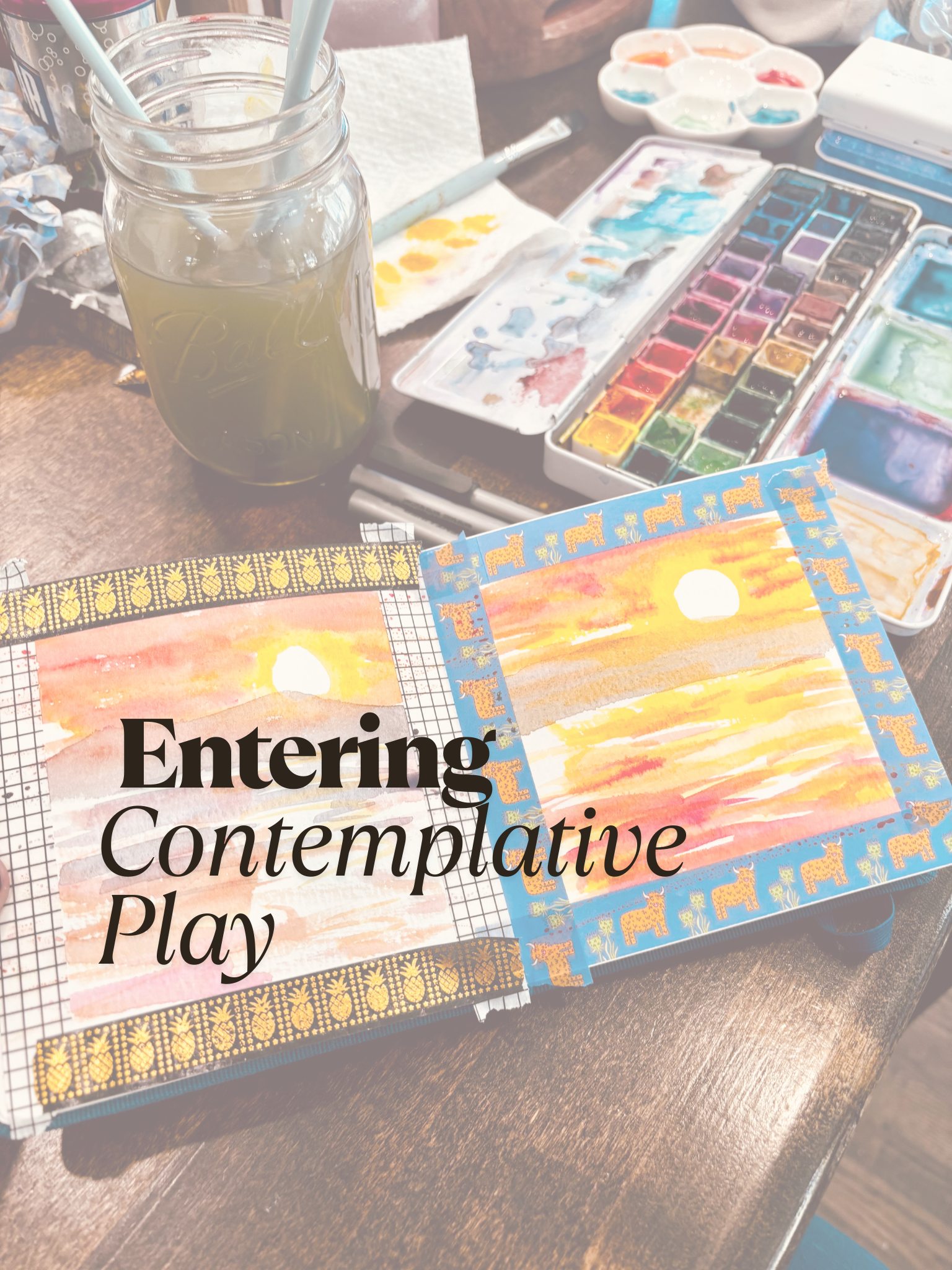
Contemplative play gives us a way to be fully present without the pressure to perform or produce. It slows us down enough to notice what is true, what is beautiful, and what is stirring inside us. In a world that prizes achievement and efficiency, contemplative play helps us recover wonder.
It’s not about following steps or achieving a result. It’s about showing up with openness and letting yourself notice, wonder, and be.
The ideas below are simply starting points, invitations into a slower rhythm. You might use one, combine a few, or let them spark something entirely your own. What matters most is not what you make, but how you attend to the moment.
Below are a few ways to enter contemplative play, alone or in community, with hands, heart, and imagination awake to God’s presence.
Ideas for Contemplative Play
Color slowly with crayons, markers, or watercolor. Don’t worry about staying in the lines.
Shape clay or playdough with your hands; see what forms naturally.
Go outside and collect a few interesting leaves, stones, or sticks. Arrange them in a small pattern.
Sit under a tree or near a window and watch what moves, whether it’s clouds, light, leaves, or shadows.
Take a slow walk, noticing what you see, hear, and feel as you move.
Light a candle and watch the flame for a minute or two.
Trace a spiral or simple shape in sand, salt, or rice with your finger.
Draw or paint what peace, love, or hope might look like to you.
Write a short thank-you note to God or to someone who showed you kindness.
Listen to gentle music and let your hands or body move with it.
Build something out of blocks, rocks, or Legos.
Close your eyes and take five deep breaths, noticing what you feel in your body.
Look closely at something small like a flower, a piece of fabric, or a shell and notice every detail.
Share something you made or noticed with someone else and listen to what they share.
Pour water slowly from one cup to another and listen to the sound it makes.
Lightly trace your hand on paper and fill it with small drawings or words of gratitude.
Look up at the sky for a full minute and notice how it changes.
Tear or cut paper pieces and glue them into a collage without planning the outcome.
Walk a simple path, spiral, or labyrinth, pausing at the center to take a deep breath before returning.
Stack stones or small objects, noticing when the balance feels right.
Blow bubbles and watch them drift and disappear.
Write a single word that feels important today and decorate around it with color or pattern.
Trace a heart shape on paper or in the air and imagine offering your love to God.
Sit quietly with your eyes closed and imagine light filling the room.
Draw or color together with someone, side by side, without talking.
Hold a smooth stone and think of one thing you’d like to release or let go.
Listen for distant sounds, like birds, wind, cars, or voices and notice how far away they are.
Watch a candle go out, following the smoke as it disappears.
End with a deep breath, thanking God for what you’ve noticed.
These may seem like simple or even silly examples, but that’s kind of the point. We spend so much of our lives producing and performing that we forget how to simply be. So take a little time to pause and play. Choose one small practice and see where it leads. Notice how you feel afterward. You might be surprised by the peace or joy that meets you there.
Making Space (Even when it feels impossible)
Sometimes making space feels impossible. It feels like a luxury, something only people with enough time, money, or resources can do. Something for later, when life slows down a bit.
But in God’s economy, resources are abundant. There is already enough. You are already enough, and you already have what you need to make space for yourself and for Him.
The truth is, the problem isn’t really about resources. It’s about priority. We aren’t used to prioritizing stillness or slowness, especially when it doesn’t feel “productive.” Making space doesn’t check anything off a list. It might not even feel like anything at first.
But it’s holy work.
And it doesn’t have to be dramatic or long or quiet or perfect. Making space might look like:
A few deep breaths before you rush into the next thing
A short prayer whispered while washing dishes
Doing something creative, just for the joy of it
Playing with intentionality
Meeting with a spiritual director
Unplugging for a few minutes or a few hours
Taking a retreat
Making space can be minutes. It can be days. What matters is that we’re intentionally being with God, not just doing things for Him.
The thing about making space, even a few minutes, is that it stretches time. It’s strange but true: time feels fuller, slower, more open. At first, it might feel boring. That’s okay. Keep showing up. Soon those quiet, unhurried minutes will become so precious that you’ll find yourself craving more and more of them.
Maybe that’s the gift: not that we make space once and for all, but that we keep learning how to make it again and again, right where we are.