
An Examen for Kids: Talking to God about Your Day

This is a quiet time to talk with God about your day. You can close your eyes, or draw while you listen, or just be still. Let’s just notice what happened today together.
Who or what are you thankful for today?
Let’s thank God together!What brought you joy today?
Did you dance with a friend until you fell down laughing?
Did you sing a silly song about turtles wearing pants?
Did you laugh at a joke your friend told you at recess?
God is joyful with you.What made you sad today?
Did you stub your toe on an open door?
Did your friend say something that hurt your feelings?
Did you have to say a hard goodbye?
God is sad with you.What excited you today?
Did you learn something new about something you love?
Did your teacher tell you that you did a great job in school?
Did you get a new pair of sneakers?
God is excited with you.What scared you today?
Did you have a bad dream that made you scared?
Did you have to answer a hard question in front of the whole class?
Did a dog bark and scare you when you weren’t expecting it?
God is here to comfort you.What made you angry today?
Did you get in a fight with a friend?
Did you get an answer wrong that you thought was right?
Did someone take your favorite toy?
God is big enough to hold your anger for you.Where did you notice God today?
Did you see something beautiful in creation?
Did someone comfort you when you cried?
Did you share a snack with someone who didn’t have one?
God is with you every moment.What do you hope for tomorrow?
Let’s tell God your hopes together.
*My house has only preteen+ at this point, so we have shortened this to just “high/lows” (and sometimes we include “buffalos” - just something funny/random) at dinner time. It’s a way to be engaged in noticing with each other. We even have a special high/low dance, which we are assured is very “cringe”.
sacred story time (befriend a bear)
Last time, we began our journey with Pooh under a tree, listening and wondering. This week, we find him climbing that tree in search of honey, singing little songs, thinking funny thoughts, and eventually taking quite the tumble.
As we read this week’s passage, I hope you’ll let it stir both your gratitude and your grumbles, your imagination and your need for comfort. Come play, pray, and wonder with me.

Pooh climbed and he climbed and he climbed, and as he climbed he sang a little song to himself. It went like this:
Isn't it funny
How a bear likes honey?
Buzz! Buzz! Buzz!
I wonder why he does?
Then he climbed a little further ... and a little further ... and then just a little further. By that time he had thought of another song.
It's a very funny thought that, if Bears were Bees,
They'd build their nests at the bottom of trees.
And that being so (if the Bees were Bears),
We shouldn't have to climb up all these stairs.
He was getting rather tired by this time, so that is why he sang a Complaining Song. He was nearly there now, and if he just stood on that branch ...
Crack!
"Oh, help!" said Pooh, as he dropped ten feet on the branch below him.
"If only I hadn't——" he said, as he bounced twenty feet on to the next branch.
"You see, what I meant to do," he explained, as he turned head-over-heels, and crashed on to another branch thirty feet below, "what I meant to do——"
"Of course, it was rather——" he admitted, as he slithered very quickly through the next six branches.
"It all comes, I suppose," he decided, as he said good-bye to the last branch, spun round three times, and flew gracefully into a gorse-bush, "it all comes of liking honey so much. Oh, help!"
He crawled out of the gorse-bush, brushed the prickles from his nose, and began to think again. And the first person he thought of was Christopher Robin.
Noticing prompt
Who is the first person you think of when you are in trouble? What is it about that person that brings them to mind? Are they helpful? Kind? Comforting? Are you the kind of person that people seek out for help?
Play prompt
Try writing a gratefulness haiku and a complaining haiku (5-7-5 syllable structure). Notice the feelings that each provoke as you write. Here’s my example (I’m not sure if it’s complaining or gratitude! Maybe a little of both!):
Green leaves with bird poop
Out my window as I write.
That means birds were here.
Imagination prompt
What would it be like to be a bear in the town where you live? What would bring you joy? What would be frustrating? Imagine befriending a bear. Where would you go? What would you do together?
Prayer
Welcoming God, help me to take all my feelings to you, whether gratefulness or frustrations. Thank you for always inviting me, even in my unpleasant moments! Thank you for being someone I can go to for help with anything.
Download a PDF of this content for a Winnie-the-Pooh coloring page!
The Voice That Offers Freedom

I chose this image because when I look at those stingrays, I think they look so free and happy.
In spiritual direction, I’ve learned to listen closely for one particular sign of the Holy Spirit: anything that offers more freedom.
Not just a fleeting sense of relief, but like a deep breath after holding it too long. Like shoulders dropping as the weight you’ve been carrying finally slips off. Like space in your chest where anxiety used to live. Like permission to be fully yourself without apology.
It feels like stepping out into a spacious field, with room to run and realizing this is where you were meant to be all along.
Freedom doesn’t always come with fireworks or fanfare. Sometimes it’s as quiet as peace, as simple as clarity, and as holy as rest. It often shows up when you choose love over fear, when you stop trying to earn your worth, when you say no to something that once had power over you.
When the Spirit is present, freedom often follows. Not necessarily ease, but lightness.
"Where the Spirit of the Lord is, there is freedom." —2 Corinthians 3:17
Freedom is one of the primary marks of the Spirit’s presence. When God is near, there’s less fear, less shame, less pressure to perform and more room to live fully and truthfully.
Isn’t it amazing that this is one way we can know the voice of Jesus? He is always offering more freedom, more grace, more rest for the weary soul. He said, “If the Son sets you free, you will be free indeed” (John 8:36). Jesus doesn’t coerce, He calls us out of our stuck places and invites us into healing, trust, and lightness of heart.
And yet, if we’re honest, we often sit comfortably in our own enslavement. Just like the Israelites who longed for Egypt when the wilderness felt too uncertain, we cling to what’s familiar, even if it binds us. We resist change. We fear the wide-open spaces of real freedom.
But Jesus keeps calling. He keeps speaking and tugging at our hearts. He keeps inviting us into the kind of life where we are no longer driven by fear, but led by love.
So the next time you’re discerning, ask yourself: Does this bring more freedom?
If the answer is yes, you just might be hearing the voice of God.
All the ways you can bloom

I continue to think about blooming, which shouldn’t be surprising given the current stage our beautiful wildflower garden (see photo). In my last post, I talked about how you can bloom through rest and play, which I think is my preferred method of blooming. And of course, when we think of blooming, we usually imagine sunlight and stillness, soft petals and spring. And yes, some blooming does happen that way: in moments of rest, joy, or playful creativity, when our hearts feel light and our calendars finally give us room to breathe.
But it occurred to me that we can also bloom through other things as well, including expressed sorrow (grief/lament) because it keeps our hearts soft (we may not usually think of this as blooming!). Because blooming may not always be the beautiful spring flowers kind of blooming. It’s not always pretty. It’s not always peaceful. And it’s never one-size-fits-all.
To bloom is to unfold more fully into who you already are. It’s the process of becoming and that journey can begin in all kinds of soil.
So here are just a few of the ways its possible to bloom, if we allow blooming to happen:
When you stop hustling for your worth. When you let go of productivity as identity. When your soul finally exhales and finds enoughness in simply being.
When you step into delight. When you create without a goal. When wonder is welcome and joy isn’t postponed.
When loss breaks you open. When you feel the ache and still choose to stay soft. When tears water something deep underground.
When you learn resilience by living it. When hard seasons refine you rather than define you. When growth feels more like grit than grace.
When you’re seen and held without needing to perform. When love lets you lower your guard and come home to yourself.
When something beautiful flows through you. When you co-create with God. When you feel most alive in the work your soul was made to do.
When pouring yourself out connects you to something bigger. When giving isn’t draining, but deeply aligning.
When shame starts to loosen its grip. When old wounds begin to close. When you reclaim parts of yourself that were buried or silenced.
No matter the path, one thing is always true: Blooming happens when it’s safe to unfold.
And that’s exactly what spiritual direction offers.
It’s not about giving you answers or fixing you. It’s about creating sacred space to notice what’s already stirring. A place to pause and listen. To name your truth and be met with compassion. To explore joy, pain, doubt, and wonder without judgment.
In spiritual direction, there’s no pressure to be in a certain season. You can be in full bloom or lying fallow. Grieving or creating. Wrestling or resting.
Your whole self is welcome.
The director doesn’t point to a path and say, “Go bloom.” We walk beside you, gently noticing where the light is already reaching in. We remind you that blooming doesn’t mean forcing. It means becoming. And that becoming takes many beautiful forms.
You can bloom through rest.
You can bloom through struggle.
You can even bloom in the dark.
And wherever you are in that process, there’s space for you here.
What does it mean to bloom?
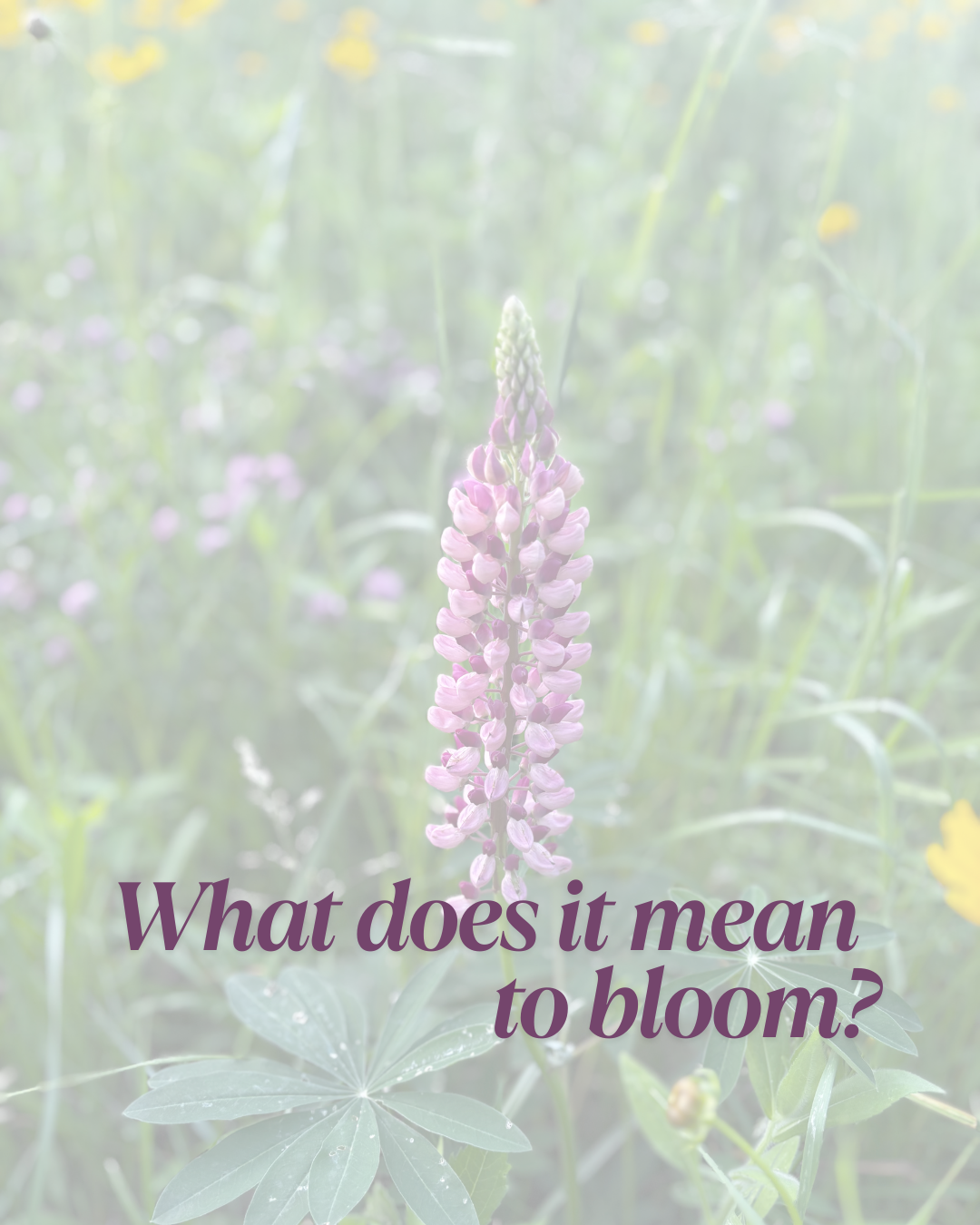
My post on Instagram a few days ago got me thinking more deeply about what it really means to bloom. I love using that word with pictures of flowers, but I didn’t want it to be some trite caption, like, flowers bloom and you can too! I wanted it to really mean something.
I keep coming back to the idea of blooming as gentle growth toward our true selves. Or as I wrote in that post: to unfold into the fullness of who you are with freedom, abundance, and joy. Just like a flower doesn’t force itself open, blooming is a process of allowing, not striving. It happens when the conditions are right: sunlight, water, space.
For people, those conditions often include rest, play, and safety.
One of the places where those conditions are intentionally nurtured is in spiritual direction. Spiritual direction helps create space where blooming becomes not only possible, but often, inevitable. It doesn’t “make” you bloom the way sunlight makes a flower open. But it turns toward the light with you. It makes space for it. It witnesses the slow, often hidden, unfolding of who you are becoming in God.
Here’s how spiritual direction supports blooming:
It offers safety and stillness.
In a noisy, fast-paced world, spiritual direction gives you permission to pause, listen, and be listened to without agenda. That kind of presence is deeply nourishing. It creates the right internal conditions for blooming.
It helps you notice where life is already stirring.
Spiritual directors are trained to listen for grace, for freedom, for the gentle movement of the Spirit. They help you see where growth is happening—even if it's underground.
It honors all seasons.
Spiritual direction doesn’t rush your blooming. It holds space for winter, for pruning, for lying fallow. It trusts that dormancy isn’t deadness—it’s preparation.
It returns you to the true self.
Blooming isn’t about becoming something new and shiny. It’s about unfolding into who God created you to be all along. Direction gently peels away what’s false or forced and helps you reconnect to your God-given core.
And it often invites contemplative play, not always with crayons or crafts (though those are welcome!), but through wonder, metaphor, silence, curiosity, and imagination. The kinds of play that open the soul instead of performing for others.
In short: Spiritual direction is like a quiet garden where your soul gets room to breathe, grow, and rest in the presence of the Divine Gardener. Blooming tends to follow, not because you're trying harder, but because you're finally safe enough to unfold.
So when I say “bloom,” I mean that.
Not pressure. Not productivity.
Just a holy, spacious becoming.
For parents who want to help their children to bloom: it’s not about pushing or shaping them into something. It’s about creating the kind of safe, spacious environment where they feel deeply seen, loved, and free to unfold in their own time. That might look like making time for unstructured play, honoring their natural rhythms, inviting their questions without rushing to answer, or simply delighting in who they already are (“I’m so glad you’re you.”). Like a steady gardener, you don’t bloom them, but you can protect the soil, offer warmth, and trust the holy process already at work in them.
Make Space: begin with just one pause

This week, try beginning with just one small pause, a moment to clear a little room in your heart, your schedule, or even your table.
Light a candle before breakfast.
Set aside one thing that’s crowding your space or your mind.
Open a blank page and take a breath before you write or draw.
Lately, I’ve noticed how often I reach for my phone
when instead, I could simply pause. Breathe. Be present in the moment. It feels like such a cliché! I wish I could say I was past it. But the pull is real, and I’m learning to notice that moment before the reach to choose stillness instead.
This week I’ve been carrying some heavier things, so I’ve been extra gentle with myself and intentionally made more space for quiet art time and reflection. It’s helped more than I expected.
One thing I love about spiritual direction is how much it honors this kind of space-making. When you schedule time with a spiritual director, you’re making an appointment with someone else to help you make space for God.
And honestly? That’s often the only way it happens. It’s hard to do on your own, especially for a full hour.
But you don’t need an hour. Or a perfect setup. Sometimes, making space is just:
turning down the noise
setting down the phone
asking God, “What do You want to grow here?”
Even a few quiet moments can change the shape of your day.
For Life with Little Ones (or Big Distractions):
Making space might look like:
a few deep breaths while your child plays
turning off music for one quiet car ride
a short breath prayer as you fold the laundry
I remember a breath prayer I used a lot, especially when my kids were little: (inhale) Lord, lift up my head. (exhale) I can’t do this without you.
Even this can be enough.
Monthly Examen: A Prayerful Pause

Each month, I am going to invite a time to pause, reflect, and pay attention to the presence of God in our lives, to our emotions, and to the movement of grace in ordinary moments. The five steps of St. Ignatius’s Examen offer a gentle framework for this kind of reflection:
Become aware of God’s presence.
Review the day with gratitude.
Pay attention to your emotions.
Choose one feature of the day and pray from it.
Look toward tomorrow.
Let’s take a few quiet minutes together and look back over the past month.
When did you feel closest to God?
Was it in the middle of joy or celebration? Or perhaps in a moment of grief or struggle? Maybe it came through Scripture, through creativity, through time in nature, or in the quiet of an ordinary afternoon. There’s no wrong answer. Simply pause and notice.
When did you feel most like your true self?
Was there a moment when something deep inside whispered, This is what I was made for? Try to remember that feeling: what you were doing, who you were with, how it felt in your body.
Were there moments when God felt distant?
When you longed for Him but couldn’t sense His nearness? Hold those moments gently. Bring them to God now. Ask Him what He wants you to know about His presence, even when it feels hidden.
What are you grateful for from this past month?
Is there a particular day, moment, or even a small detail that fills you with warmth or thankfulness? Offer that gratitude back to God.
Where do you need help right now?
Is there an ongoing struggle or quiet ache you’re carrying? Invite God into that place of need. You don’t have to have the right words, just be honest.
What are your hopes for the month ahead?
Tell God what you’re longing for, dreaming of, or simply what you need. Even though He already knows, there is something powerful about naming those hopes in prayer.
sacred story time (climb a tree)
This week, I’m beginning a new series that uses classic children’s stories—beginning with Winnie-the-Pooh—to spark contemplative play. These prompts are meant to help you slow down, notice the world around you, and engage your spirit through simple acts of creativity, curiosity, and prayer.
In this first story, Pooh hears a buzzing in a tree and, being the thoughtful bear that he is, sits down to think about it. That small act—sitting, listening, wondering—feels like just the right place to begin.
I encourage you to enter like a child, while we read, wonder, and imagine together.
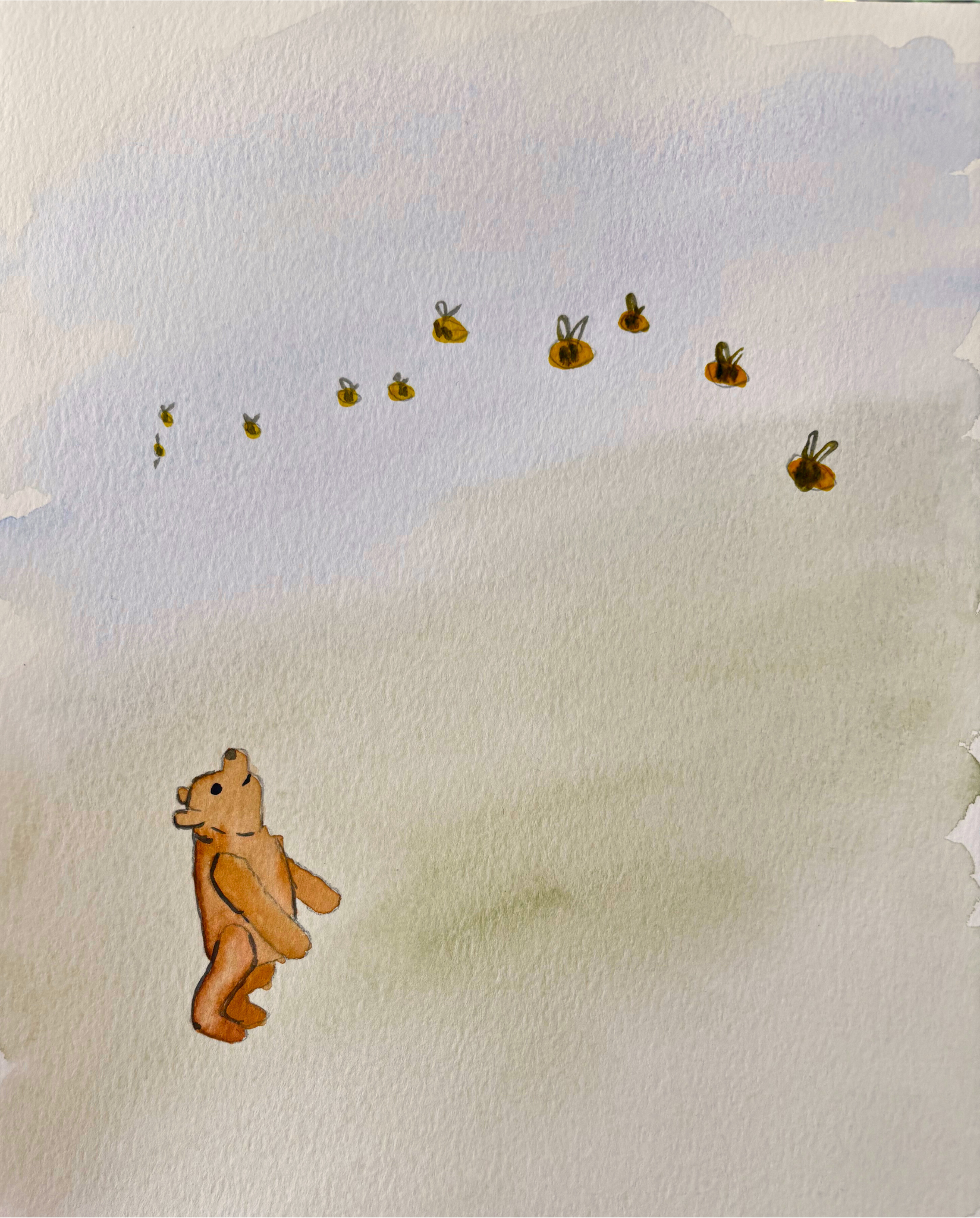
Once upon a time, a very long time ago now, about last Friday, Winnie-the-Pooh lived in a forest all by himself under the name of Sanders.
One day when he was out walking, he came to an open place in the middle of the forest, and in the middle of this place was a large oak-tree, and, from the top of the tree, there came a loud buzzing-noise.
Winnie-the-Pooh sat down at the foot of the tree, put his head between his paws and began to think.
First of all he said to himself: "That buzzing-noise means something. You don't get a buzzing-noise like that, just buzzing and buzzing, without its meaning something. If there's a buzzing-noise, somebody's making a buzzing-noise, and the only reason for making a buzzing-noise that I know of is because you're a bee."
Then he thought another long time, and said: "And the only reason for being a bee that I know of is making honey."
And then he got up, and said: "And the only reason for making honey is so as I can eat it." So he began to climb the tree.
Noticing Prompt
Find a tree to sit under or climb. What do you notice? Is the bark rough or smooth? What color are the leaves? How does the air feel—warm or cool? Do you hear any sounds? See any animals or insects? Take a moment to simply be, and notice how you feel as you sit with nature.
Play Prompt
Read or listen to a children’s book outside—under a tree if you can. Read slowly, like a child hearing it for the first time. What parts bring you joy or make you smile?
Imagination Prompt
If you were a tree, what kind would you be? What would your bark feel like? What color would your leaves be? Why? Try drawing or coloring yourself as a tree.
Prayer
Lord, help me see your world with wonder. Teach me to slow down and notice even thesmallest things—like the bark of a tree. Help me come to you like a child: curious, open, and full of need.
Download a PDF of this content for a Winnie-the-Pooh coloring page!
Jesus and the Sacred Gift of Play

When we think of spiritual practices, we often think of prayer, silence, scripture, or stillness. But I want to offer a gentle reminder: Play can be sacred, too.
Not play for productivity. Not play as a break from "real" spiritual life. But play as a gentle, open-ended way of engaging the world—one that brings us into presence, wonder, and connection with the sacred.
I call this contemplative play.
As strange as it may sound, I believe contemplative play is a deeply spiritual practice. And I believe Jesus would agree.
Jesus said, “Become like little children.”
In the Gospels, Jesus doesn’t just tolerate children, He welcomes them and lifts them up as models of faith.
“Unless you change and become like little children, you will never enter the kingdom of heaven,” He says (Matthew 18:3).
Children are open, curious, and creative. They’re fully present. They laugh easily. They don’t worry about performing or earning love. They simply are.
When we play, without agenda or pressure, we begin to return to that childlike posture. We remember that we are loved, not because of what we produce, but because we belong.
Jesus taught through story, gesture, and imagination.
He didn’t hand out theological treatises. He told stories. He drew in the dirt. He used mustard seeds, lilies, coins, and sheep to help people encounter deeper truth. His way of teaching invited the imagination, the senses, and the body, not just the intellect. It welcomed play. Not to escape reality, but to encounter God more deeply within it.
Play reminds us not to take ourselves too seriously.
Jesus didn’t avoid joy. He celebrated. He turned water into wine. He welcomed children into the middle of serious conversations.
Contemplative play helps us soften. It reminds us not to take ourselves too seriously and to take God’s love more seriously than we ever imagined. It makes room for delight.
And isn’t that what Jesus came to bring? “I have told you this so that my joy may be in you, and that your joy may be complete” (John 15:11).
In a world that often equates faith with striving and seriousness, play is a form of holy resistance.
It says: I don’t have to earn love. I can laugh, rest, create, and explore. I am God’s beloved child.
Play helps us follow the movement of the Spirit.
Jesus often moved in surprising, Spirit-led ways. He turned aside to touch the untouchable. He paused in the middle of crowds to ask questions. He noticed the overlooked.
The Spirit still moves like that: in whispers, in nudges, in unexpected joy.
Contemplative play helps us practice noticing. It trains us to be receptive and open. It slows us down enough to see where God might be showing up in ordinary, even playful, ways.
Jesus invites us to come as children.
Not childish, but childlike: open, trusting, curious, and ready to play.
Because sometimes the most sacred thing we can do is allow ourselves to be delighted.
Want to try contemplative play for yourself?
Each month, I’ll share creative and noticing prompts, coloring pages, and picture book reviews to help you explore this practice at your own pace.
But here’s another beautiful way to experience it firsthand:
Sign up to serve in children’s ministry at your local church.
Seriously. It’s one of the best places to learn how to come to Jesus like a child. You’ll be surrounded by wonder, curiosity, creativity, and holy interruptions. Children will show you how to laugh, question, trust, and play.
You’ll be reminded, again and again, that faith isn’t about striving. It’s about being present.
That’s what I do, and it’s one of the richest parts of my spiritual life.
So try contemplative play at home, and consider joining the playful, sacred work happening with children in your church community.
Let them lead you into the kingdom.
How Spiritual Direction is Different than Counseling
I often get asked how spiritual direction is different from counseling—especially Christian counseling. It’s a great question, and one that deserves a thoughtful answer, because while both can be deeply supportive, they serve different purposes.

Here are five ways spiritual direction stands apart:
1. There’s no advice.
It might feel surprising at first, especially if you're used to counseling or mentoring, but spiritual direction isn’t about receiving guidance on what to do. You might hear familiar questions, like “How does that make you feel?”, but they serve a different purpose. My role isn’t to help you solve a problem; it’s to help you notice God’s presence in your life and listen more deeply.
2. Everything comes back to your relationship with God.
You can bring anything to spiritual direction: work, relationships, loss, joy, doubt. But no matter what we talk about, the lens is always your relationship with God. The real question is: Where is God in this? or What might God be inviting you into?
3. There’s a lot of silence.
In counseling, silence might feel awkward, something to be filled. In spiritual direction, silence is sacred. It’s in the stillness that we often hear God’s whisper. We make room for the Holy Spirit to speak, not just to talk about God, but to actually listen to God together.
4. It is restful.
Spiritual direction isn’t another task or therapy appointment. It’s an invitation to rest. After a busy or emotionally charged day, it can feel like stepping into a quiet sanctuary. There’s nothing you have to perform or fix. You can just breathe.
5. You leave lighter.
You might come in carrying burdens (confusion, grief, longing) but most people leave feeling lighter. Not because everything is “fixed,” but because they’ve remembered what’s true: that they are seen, loved, and accompanied by God. That reassurance is powerful.
6. The director is not the expert—you are.
In counseling, the therapist often brings clinical expertise. In spiritual direction, we trust that you already know God and are learning to recognize God's voice. The director is simply a companion, helping you notice and name what is already true in your experience.
7. It’s about presence, not performance.
You don’t need to come with a goal, a question, or a tidy narrative. There’s no expectation to “make progress.” Just bring your honest self, tired, joyful, angry, numb, hopeful, and we’ll sit with whatever is there.
8. It’s slow on purpose.
Spiritual direction doesn’t rush. In a world that prizes productivity and answers, direction invites you to slow down and linger. Some sessions might feel like “nothing happened” but in time, those slow moments often turn out to be sacred ground.
9. It’s rooted in trust in the Spirit’s work.
There’s a shared belief that the Holy Spirit is the real director in the room. We’re both listening together, not just to what’s said, but to what’s stirred. The emphasis isn’t on technique or outcome, but on discernment and presence.
10. It's often seasonal or cyclical.
While counseling may be ongoing or tied to specific goals, spiritual direction often ebbs and flows. People sometimes enter direction during a time of discernment, grief, transition, or spiritual dryness—and continue because it becomes a place of grounding through all seasons.
In short, spiritual direction isn’t about fixing or figuring things out. It’s about noticing. Noticing where God is moving. Noticing how you’re responding. Noticing how deeply you are loved.
If you’ve never experienced spiritual direction and are curious, I’d love to talk more. It’s one of the most gentle, life-giving practices I know, and it’s always a gift to hold that sacred space with someone.
holy snacking

For the past few weeks, I’ve been working on a video that highlights the children’s ministry at my church. As part of it, I asked each child three simple questions:
What’s your favorite thing about Sunday school?
What’s your favorite Bible story?
Do you like going to church?
The answers were hilarious, heart-melting, and holy.
Without exception, every single child mentioned “snack time” or “snacks” as their favorite part of Sunday school. I’ll admit, about 5% of me wished they had said something about the teachers, the Bible stories, or at least offered up the classic Sunday school answer: “Jesus.” But nope. It’s the snacks.
The other 95% of me? Completely delighted.
Because honestly, this is exactly what Jesus meant when he said to come to him like a child: joyfully, wholeheartedly, and maybe even just a little hungry. What if we approached life—snacks included—with that same kind of delight? What if even something as ordinary as snacking could become an act of worship?
And then there was the third question: Do you like going to church?
Every child answered yes. Every single one. In this day and age, that feels like a small miracle.
Is it just because of the snacks? Maybe. But I think there’s more to it, even if the kids don’t have the words for it yet. They feel loved. They feel seen. They feel safe. They get to play with their friends, be silly, be honest, and just be kids. And yes, they get to say—without shame or pretense—that their favorite part is snack time.
And that, I think, is holy too.
What I’m About and Where This Blog Is Headed

It’s been a while since I’ve written here. That’s partly because the last couple of years have been filled with deep reflection as I’ve moved through my training in spiritual direction. In the past, this blog served as a kind of examen—a space to name and notice how God has been shaping me. But with regular written examens required throughout my training, my need to process publicly here has naturally quieted down.
Now, as that season begins to draw to a close, I find myself asking the big questions again (questions we all ask, and if we don’t, maybe we should be?):
What’s next?
What am I passionate about?
How do I most want to spend my time?
A recent retreat gave me the space to listen. I journaled. I made lists—of what I love, what I want to do more of, and what I want to release. And through all of that emerged something simple, honest, and energizing.
Here’s what I’m about:
Teaching kids and adults contemplative spiritual practices through:
coloring books and journals
picture books (mine and others)
Godly Play and other contemplative curricula
arts-and-crafts-based play
When I step back and look at it, the phrase that best captures all of this is “contemplative play.” Or, put another way, finding God in play—encountering the sacred through color, imagination, story, and creative rest.
So, I’ve been doing some refreshing behind the scenes—updating my website and narrowing my focus. I want this blog (and the monthly newsletters to come) to be a space where I share ideas, prompts, and resources to help you bring contemplative play into your own life and the lives of those you love.
Whether you’re a parent, educator, spiritual director, or creative soul just looking for something deeper—I hope you’ll journey with me.
Let’s make space. Let’s create and play. Let’s go deeper. Let’s rest and remember.
Pre-cut Fruit Just Tastes Better
I have a long-standing joke with a friend about how much I love when she brings me cut up fruit. She laughs because she says she doesn’t do anything special to it, but when I bite into that fruit, I know it’s something special. I’ve noticed this with other people, too. Fruit just tastes better to me when someone else has cut it into small, bite-sized pieces. (My mouth is even watering thinking about it!)
I also buy pre-cut strawberries at the supermarket almost every week. This feels like a huge indulgence. I know I could cut up my own strawberries! It would be cheaper, too. But somehow buying them pre-cut makes them taste better and sweeter.
Today I was reading a text exchange with a few friends, each one offering to bring food to a luncheon we were planning. I silently begged my one friend to offer to bring fruit because I knew she’d cut it up just right! I stopped myself then and wondered about this for the first time. Why do I delight in this so much? As I said, I could prepare it myself! What is the significance of someone else preparing it for me?

That’s when a memory flashed, of being a small child visiting my grandparents in Florida, of waking up to small bowls of cut up Florida oranges, prepared lovingly by my grandfather, “Bumpa”, of the small forks that stabbed only one piece at a time, making the small bowl last longer, of the perfect, bite-sized chunks of oranges - no peel, no strings (which is especially important to a child!) - that practically melted in my mouth. I remember begging Bumpa to cut up oranges for me, even as I grew up and he grew old. No one could cut up oranges like my grandfather. And each bowl he handed me felt a lot like love.
Bumpa had a lot of wonderful qualities that are worth an essay or two of their own, but today I am missing those days of him offering me not only a small bowl of perfectly cut up oranges, but a sign of his love for me.
So now I’m wondering if my love of pre-cut fruit could really tie back to those days of perfectly cut up Florida oranges. Is that why I love fruit that is especially prepared just for me? Because maybe the fruit really is sweeter when it comes from someone else, maybe other people know how to choose fruit better than I do! Or maybe, just maybe, it’s a little taste of what we are all longing for: the feeling of being loved.
a short update...

I am having surgery on Friday and somehow that feels like a deadline of sorts to submit a couple of my finished stories. I am going to submit my middle grade novel, as well as a picture book manuscript this week! I’m nervous and excited and that’s how I know it’s a good thing.
So today I am doing some final edits as I read through them one more time. I want to be published, of course, but mostly I know I just have to try. That’s all we can do, right? I’ve had this dream since I was 10, so it’s time to really give it a shot. I’ll keep you posted!
Spiritual Direction
In my training to become a spiritual director, we were tasked with coming up with a brochure of sorts about our spiritual direction practice. I thought I’d post mine here, in case anyone would like more information about it!

Resting in Belovedness
“May I invite you to drop the old names, come out from under the shame that tries to hinder your intimacy with God and others, and step onto the spacious path. Child of the living God, sing to the living God.”
--Tamara Hill Murphy in The Spacious Path: Practicing the Restful Way of Jesus in a Fragmented World
I wrote a couple months ago about shedding old coping mechanisms to live more intentionally and to walk in truth and today I’m going to write about another. This one has been a longer journey for me, with many iterations. But it ends with a tattoo.

It began recently as it always does: with an awkward encounter with an acquaintance.
In the past, I would have left the encounter and verbally berated myself about how weird and awkward I am, asking myself what was wrong with me. Looking back, I am sad about how cruel I was to myself - knowing that if someone else had said to me what I said to myself, it would be labeled abusive. I am happy to say I am past that, as that was a more obvious affront to God and His good work that is me.
But as I fought that old habit, it morphed into the thought that (and this is embarrassing to admit) “Wait until I lose weight, then they’ll want to be friends with me.” It was a mostly sub-conscious thought, but it somehow gave me (false) hope that someday I’d be better and more deserving of people’s love. As I was slowly convicted of loving myself as God’s image-bearer, I again realized that this was not a healthy thought and began to fight this one as well.
Soon though, the thought turned into the more subtle “well, that was awkward but wait until (fill in the blank) happens” pattern. I had become more comfortable with my weight and physical self, but still wasn’t happy with just being me.
This pattern took me a while to suss out. I had shed the verbally abusive comments, the negative thoughts about my weight, but I still put my hope it a false idea that someday people would love me for my accomplishments. I was idolizing some false ideal to help with the pain and fear of just offering my true self, take it or leave it. But the Holy Spirit is faithful and even revealed this one to me after a while, and I believe it was to bring me right here, to this moment.
After the aforementioned awkward encounter the other day, I started mentally going through different ways I could prove to this person that I wasn’t actually a weird person. I can be fun! I am a good friend! I give good gifts! (Yes, these are literally the thoughts that ran through my head…) I thought of texts I could send or offers of favors I could make. When suddenly it hit me: I am already beloved. I don’t have to prove myself to people. They can just accept me for who I am: broken, fragile me. Because the good news is that I am already beloved.
I am already beloved!
It has taken me a long time to see what a restful truth this is. I can stop my striving to prove myself and rest in my belovedness. Because the truth is, I am a good friend. I can be fun. I do give good gifts! I am a good and beautiful Creation of the God of the universe. And most importantly, I was loved by Him even before I came to be.
I absolutely love this quote from Tamara Hill Murphy in her book The Spacious Path: Practicing the Restful Way of Jesus in a Fragmented World:
Our parents name us at birth, and God gives us our forever name at the second birth of baptism. In baptism, we step into the water of death with Jesus and are raised with him, the beloved. Because belovedness begins in God, we do not name ourselves beloved; instead, we receive the name—the reality of ourselves, fully seen and loved by God—as a gift. We accept beloved as our name, and we accept ourselves as being loved. Our temptation is to live as if we are beloved without letting the truth sink down into the true state of our souls. We may believe God loves us, but we haven’t allowed that love to help us discover the truth about ourselves. Any rest we feel that doesn’t help us discover the truth about ourselves is a false rest.
And oh! The rest and freedom that comes in truly believing that I am beloved. No more coping mechanisms after awkward encounters. Instead, I will snuggle into the truth of my belovedness. I’m so grateful that God calls me his beloved. And I’m grateful that my parents gave me the name that means beloved.

And that’s why I got a tattoo, to always remind myself of that truth and find rest.
Announcing "The Enchanted Grove"!

I am so excited to announce the publication of my first coloring book! As you probably already know, I love to make coloring pages as a restful hobby. It began for me in early 2020, during the first lockdown days of the pandemic. I realized that making art felt too overwhelming, but I still needed a creative outlet. That’s when I first posted this hedgehog coloring page. Something about the simple black lines felt soothing to me, so I kept going. I was soon putting coloring pages like this one in our church’s Easter book and doing customized pages like this one.
Since then, every month, I’ve posted a few more, including some activity pages. Finally, earlier this year, I took a class on how to publish your own coloring book. In my excitement, I was tempted to rush its completion, but I tried to take my time so I could be proud of every page, and especially the cover.
If you do color any of the pages (either by purchasing a copy here or by downloading some of the sample pages I’ve posted), please share your versions with me. One of my surprising joys in creating these coloring pages is seeing how other people use color to make them unique and beautiful.
Two things I refuse to do anymore
Wish away the time (or “push through”)
Try to “get ahead”
I’m going to be honest and say this is a rushed blog post because I wanted to have something to post for the month of August! But what with vacation, back to school, and being sick, among other things, I haven’t sat down to write at all the entire month. But I have been pondering those two points for a while now, as I try to embrace a more restful lifestyle, even in the chaos of life, and had written those two points down a few months ago.

First of all, for many years, I would whisper to myself “just push through to bedtime” or “once this week is over, everything will be better”, but recently I realized I’ve been saying those things for nearly 40 years! So obviously these are lies I tell myself to get through a hard thing or week and something needed to change. I have been working on this because it’s a pretty big mental shift but I refuse to wish away the time anymore. It goes too quickly on its own!
I just finished Anthony Bloom’s Beginning to Pray and these are some of my favorite quotes from the chapter “Managing Time”:
“The moment I began to feel ‘I must be quick”, I would sit back and engage in small talk for a few minutes just to prevent myself from hurrying…
“Learn to master time, and you will be able - whatever you do, whatever the stress, in the storm, in tragedy, or simply in the confusion in which we continuously live - to be still, immobile in the present, face to face with the Lord, in silence or in words.”
He argues that we should practice sitting still and doing nothing for five minutes, gradually increasing that time the better we get at it (it makes sense that we should have to practice this, given that we are naturally very “busy” creatures!). So I figure that if I need to take a break for 5-10 minutes to gain some perspective, take some deep breaths, whisper some prayers, or write some laments or gratitudes, then that is worth stopping and doing in order to stop wishing away the moment.
My second point, “trying to get ahead”, is related to the first. This is another lie I’ve told myself for a long time! You know the one: if I just do this thing now, I won’t have to do it tomorrow and I’ll get ahead (I suppose the goal of this is so maybe we can gain some rest tomorrow? Which never happens!)*. I realized this one Sunday night when I threw in a load of laundry to “get ahead” for Monday. It hit me that there would always be laundry. It’s laughable to think there’s a “getting ahead” with laundry! So I should just rest now, when I’m supposed to be practicing Sabbath rest anyway!
And isn’t this true with so many other things in life? The work will always be there. The idea of “getting ahead” is almost universally a lie (I suppose we can all come up with exceptions) that I don’t want to buy into anymore. I need to rest when I can, which is probably still less than I need.
So these are two things I am working on not doing anymore. Does anyone want to join me?
*Weirdly, I also do the opposite. The famous procrastinator phrase “Why do today what you can push off until tomorrow?” also applies. What can I say? People are complicated.