
Not all spiritual formation looks serious.
This is a carousel I shared on Instagram, but I felt like it deserved a place on my blog. So instead of trying to write a blog post based on a series of pictures, I did the efficient (lazy?) thing and just posted those pictures here.
Caption: I feel like I should be making videos for Instagram so I can prove it's just me here behind the scenes but I really don't want to start doing that! So I thought I'd start doing some carousels of some of the play in my life. All of these ways of playing form us, and it is a good God who forms us just as much through play as through study and contemplation and prayer. I will say that often my play actually does turn to contemplation because I am moved from play to joy to praise (and I would argue that all that IS prayer!)! That is why I will keep talking about contemplative play on here. I am in awe of a God who would allow me to find him in play, who gives me joy even in grief and hard days.

Creative Prompt: Paint a stack of books

What am I learning or noticing as I live with Jesus right now?
We are always learning and noticing things as we move through our days. Sometimes we learn something about ourselves. Sometimes we notice an old pattern showing up again. We discover something that brings us joy, or something that makes us tired. We realize we're changing our mind about something. We become aware of a question we keep returning to.
And sometimes, when we pay attention to all of this with Jesus, we begin to notice something about him, too.
So for this creative practice, we're going to paint a simple stack of books and make some space to wonder:
What am I learning or noticing as I live with Jesus right now?
Draw or paint a stack of books or use this coloring page. As you work, think about your life with Jesus lately.
What have you been noticing?
Wondering Questions
As you create, you might wonder:
What have I been noticing about myself lately?
What seems to keep getting my attention?
What has been bringing me life?
What has felt difficult or uncomfortable?
When have I felt especially close to Jesus?
What am I noticing about who Jesus is?
Is there something Jesus seems to keep bringing me back to?
What am I curious about in my life with Jesus right now?
You don't need to answer all of these.
Notice if one seems to catch your attention. Stay with that one.
A Kid-Friendly Version
Invite kids to draw a stack of colorful books. They can decorate the covers, add funny titles, or make each book completely different.
As they work, you might wonder together:
What have you noticed lately?
What has made you really happy?
Has anything felt hard?
When do you feel close to Jesus?
What do you wonder about Jesus right now?
There's no particular answer you're trying to get from them. Let their wondering go wherever it goes.
A Closing Invitation
When your stack of books is finished, take a moment to look at it. Then sit quietly with Jesus and ask:
Jesus, what am I learning or noticing as I live with you right now?
Don't work too hard to find an answer, just notice what comes.
If you feel comfortable, I’d love to see what you create. When I share these prompts, I’ll always try to share what I’ve made too. Tag me on Instagram or comment below with a photo or reflection.
retreats & spiritual direction

I’ve been doing a lot of arts and crafts retreats recently, and I love them so much. They bring together two things I love: arts and crafts, and talking about, and simply being with, Jesus. And I’m finding that they can be a really gentle introduction to contemplation, especially for people who might feel a little intimidated by spiritual direction.
These retreats do have some spiritual direction woven into them. We sit together in silence and listen for God. We share what’s on our hearts and what we’re noticing. We don’t try to solve problems, for ourselves or for one another. We simply offer each other our presence.
But retreats and spiritual direction aren’t quite the same thing.
A retreat gives you a place to slow down, play, make something, and notice what might be stirring in you. Spiritual direction gives you more space to stay with those things—to wonder about them with someone who is listening alongside you, and to pay attention over time to what God might be doing in your life.
I would hate for someone to discover that they love this kind of contemplative space at a retreat and think that means they don’t need spiritual direction. If anything, I hope the retreats might make spiritual direction feel a little less mysterious or intimidating.
So I guess what I’m saying is: you should do both. 😊
what if play is part of how we know God?

I’ve been talking lately about the relationship between play and creativity. I talk about creativity a lot. I love to paint and color and write. I lead creative retreats and share creative prompts. But even though it might seem like it, creativity isn’t really the center of what I do. Play is. More specifically, contemplative play. I think creativity is one expression of play, but play is much bigger than creativity.
And I think playfulness matters more to our life with God than we sometimes realize. Christians put a lot of emphasis on the intellectual side of faith. We study Scripture, read books, listen to sermons, and learn theology. All of those things are good, and I certainly don’t want to dismiss them. But sometimes I wonder if we have quietly decided that these are the serious ways of knowing God.
Play can seem frivolous by comparison, maybe even a little childish and silly. Except Jesus keeps pointing us toward children.
He tells his disciples that the kingdom of God belongs to people who receive it like a child. And I don’t think that means children have nothing to learn. It means there is something about the posture of a child that grown-ups desperately need.
Children wonder, imagine, and don’t think twice about receiving and needing. They delight in simple things. They ask questions without always needing immediate answers. They can become completely absorbed in something simply because it is interesting or beautiful or fun.
What if some of that belongs in our life with God, too?
Look at the world God made. It is not merely functional; it is extravagant! There are thousands of kinds of flowers and beetles and birds. There are ridiculous-looking animals and enormous mountains and tiny mushrooms. There are colors and textures and tastes and sounds that don't seem necessary for our survival at all. Creation gives us plenty of reason to believe that God values delight!
And Jesus himself doesn't seem interested only in filling people's minds with correct information. He tells stories, asks questions, notices flowers and birds, celebrates at weddings and provides meals. He welcomes children who the adults apparently think are interrupting something more important.
Maybe growing in faith isn't only about knowing more. Maybe sometimes it is about becoming more receptive, curious, playful, and delighted. More willing to wonder and receive the kingdom as a gift instead of something we can master.
That is part of what I mean by contemplative play.
Contemplation invites us to pay attention, to slow down, notice and receive what is already here. Play brings curiosity, imagination, freedom and delight to that attention. Sometimes contemplative play looks like painting or coloring. Sometimes it looks like wondering about a Bible story using imaginative prayer, without rushing toward the "right" answer. Sometimes it looks like walking outside, noticing something strange, making something just because you want to, laughing, experimenting, or sitting quietly enough to see what catches your attention.
None of this replaces Scripture or theology or learning, but I wonder if it helps us know God in another way. Because God is not an idea to understand. He is a person to know and love. And maybe our intellect is only one of the ways we were made to know him.
We were also given bodies and senses, imagination, curiosity, and laughter. The ability to make and explore and wonder and delight. Those aren't distractions from a serious spiritual life. I think they are part of it that we too often forget.
Maybe Jesus' invitation to become like children isn't an invitation to know less, maybe it's an invitation to receive and play more.
And that’s why I use creativity so often. Creativity gives us a way to practice this kind of play, to experiment, wonder, notice, imagine, and make something without needing to know exactly where we’re going. So I paint and color and write. I lead creative retreats and share creative prompts. Not because I think everyone needs to become more creative, but because making things gives us a way to play. And in that play, maybe we can become a little more like children: curious, receptive, delighted, and open to what God might want to give us.
Photo Prompt: Photograph a mushroom
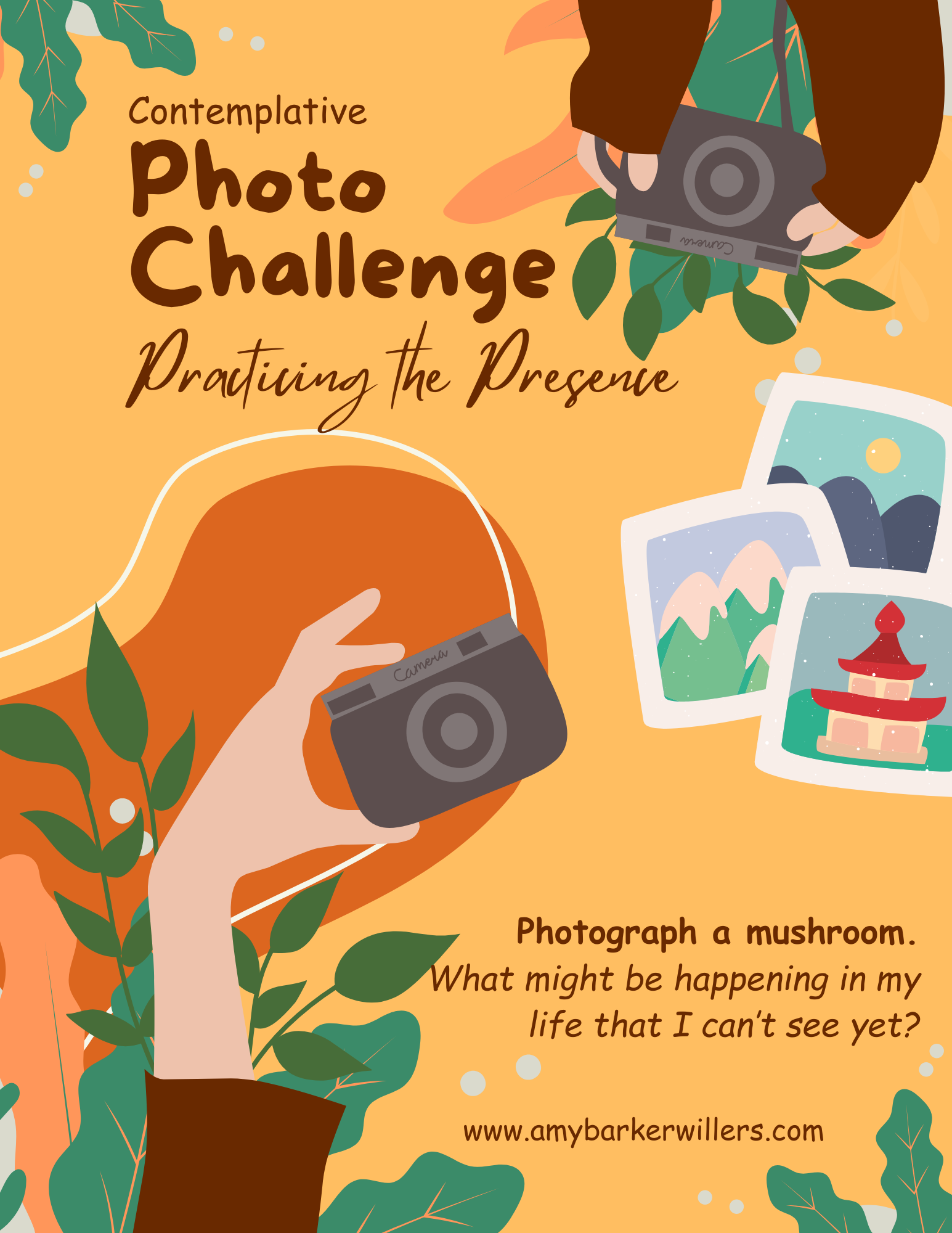
Today’s Practicing the Presence invitation: Photograph a mushroom.
Is there a season for mushrooms? I’m not sure, but they seem to be everywhere in my yard all of a sudden. Mushrooms appear almost overnight, especially after rain. You may not have noticed anything happening, and then suddenly, there they are.
As you take your photo, ask yourself:
What might be happening in my life that I can’t see yet?
Practicing the presence means paying attention to what God is doing right now, even when we don’t fully understand it or see the results yet. Sometimes we notice God’s work clearly. Other times, much of it seems to be happening beneath the surface.
A mushroom can be a small reminder that unseen doesn’t mean inactive.
Today, notice what appears. And consider where you might trust that God is at work even when you can’t see it yet.
Creative prompt: draw a bunch of stars

Draw or paint a page full of stars or color the ones on this coloring page.
They can be big or tiny, neat or wonky. You can make five-pointed stars, simple asterisks, little bursts of light, or whatever kind of star is easiest for you to make. As you work, hold this question:
I wonder what has felt bright lately?
Wondering with Jesus
As you draw, you might wonder:
What has felt bright lately?
What small good thing have I almost overlooked?
When have I felt especially alive or joyful?
Where have I noticed hope?
Where have I experienced God's goodness recently?
I wonder what Jesus might be inviting me to notice and enjoy?
You don't need to turn every good thing into a spiritual lesson. Sometimes noticing and enjoying a gift is enough.
A Kid-Friendly Version
Invite kids to fill a page with stars.
As they draw or color, ask them to think of things that have made them happy lately: playing with a friend, a favorite meal, something funny that happened, a pet, a good day at school, playing outside.
They can draw or write one thing inside each star.
You might wonder together:
What made you smile this week?
What was something really good?
What do you want to thank Jesus for?
I wonder what Jesus loved seeing you enjoy?
A Closing Invitation
When you're finished, look over your collection of stars. Notice all the different things that came to mind.
Then sit quietly with Jesus for a moment and ask:
Jesus, is there any light in my life that you want to help me notice?
Wait without trying too hard to find an answer. Maybe another small bright thing will come to mind. If it does, there's always room for one more star.
Making Space as Surrender
I've been wrestling with the phrase make space for God. I don't want my spiritual practices to become another list of things I should be doing. I don't want to imagine that if I pray enough, sit in silence long enough, or pay close enough attention, I can somehow make God show up. Because God is already here.
So perhaps making space isn't really about creating something at all. Maybe making space is an act of surrender. It's releasing my need to make something happen. Releasing the pressure to have a meaningful experience with God. Releasing even my attempts to notice God particularly well.
Instead, I can rest in what is already true: God is present. God is acting. God is holding me.
And from that place of surrender, I can make actual, embodied space in my life. I can put down my phone. Sit in silence. Pick up a paintbrush. Take a walk. Pray. Wonder. Pay attention. Not because these things bring God closer, but because I am learning to orient my life toward the God who is already close.
That's the part of making space I don't want to lose. The space is my actual life—my house, my body, my work, my relationships, my neighborhood, my time. I want all of it to be increasingly oriented around God.
But that orientation begins with surrender, not effort. So maybe I can keep asking myself each month, How will I make space for God? As long as I remember that the question isn't really What spiritual things will I accomplish this month?
It's closer to: Where can I stop striving? How might I turn toward the God who is already here?
And maybe before I make any plans at all, I can breathe:
Inhale: You are already here.
Exhale: I surrender to your presence.
Making space isn't how I get myself to God. It's surrendering to the God who is already here.
What Does It Mean to “Make Space for God”?
At the beginning of every month, I talk about how we can make space for God. I appreciate that practice because it helps me center myself before God and realign my priorities. It brings my attention back to what God is already doing.
But to be honest, I'm getting so I don't even like the term make space. Sometimes it sounds like something we do in our own strength, almost as if we can manufacture God's presence. If I can just be quiet enough, pray enough, slow down enough, pay enough attention...then maybe I'll experience God. And when something becomes dependent on our own effort, we inevitably feel guilty when we fail.
Making space becomes another spiritual achievement.
Every month, I like to set an intention and ask, How will I make space for God this month? I still think there is something good about that question. But I can't stay there too long without reminding myself of what comes first:
God is already here. God is already acting. God is already holding me.
Silence, creativity, spiritual direction, wondering, prayer—none of these practices produce God's presence. They aren't techniques for getting ourselves into the right state so God can reach us. They're ways of turning toward a reality that precedes our effort.
And maybe even more importantly: I don't have to successfully make space for God for God to be present.
I don't have to have a beautiful quiet time. I don't have to feel particularly spiritual. I don't even have to be particularly good at paying attention. God isn't waiting on the other side of my successful spiritual practice. He's already here.
So I'm still wrestling with what I mean when I say make space for God. Maybe I don't need to stop saying it. Maybe I just need to understand it differently.
are you creative? take this test and see!

Take this test to find out if you are creative (even if you think you know the answer already!):
Have you noticed something lately that made you stop and pay attention?
A sunset, an interesting building, a funny-shaped mushroom, a song, someone's words, a really good color?Have you wondered about something just because you were curious?
How something works? Why something is the way it is? What would happen if…?Have you explored something recently?
A trail, a new recipe, a new idea, a different way home, a book, a hobby?Have you responded to something you've noticed?
Taken a picture, told someone about it, looked it up, written it down, changed something, tried something?Have you ever made something?
Dinner counts. So does a garden, a spreadsheet, a Lego tower, a doodle, a plan, a playlist, a solution to a problem, or an actual piece of art.Are you human?
Results:
If you answered yes to even a few of these (and especially that last one), congratulations: you're creative.
Because creativity isn't the same thing as being artistic. Creativity is our response to God's world through noticing, wondering, exploring, and making.
Creative Prompt: paint some houses

Paint a row of simple little houses or use this coloring page.
They don't need to be complicated: a square, a roof, a few windows and a door. Make them colorful and wonky. Add chimneys, flowers, trees, paths, curtains, or anything else you'd like.
As you paint, hold this wondering:
What does it mean for me to be at home with Jesus?
You don't need to come up with an answer. Let the question sit with you while you paint. Maybe you think about the places where you already feel close to Jesus or maybe you notice something you long for. Or maybe you just simply enjoy painting houses while remembering that you are already welcomed and loved by him.
As you work, you might wonder:
I wonder what helps me feel at home with Jesus?
I wonder when I feel most able to simply be with him?
I wonder what Jesus wants me to know about my place with him?
I wonder what makes it hard for me to believe that I belong?
I wonder what it would feel like to stop trying to earn my welcome with Jesus?
I wonder where Jesus is inviting me to rest in his love right now?
Don't try to answer them all. Notice if one question seems to stay with you.
You might even ask Jesus directly:
Jesus, what do you want me to know about being at home with you?
Then keep painting and listening.
A Kid-Friendly Version
Invite kids to draw a house they would really like to live in.
It can have whatever they want: a giant slide, a room for pets, rainbow windows, a swimming pool, a candy garden.
While they draw, you might wonder together:
What makes somewhere feel like home?
What makes you feel safe and loved?
I wonder what it is like to know that you always belong with Jesus?
I wonder what Jesus loves about having you close to him?
There doesn't need to be a lesson at the end. Give them room to wonder.
Making Our Home in Jesus
In John 15, Jesus tells his friends to abide in him, to remain with him, to make their home in his love.
I love that image because our life with Jesus isn't only about doing things for him. It is about being with him. We don't have to arrive at Jesus' door with everything figured out. We don't have to become more impressive or more spiritual before we're allowed inside. We are already wanted.
A Closing Invitation
When your houses are finished, look at them for a moment. Imagine one of those little houses as a picture of your life with Jesus. There is a light on. The door is open. You are expected and you belong there.
And sit for a moment with this wondering:
Jesus, what would it look like for me to make my home in your love today?
does attention really matter?

I firmly believe that our ordinary human lives can glorify God. He created us to live and glorify him, so the ordinary things that are part of our human calling—breathing, sleeping, eating—are not separate from a life that glorifies God. I also believe that our work, play, and rest can glorify God. They are extensions of our human callings, part of God’s vision for his creation that He gave us in the garden. Even people who don’t know God are still his beautiful creations, bearing his image as they live and breathe and work and play and rest.
We have a park and a good sledding hill across the street from us. Sometimes in winter I watch teenagers sled down that hill and laugh and laugh and I know in that moment God is delighted in them. I can feel it as I watch and laugh even just to myself. God is delighted that those teenagers are engaging with his creation in such a free and pure way.
This is why sometimes I tell people to just make art for play or make it ugly on purpose. Just let yourself be, without even thinking, just enjoy yourself! This, too, can be part of a life that glorifies God. We don’t have to turn it into something “spiritual” first.
So why do I talk about “contemplative play” so much, if we don’t have to turn every moment into a spiritual practice?Well, the fact of the matter is, God is so good and so loving that as we live our ordinary lives, He also invites us to know Him and love Him more and more. This is where the contemplative part comes in. If we take a moment in the play, in the work, in the rest, to notice what is going on inside, to surrender to God in that moment, to ask him for help, to praise him, in all of it saying, “this, too, is for you, God,” then we are working on a perspective shift, growing in our inmost lives and fostering a deeper love for Him in everything.
There is so much talk about self-reflection, and that is good and worth doing. But as Christians, our self-reflection should be more focused on Jesus, and as we reflect on Him, He reveals more and more of who we are.
When I was a teenager, I wrote in my journals something like the following:
I’ve noticed that when I am closer to Jesus and keeping my eyes on him, I feel more and more like myself. It doesn’t make sense, but it makes me think that somehow we were created to be more fully ourselves when Jesus is at the center.
I have never forgotten this. This is the point of the contemplative life: keeping Jesus at the center. And He is so good that He, in turn, makes us more and more of our true selves. That is the abundant life that He promises: to live fully as the people He created us to be. This is what I’m talking about when I say where we place our attention matters.
When we do surrender, our attention slowly begins to shift. This is where those good spiritual practices come in. We begin to make space in new ways, and over time we find ourselves noticing God’s abundance where we couldn’t see it before. Life may not have changed, but our eyes are more open to His presence, goodness, beauty, and love. (attention, surrender, and the life we have)
So don’t feel guilty when you are happy, or when you are playing, or when you are working and you aren’t always thinking about God. We won’t keep our conscious minds on God all the time, and it isn’t a failing; it is part of being human. (Isn’t this so freeing?) But do take time to do the good spiritual practices, do the examens, schedule spiritual direction, take a moment to make space, do some breath prayers through the day. Not because these practices make the rest of your life more holy, but because they help turn your attention toward the God who is already there. The attention matters because God is good enough to want us to grow in our love for him, and He will help us along the way.
prayer crafts: bookmarks
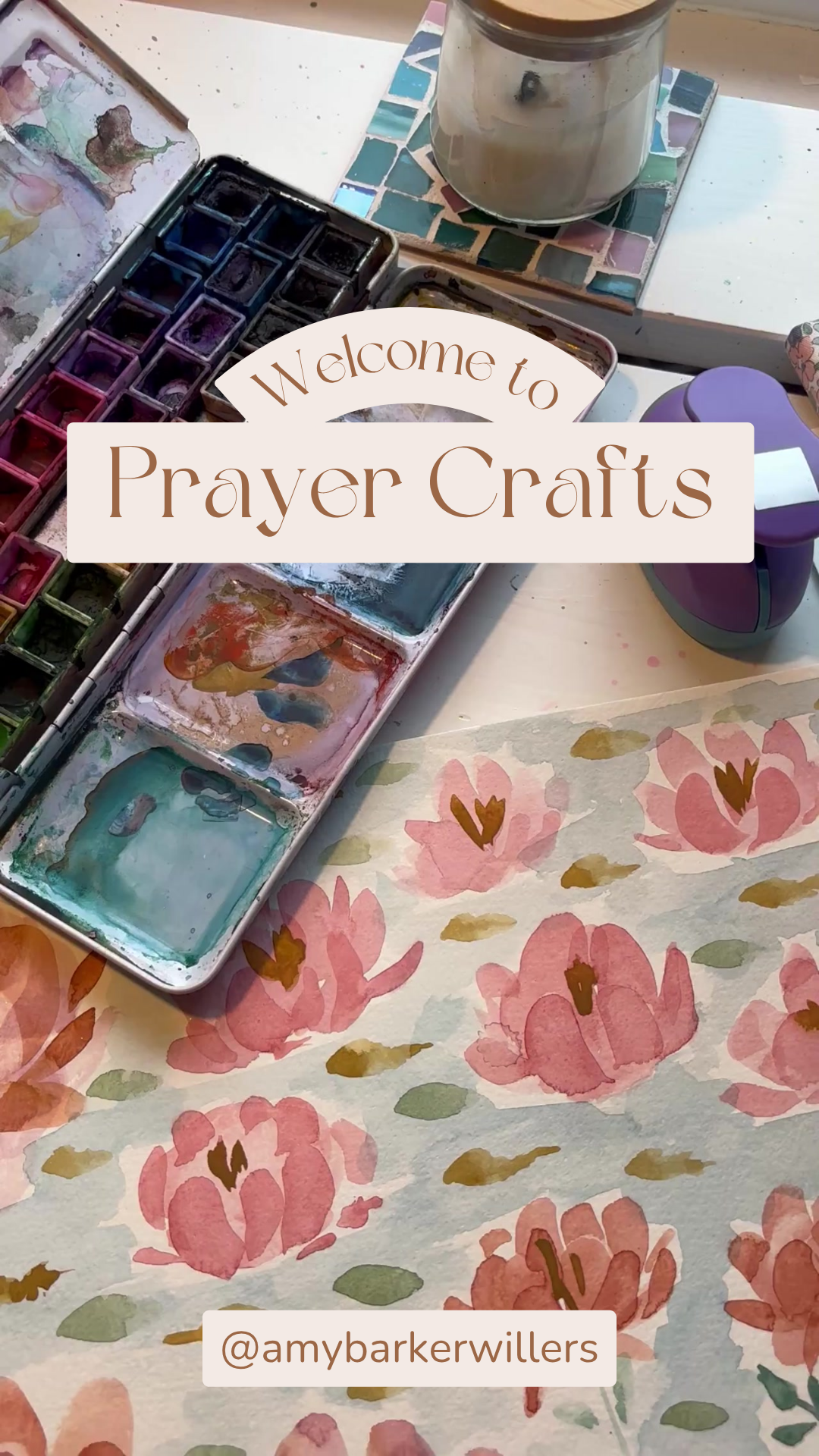
Prayer Crafts, where we make something, and it means something.
For this prayer craft, we’re making a simple bookshelf bookmark, a bookmark that can remind us to pay attention every time we open a book.
Start by coloring a whole bunch of rectangles. I used markers, but you could use paint, colored pencils, crayons, or whatever you have nearby. Don’t worry about making them look like books yet. Just play with color.
As you color, hold this question quietly:
Where have I been noticing God lately?
Maybe God has felt present in something beautiful, a conversation, a moment of rest, or something that made you laugh. You don’t have to come up with a profound answer. Just notice what comes to mind.
When you’re finished coloring, cut out your rectangles and choose some favorites. Arrange them on a darker strip of paper like books on a shelf. Turn a few sideways to make little stacks. Glue everything down, and add any extra details you’d like. I added a tiny cactus sticker and used a pen to give some of my rectangles little book details.
Then tuck your finished bookmark into whatever you’re reading.
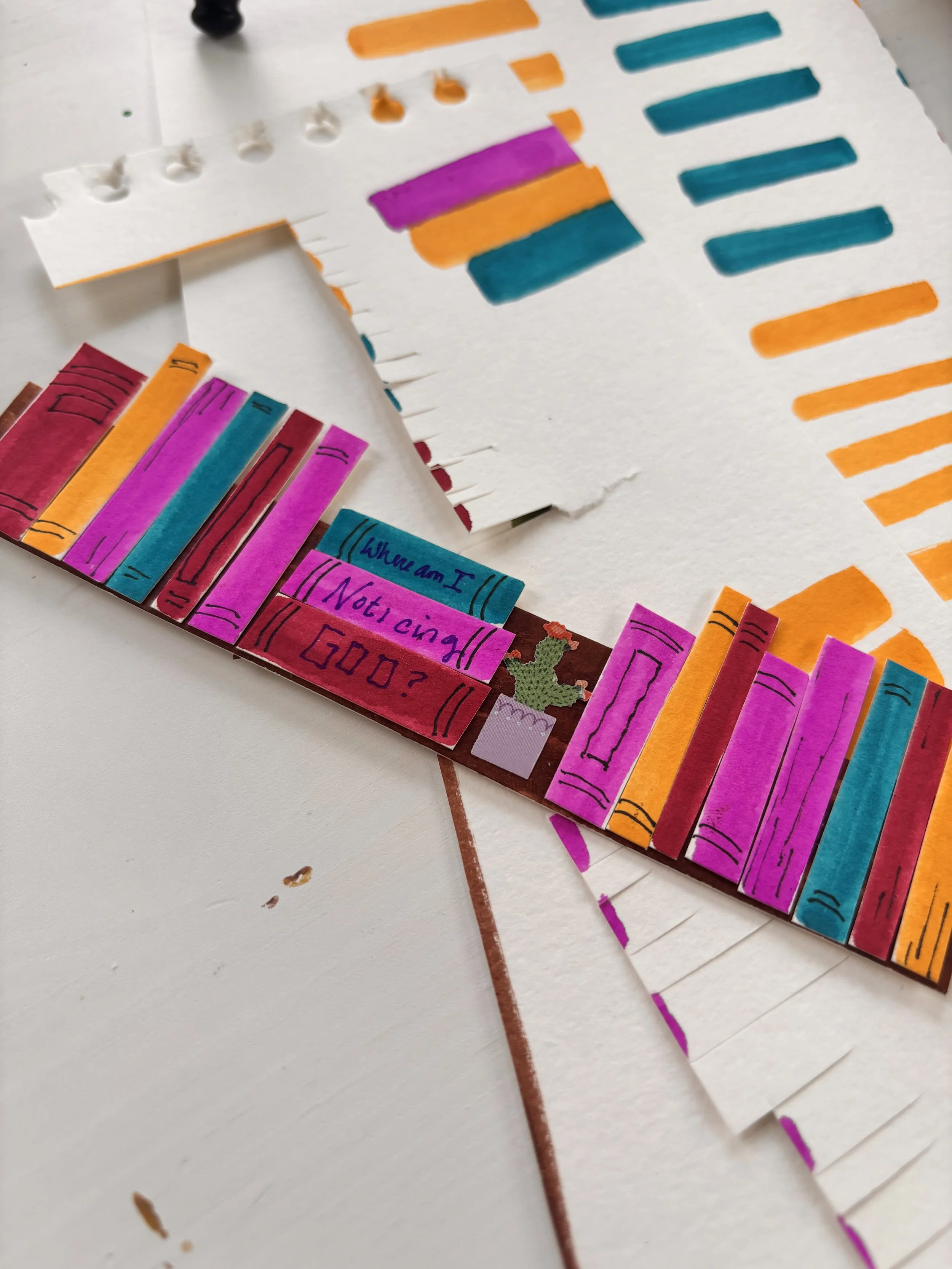
Each time you see it, let it become a tiny invitation to ask again:
Where am I noticing God?
Maybe it will be in the words you’re reading. Maybe in the room around you. Maybe in something that happened earlier that day. Or maybe you’ll simply sit quietly for a moment and notice what God brings to mind.
Sometimes making space for God can be as small as remembering to pay attention.
Creative prompt: Paint a Bowl of Impossible Fruit
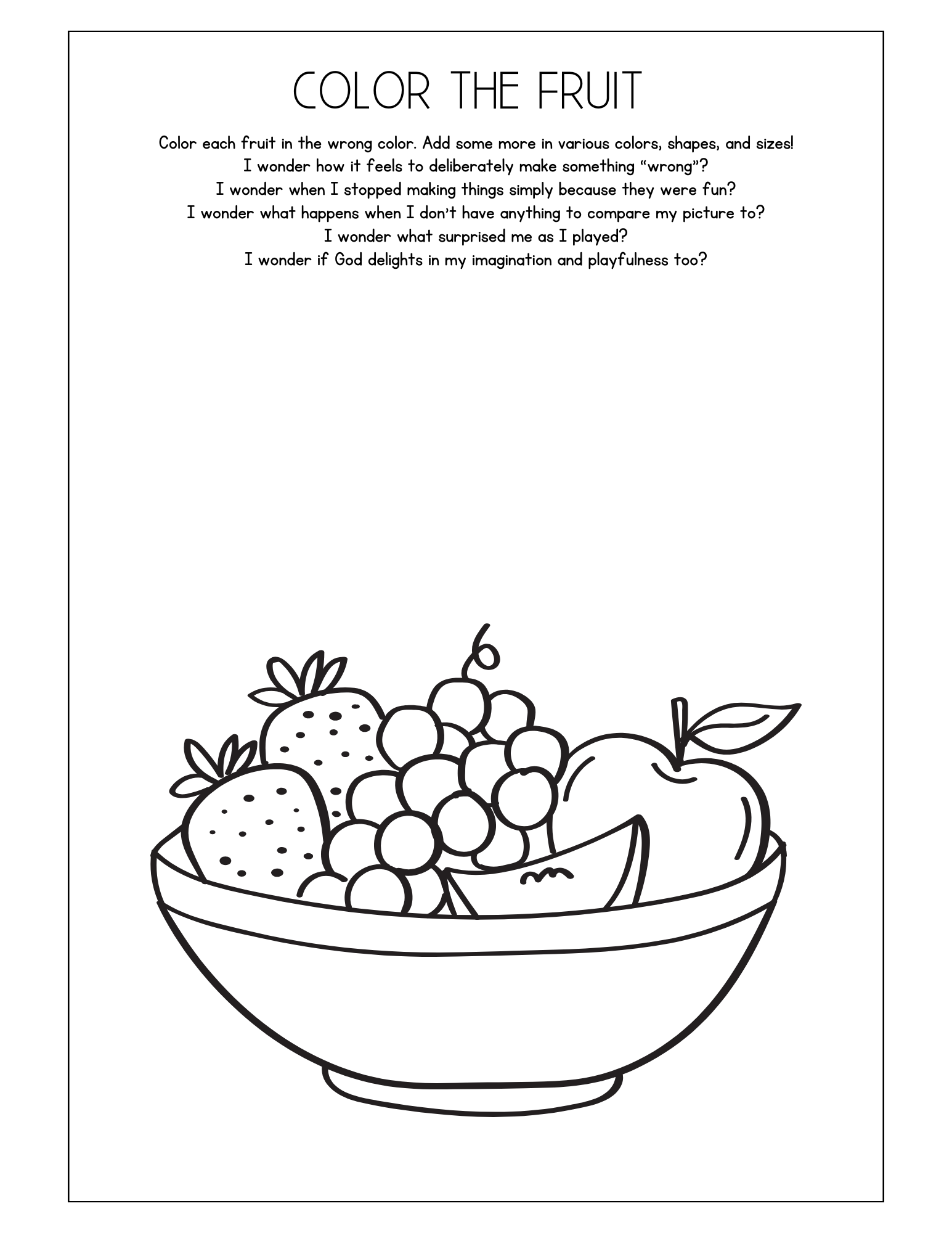
Begin by painting or drawing a simple bowl, then fill it with fruit, or use this coloring page. You can paint fruit you recognize, but use completely unexpected colors, a blue banana or a striped strawberry, or even invent fruit that doesn’t exist at all!
Try not to ask, Does this look right?
Ask instead: What would be fun?
Let yourself make something that couldn’t exist anywhere except on your page.
Wondering Questions
As you create, you might wonder:
I wonder how it feels to deliberately make something “wrong”?
I wonder when I stopped making things simply because they were fun?
I wonder what happens when I don't have anything to compare my picture to?
I wonder what surprised me as I played?
I wonder if God delights in my imagination and playfulness too?
You don't have to turn the practice into a lesson. You can simply notice what happens when you give yourself permission to play.
A Kid-Friendly Version
Kids may already be much better at this than grown-ups!
Draw a bowl and fill it with the strangest fruit you can imagine. Make up your own colors, shapes, and kinds of fruit. Then give your new fruits names. Maybe you've invented a Purple Fuzzberry or a Rainbow Crunch Melon.
You might wonder together:
What does your fruit taste like?
Where does it grow?
Which one would you most like to eat?
Can you invent a fruit that has never existed before?
Follow the silliness wherever it goes.
When you're finished, look at your bowl of impossible fruit. Notice which one makes you smile. Which one surprised you? Which one could only have come from you?
And then hold one final wondering:
I wonder what Jesus enjoys about the way I play and imagine?
You don't have to answer. Maybe today it's enough to enjoy the fruit.
If you feel comfortable, I’d love to see what you create. When I share these prompts, I’ll always try to share what I’ve made too. Tag me on Instagram or comment below with a photo or reflection.
Are you creative? Take this test to find out!

I absolutely adore non-traditional creative endeavors, like this troll made from all-natural materials by Thomas Dambo (finally got to see one in person recently!).
Take this test to find out if you are creative (even if you think you know the answer already!):
Have you noticed something lately that made you stop and pay attention?
A sunset, an interesting building, a funny-shaped mushroom, a song, someone's words, a really good color?Have you wondered about something just because you were curious?
How something works? Why something is the way it is? What would happen if…?Have you explored something recently?
A trail, a new recipe, a new idea, a different way home, a book, a hobby?Have you responded to something you've noticed?
Taken a picture, told someone about it, looked it up, written it down, changed something, tried something?Have you ever made something?
Dinner counts. So does a garden, a spreadsheet, a Lego tower, a doodle, a plan, a playlist, a solution to a problem, or an actual piece of art.Are you human?
Results:
If you answered yes to even a few of these (and especially that last one), congratulations: you're creative.
Because creativity isn't the same thing as being artistic. Creativity is our response to God's world through noticing, wondering, exploring, and making. It is part of who we are as humans. Maybe it’s time to embrace your creative calling...
photo prompt: something growing
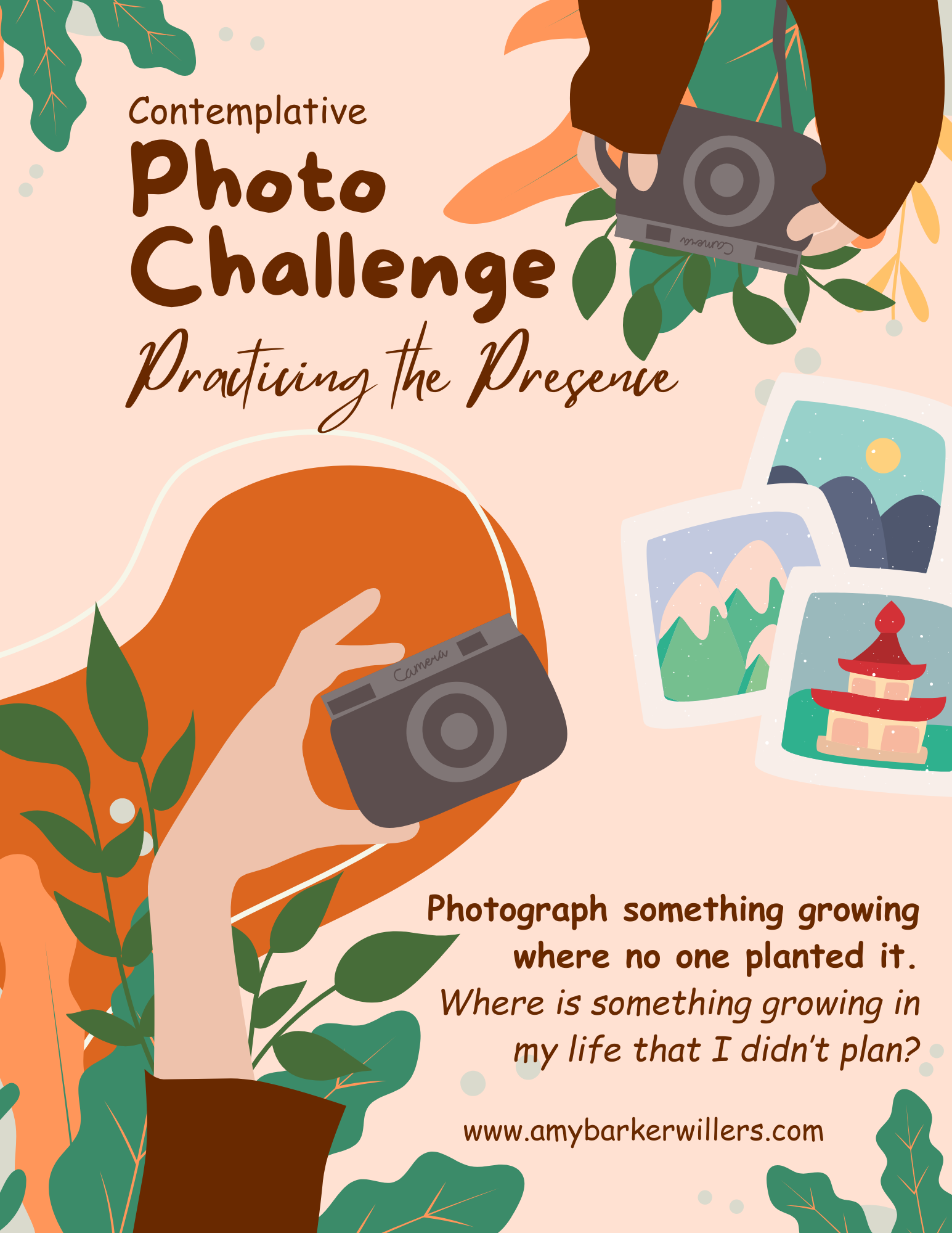
Today’s Practicing the Presence invitation:
Photograph something growing where no one planted it.
Then ask yourself:
Where is something growing in my life that I didn’t plan?
Practicing the presence is about noticing where God is already at work. We can spend a lot of time thinking about what we need to make happen, fix, or figure out. But not everything good in our lives is something we planted ourselves.
Sometimes growth just appears. Maybe something in you is changing. Maybe a new relationship is forming. Maybe you’re discovering an interest, a hope, or a little bit of courage you didn’t have before.
Today, look for something growing where no one planted it. Let it remind you to notice what might be quietly growing in you, too.
Where might God be at work without you having to make it happen?
Arts and Crafts: a fun way to make space
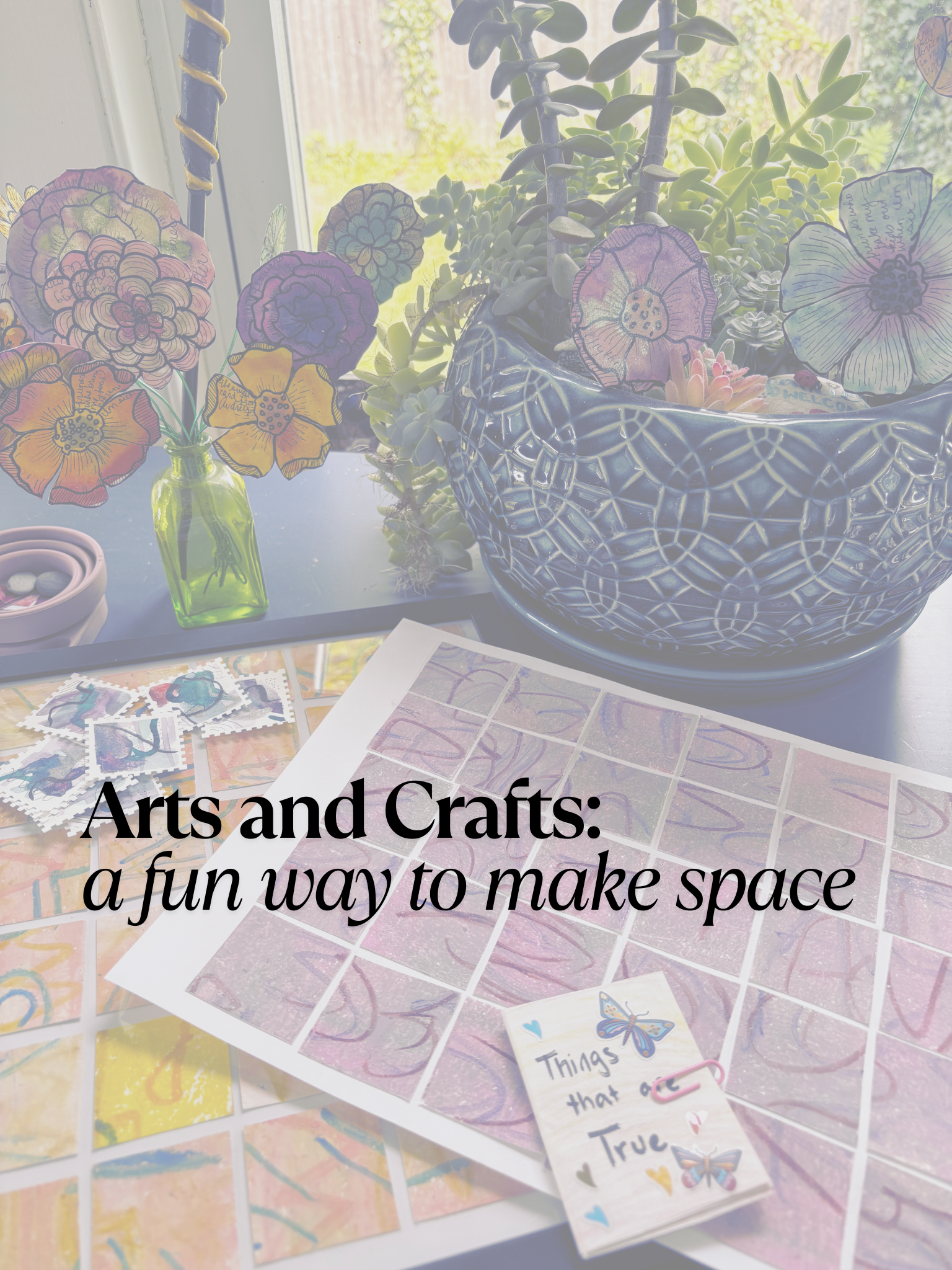
That’s a wrap on my summer Prayer Craft retreats!
It has been such a joy to use my love of arts and crafts to help people make space for God in their lives. (Seriously, someone pinch me!) And what a good God, that He wants to meet us in the fun and silly things of life, too.
So keep making space for arts and crafts. Let them help you slow down and notice God: His beauty, His goodness, and what He is doing in you. Let yourself sit in His delight in you. Listen for the good and true names He calls you.
There are more retreats to come, including two two-hour retreats this fall. But for now, I’ll leave you with the prayer that ended our time together today:
God, thank you for this little bit of time to play together and with you. Thank you for meeting us in hard things and also in fun things.
Help us carry a little of this spaciousness with us when we leave. And help us keep noticing the small ways you meet us in the middle of our ordinary lives.
Amen.
clearing the table: making space as hospitality
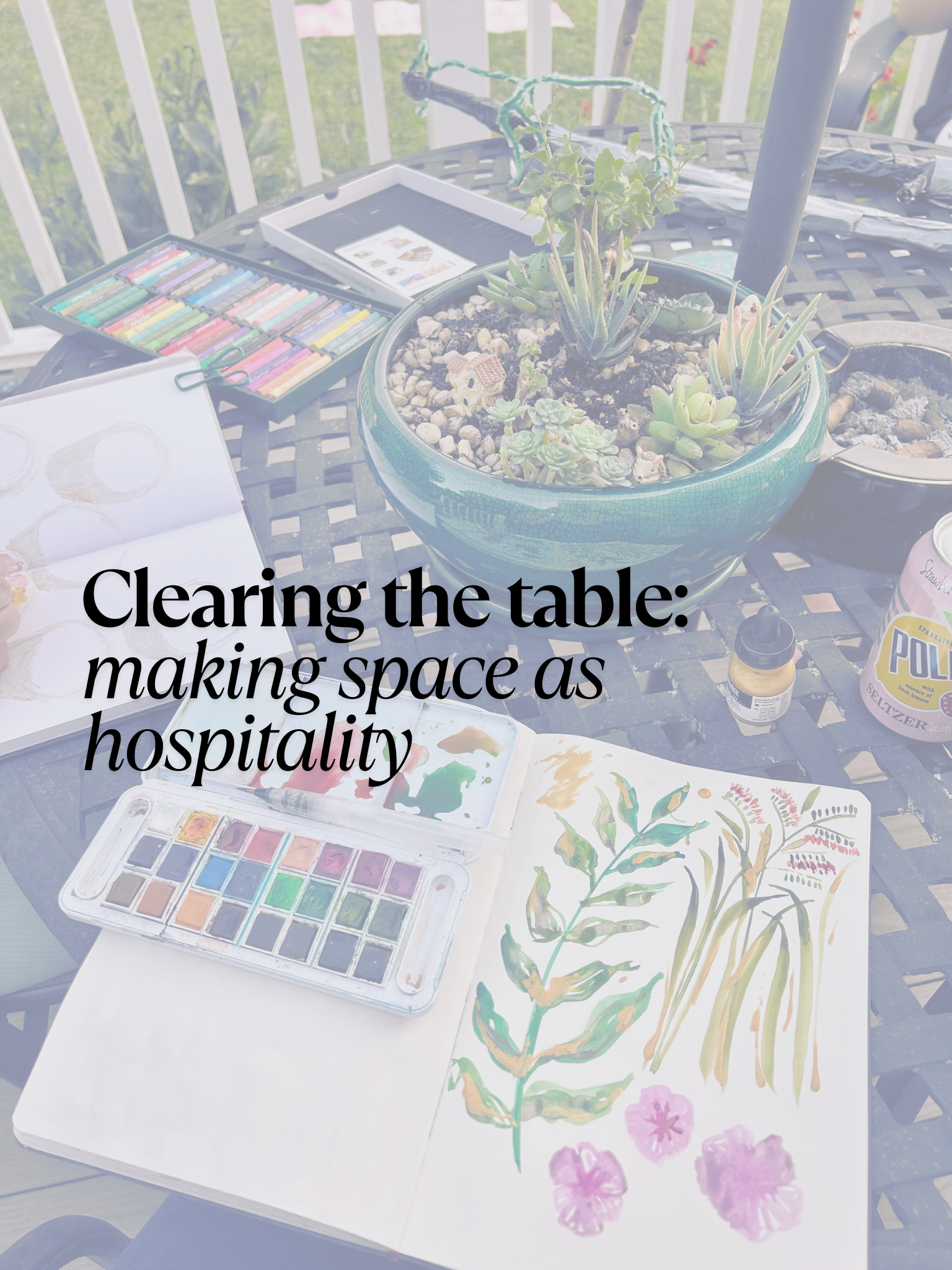
When I think of making space, I think of clearing the table before dinner.
If your house is anything like ours, the dining room table quickly fills up with crafts, homework, tools, or even plates from the night before. It's also the staging area for things we mean to take downstairs, return to someone, or pack for a trip. Somehow, it is always full.
But every evening, before we sit down to eat, we clear it. We put some things where they belong. We move other things aside. Sometimes we simply decide that a project can wait until tomorrow.
We don't clear the table because we just love empty tables (though we do!). We clear it because we're making room for something better. Clearing the table becomes an act of hospitality. We make space so we can rest, share a meal, laugh, listen, and simply be together.
Making space with God feels much the same. Our lives naturally fill up with responsibilities, good opportunities, unfinished projects, worries, and distractions. None of those things are necessarily bad. But every so often, we need to look at the "table" of our lives and ask what really belongs there right now and what can be set aside, even for a little while.
Making space is an act of hospitality. It's making room to notice God's presence. It's making room to receive instead of always producing. It's making room for the people we love, and for our own souls to rest. Making space isn't about creating an empty life. It's about making room for a relationship.
So what is sitting on your table today? What could be put away, moved to the side, or simply left until tomorrow, so there is room to sit with God, even for a few precious minutes?